- Plants
- ›Vascular Plants
- ›flowering plants
- ›Dicots
- ›Sunflowers, Bellflowers, Fanflowers, and Allies
- ›Sunflowers, Daisies, Asters, and Allies
- ›prickleleaves
- ›prickleleaves
- ›Hecastocleis
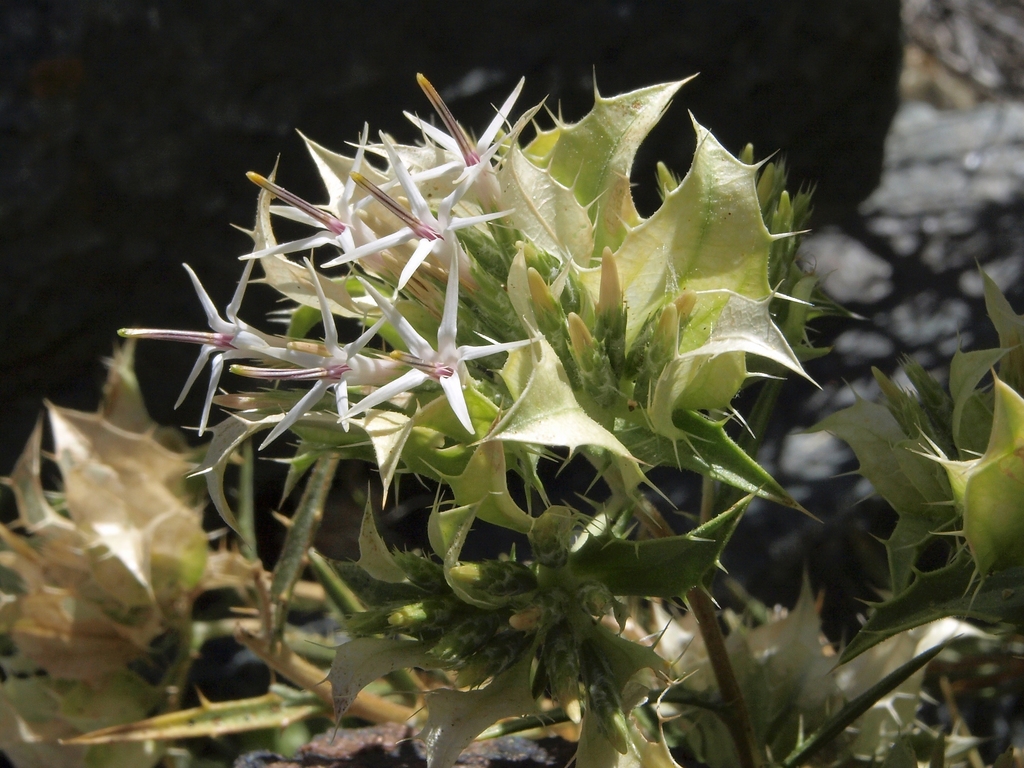
pricklebush
Hecastocleis shockleyi
Hecastocleis is a genus of low thorny shrubs with stiff branches, assigned to the daisy family. At the tip of each of the branches, inflorescences are subtended by oval, thorny, whitish to greenish bracts that enclose several flower heads which each contain only one pinkish bud, opening into a white corolla. It contains but one species, Hecastocleis shockleyi, the only representative of the tribe Hecastocleideae, and of the subfamily Hecastocleidoideae. Its vernacular name is prickleleaf. It is confined to the southwestern United States.
From the article Hecastocleis on Wikipedia (CC BY-SA), quoted section by section
Description
Hecastocleis shockleyi is a xerophytic thorny shrub of 40–70 cm (1.3–2.3 ft), occasionally 1½ m (4 ft 11 in) high. It has sixteen chromosomes (2n=16).
Leaves. The leaves are alternately set along the branches. The leaf blades are hairless or with a few soft hairs, slightly olive green, stiff and leathery, with three main veins, linear to narrowly ovate in shape, 1–4 cm (0.39–1.57 in) long, their base approximately clasping the branch, with thickened margins usually carrying three to six spines of 1–3 mm (0.039–0.118 in) long, denser spaced near the base, while the tip is more or less abruptly tapering into a point.
Inflorescence. The complex inflorescences are carried at the end of the branches. These consist of a number of crowded clusters. Each of the clusters is subtended by white to yellowish green, wavy, ovate to orbicular bracts that have a spiny margin, and further consist of one to five flower heads which each contain only a single disk floret. The most outward part of the flower head is the involucre, which is narrowly vase-shaped to cylindric and approximately 1 cm (0.39 in) high, and consists of about six whorls of four bracts called phyllaries, which have often soft woolly hairs around the edge. The base of the flower head (or receptacle) is flat and lacks a bract directly at the base of the floret. …
Range & habitat
Prickleleaf is native to the desert plains and mountains of eastern California (Inyo, Mono, Kern, and San Bernardino Counties) and southern Nevada (Mineral, Esmeralda, Nye, Lincoln, and Clark Counties), where it grows on arid, rocky slopes and flats. Records of this plant include Mount Charleston, Nevada Test Site, Grapevine Mountains and Red Pass.
Wikipedia: “Distribution”
What it does
In the mountains rimming the north-side of Death Valley, Hecastocleis shockleyi may be one of the dominant shrubs together with Atriplex confertifolia, Eriogonum fasciculatum, and Tetradymia axillaris. Less dominant but often present shrubs are Ephedra viridis, Ericameria laricifolia, and Lepidium fremontii. Trees are absent. Herbaceous plants form an open layer and regularly include the grasses Achnatherum hymenoides, Bromus rubens and Poa secunda, in addition to Claytonia perfoliata, Cryptantha utahensis, Delphinium parishii, several Gilia species, and Phacelia vallis-mortae. Biological soil crust, lichen, and moss can also be found in this plant community. It is found primarily on steep, very rocky slopes and bedrock outcrops with northerly aspects. Hecastocleis shockleyi occurs at altitudes between 1250 and 1600 m. It typically grows on calcareous clay loam, loamy sand, or sandy clay that has resulted from erosion of dolomite, limestone or shale, and is poor in nutrients. Pollination of Hecastocleis has not yet been observed, but as its flowers are white, nocturnal insects are likely candidates.
Wikipedia: “Ecology”
In human culture
The name of the genus Hecastocleis is the contraction of two Greek words, ἕκαστος (hekastos) meaning "each" and κλειω (kleio) which is said to mean "to shut up", referring to each flower having its own involucre. An alternative meaning of kleio is "glory". The species was named shockleyi in honor of William Hillman Shockley, an early plant collector of the flora of Nevada and father of the co-inventor of the transistor William Shockley.
Wikipedia: “Etymology”
Where it lives
Recorded sightings
—
geo-referenced records in GBIF, from museums, herbaria and field observers.
Drag the globe to turn it. Dots are where records exist, not a range map; darker means more records.
In the stacks
Searching the stacks…
Every page naming Hecastocleis shockleyi in the Biodiversity Heritage Library →
This page is assembled live from iNaturalist, GBIF, Wikipedia, the Source Library and the Internet Archive. It is not yet part of the hand-edited codex. iNaturalist taxon 77344.