- Plants
- ›Vascular Plants
- ›flowering plants
- ›Dicots
- ›myrtles, evening primroses, and allies
- ›myrtle family
- ›Myrtoideae
- ›gum trees
- ›Eucalyptus
- ›Symphyomyrtus
- ›Maidenaria
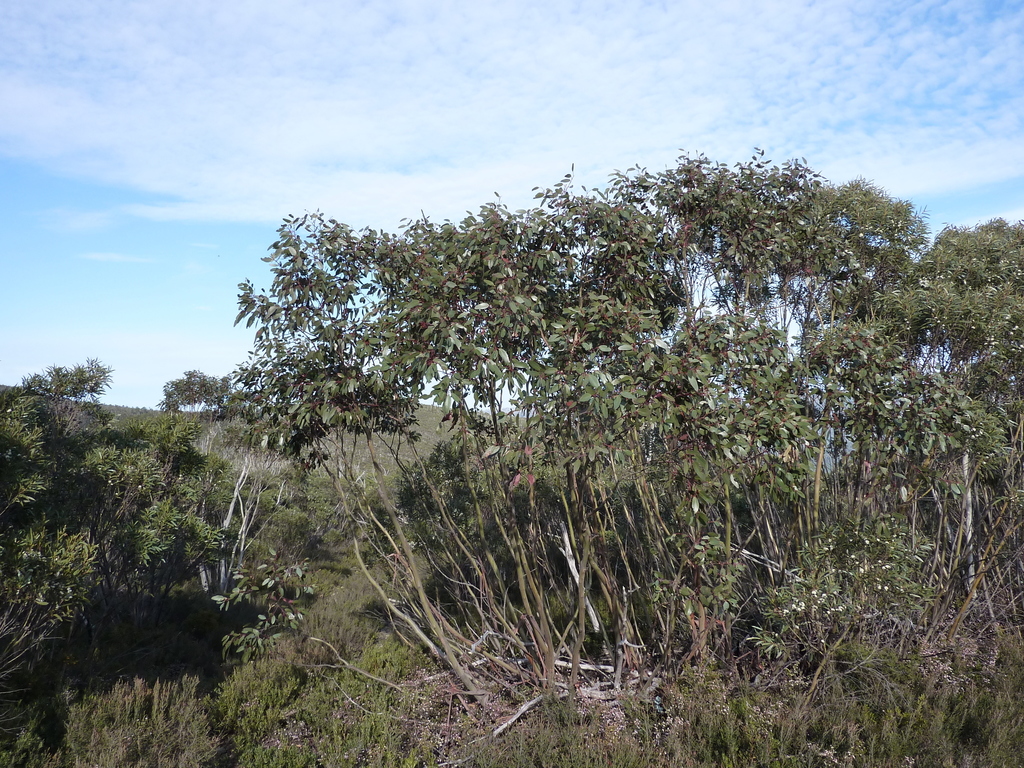
Tingiringi Gum
Eucalyptus glaucescens
Eucalyptus glaucescens, commonly known as the Tingiringi gum or Tingaringy gum, is a plant in the myrtle family Myrtaceae and is endemic to south-eastern Australia. It is a tree or mallee with smooth bark and dull greyish foliage growing in the higher parts of southern New South Wales and Victoria.
From the article Eucalyptus glaucescens on Wikipedia (CC BY-SA), quoted section by section
Description
Eucalyptus glaucescens is a tree which sometimes grows to a height of 40–50 m (100–200 ft), or a mallee. The bark is smooth, grey, green or yellow and is shed in short ribbons. (Sometimes the bark on the lower part of the trunk of the tree form is rough or fibrous.) Its adult leaves are lance-shaped, dull greyish-green, 60–120 mm (2–5 in) long and 12–20 mm (0.5–0.8 in) wide. The juvenile leaves are arranged in opposite pairs, heart-shaped to more or less round and lack a peduncle. The flowers are arranged in groups of three and the flower buds are 5–8 mm (0.2–0.3 in) long and 3–4 mm (0.1–0.2 in) in diameter. The flower caps are cone-shaped or hemispherical and much shorter than the rest of the bud. The fruit is cup-shaped to cylindrical, 6–12 mm (0.2–0.5 in) long and 6–10 mm (0.2–0.4 in) in diameter.
Range & habitat
Tingiringi gum grows in shrubland on granite slopes on the southern tablelands of New South Wales south from the Australian Capital Territory to high mountain areas in Victoria.
Wikipedia: “Distribution and habitat”
Where it lives
Recorded sightings
—
geo-referenced records in GBIF, from museums, herbaria and field observers.
Drag the globe to turn it. Dots are where records exist, not a range map; darker means more records.
In the stacks
Searching the stacks…
Every page naming Eucalyptus glaucescens in the Biodiversity Heritage Library →
This page is assembled live from iNaturalist, GBIF, Wikipedia, the Source Library and the Internet Archive. It is not yet part of the hand-edited codex. iNaturalist taxon 774110.