- Fungi Including Lichens
- ›Basidiomycete Fungi
- ›Higher Basidiomycetes
- ›Mushrooms, Bracket Fungi, Puffballs, and Allies
- ›Russulales
- ›Milkcaps, Brittlegills and Allies
- ›Lactarius
- ›Plinthogalus
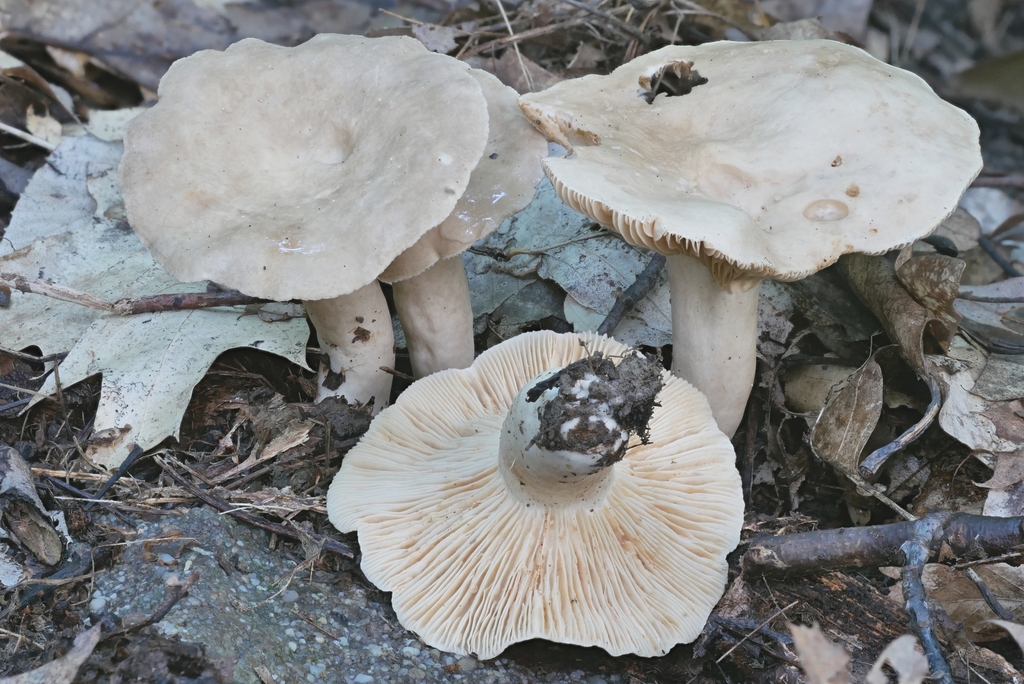
Lactarius fumosus
Lactarius fumosus, commonly known as the smoky milkcap, is a species of fungus in the family Russulaceae.
From the article Lactarius fumosus on Wikipedia (CC BY-SA), quoted section by section
Description
The cap is 3–10 cm (1.2–3.9 in) wide, broadly convex to nearly plane, sometimes shallowly depressed. The margin (cap edge) is irregular, often wavy, and lobed or ribbed. The cap surface is dry, unpolished, azonate, usually becoming somewhat wrinkled with age, pale dingy yellow-brown to whitish overall, with a smoky tinge, sometimes with tawny olive, pinkish buff, or dull brown areas. The gills are attached to subdecurrent (running slightly down the length of the stem), narrow, crowded together, whitish, becoming dingy yellow-buff, staining reddish when bruised. The stem is 4–11 cm (1.6–4.3 in) long, 6–15 mm (0.24–0.59 in) thick, nearly equal, dry, dull, stuffed, colored like the cap, whitish towards the base, staining reddish, but more slowly than the gills. The flesh is pale white, staining reddish-salmon when cut. Its odor is not distinctive, but the taste is variable: quickly acrid then mild then slowly staining acrid, or very slowly faintly acrid. The latex is white on exposure, unchanging, staining tissues reddish. The spore print is pinkish-buff. The edibility is unknown.
Microscopic characters. The spores are 6–8 by 6–8 μm, spherical or nearly so, ornamented with ridges that form a partial reticulum, prominences up to 1.5 μm high, hyaline (translucent), amyloid. The cap cuticle is a palisade of cylindrical to club-shaped cells.
Similar species. …
Range & habitat
The fruit bodies of L. fumosus grow solitary, scattered, or in groups on the ground in woods from July–October. The fungus is widely distributed in eastern North America, and has also been reported from western Canada. Its frequency of occurrence is described as occasional. Its range extends south to northwestern Mexico, where it is found associated with Liquidambar, Magnolia, Acer, and Quercus species.
Wikipedia: “Habitat and distribution”
Where it lives
Recorded sightings
—
geo-referenced records in GBIF, from museums, herbaria and field observers.
Drag the globe to turn it. Dots are where records exist, not a range map; darker means more records.
In the stacks
Searching the stacks…
Every page naming Lactarius fumosus in the Biodiversity Heritage Library →
This page is assembled live from iNaturalist, GBIF, Wikipedia, the Source Library and the Internet Archive. It is not yet part of the hand-edited codex. iNaturalist taxon 774156.