- Plants
- ›Vascular Plants
- ›flowering plants
- ›Dicots
- ›Mustards, Capers, and Allies
- ›mustard family
- ›Brassicoideae
- ›Heliophilodae
- ›Iberideae
- ›Iberis
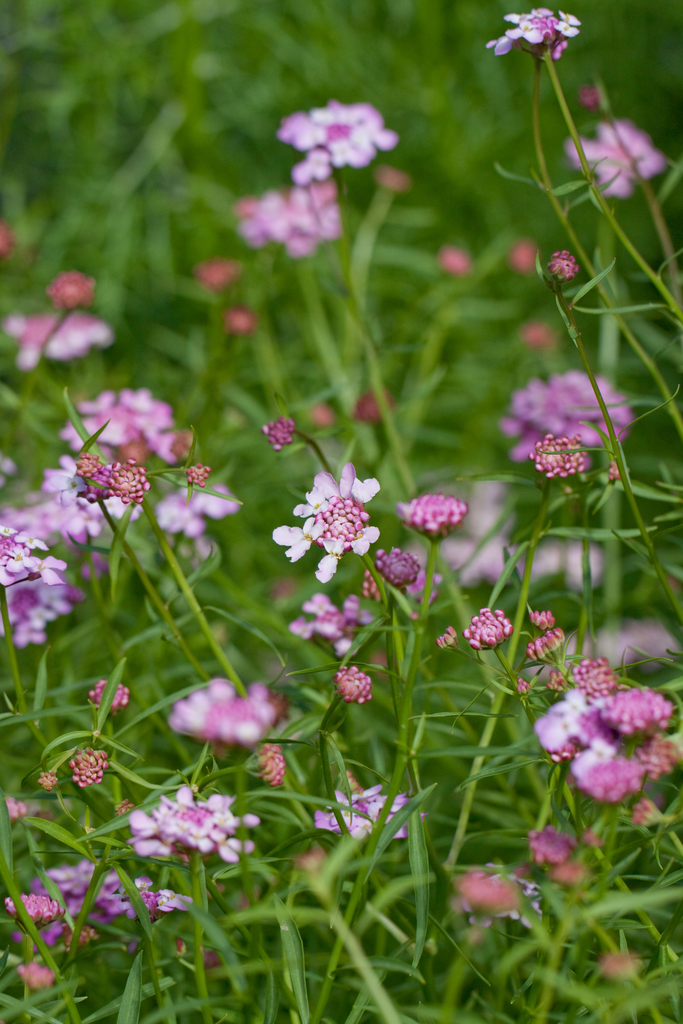
globe candytuft
Iberis umbellata
Iberis umbellata, common name garden candytuft or globe candytuft, is a herbaceous annual flowering plant of the genus Iberis and the family Brassicaceae.
From the article Iberis umbellata on Wikipedia (CC BY-SA), quoted section by section
Description
The biological form of Iberis umbellata is hemicryptophyte scapose, as its overwintering buds are situated just below the soil surface and the floral axis is more or less erect with a few leaves. The stem is twisted at the base while the flowering branches are erect and leafy. This plant reaches a height of 30–50 centimetres (12–20 in). The leaves are green and linear-lanceolate, 15–25 millimetres (0.59–0.98 in) long. The flowers are in umbel-shaped corymbs. The calyx is violet and the corolla is composed of four white, pink or purple petals. The petals are rounded at the apex, with the peripheral ones forming a large vexillum 8–10 millimetres (0.31–0.39 in) long. The flowering period extends from May through June. The flowers are hermaphroditic and pollinated by bees and butterflies. The fruit is a silique 7–10 millimetres (0.28–0.39 in) long.
Range & habitat
This species is native to the Mediterranean region. It is present in most of Europe, especially along the coasts, from Spain to Greece and in northern America.
Wikipedia: “Distribution”
In human culture
The genus name derives from "Iberia", the ancient name of Spain, while the species epithet comes from the Latin "umbel", meaning "umbrella" and refers to the shape of the inflorescence.
Wikipedia: “Etymology”
Where it lives
Recorded sightings
—
geo-referenced records in GBIF, from museums, herbaria and field observers.
Drag the globe to turn it. Dots are where records exist, not a range map; darker means more records.
In the stacks
Searching the stacks…
Every page naming Iberis umbellata in the Biodiversity Heritage Library →
This page is assembled live from iNaturalist, GBIF, Wikipedia, the Source Library and the Internet Archive. It is not yet part of the hand-edited codex. iNaturalist taxon 77485.