- Plants
- ›Vascular Plants
- ›flowering plants
- ›Dicots
- ›Soapberries, Cashews, Mahoganies, and Allies
- ›soapberry family
- ›Harpullia
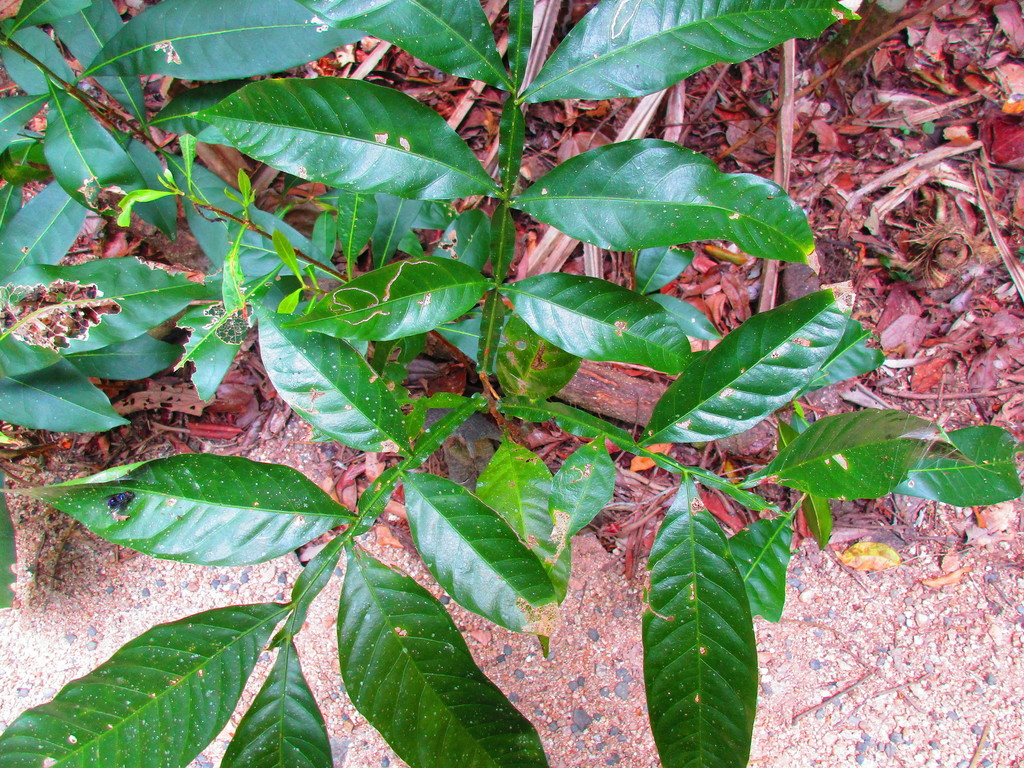
Harpullia frutescens
Harpullia frutescens, commonly known as dwarf harpullia, is a species of flowering plant in the family Sapindaceae, and is endemic to northern Queensland. It is a shrub with leaves divided into six to eight leaflets, white flowers with a pink tinge, and crimson capsules containing 2 seeds.
From the article Harpullia frutescens on Wikipedia (CC BY-SA), quoted section by section
Description
Harpullia frutescens is a shrub that typically grows to a height of up to 1–2 m (3 ft 3 in – 6 ft 7 in), its young growth covered with downy hairs. Its leaves are paripinnate, 45–185 mm (1.8–7.3 in) long with 6 to 8 elliptic to lance shaped leaflets sometimes tapering to a point, 75–170 mm (3.0–6.7 in) long and 25–50 mm (0.98–1.97 in) wide on a winged petiole 35–85 mm (1.4–3.3 in) long. The flowers are strongly perfumed, borne in clusters of mostly 2 to 4 in upper leaf axils 30–120 mm (1.2–4.7 in) long, each flower on a slender, hairy peduncle up to 5 mm (0.20 in) long. The sepals are 7–8 mm (0.28–0.31 in) long and covered with downy hairs, the petals are white with a pink tinge, and 15–20 mm (0.59–0.79 in) long. There are 5 or 6 stamens, and the ovary covered with woolly hairs. The fruit is a laterally compressed, crimson capsule about 12–16 mm (0.47–0.63 in) long containing two shiny seeds, enclosed in a yellow, cup-shaped aril.
Range & habitat
Dwarf harpullia is common in rainforest from Ayton to the Atherton Tableland area in North Queensland, usually in hilly country.
Wikipedia: “Distribution and habitat”
Where it lives
Recorded sightings
—
geo-referenced records in GBIF, from museums, herbaria and field observers.
Drag the globe to turn it. Dots are where records exist, not a range map; darker means more records.
In the stacks
Searching the stacks…
Every page naming Harpullia frutescens in the Biodiversity Heritage Library →
This page is assembled live from iNaturalist, GBIF, Wikipedia, the Source Library and the Internet Archive. It is not yet part of the hand-edited codex. iNaturalist taxon 775373.