- Fungi Including Lichens
- ›Basidiomycete Fungi
- ›Higher Basidiomycetes
- ›Mushrooms, Bracket Fungi, Puffballs, and Allies
- ›Shelf Fungi
- ›Bracket Polypores
- ›Fomitopsis
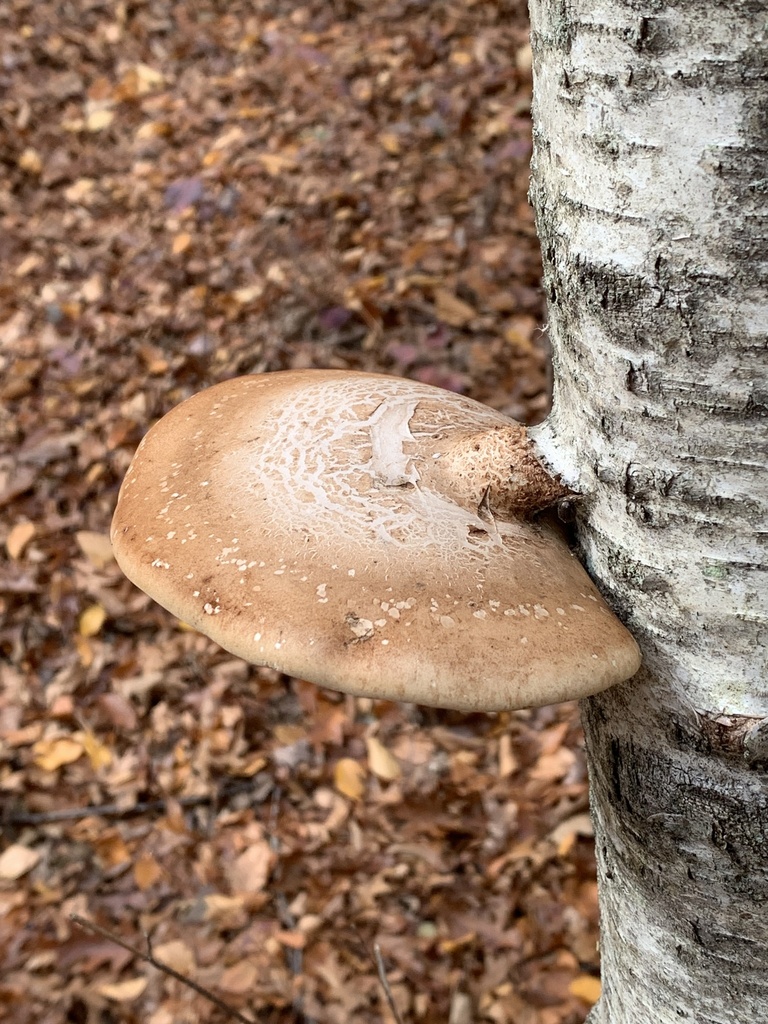
birch polypore
Fomitopsis betulina
Fomitopsis betulina (previously Piptoporus betulinus), commonly known as the birch polypore, birch bracket, or razor strop, is a common bracket fungus and, as the name suggests, grows almost exclusively on birch trees. The brackets burst out from the bark of the tree, and these fruit bodies can last for more than a year.
From the article Fomitopsis betulina on Wikipedia (CC BY-SA), quoted section by section
Description
The fruit bodies (basidiocarps) are pale, with a smooth greyish-brown top surface, while the creamy white underside has hundreds of pores that contain the spores. The fruit body has a rubbery texture, becoming corky with age. Wood decayed by the fungus, and cultures of its mycelium, often smell distinctly of green apples. The spores are cylindrical to ellipsoidal in shape, and measure 3–6 by 1.5–2 μm. Fomitopsis betulina has a bipolar mating system where monokaryons or germinating spores can only mate and form a fertile dikaryon with an individual that possesses a different mating-type factor. There are at least 33 different mating-type factors within the British population of this fungus. These factors are all variants or alleles of a single gene, as opposed to the tetrapolar mating system of some other basidiomycete species, which involves two genes.
Range & habitat
Fomitopsis betulina is one of the most common species of brown rot fungi. The geographic distribution of F. betulina appears to be restricted to the Northern Hemisphere, including Northern America, Europe, and Asia. It is only found on birch trees, including Betula pendula, B. pubescens, B. papyrifera, and B. obscura. There is some doubt about the ability of isolates from the European continent, North America and the British Isles to interbreed. It is a necrotrophic parasite on weakened birches, and will cause brown rot and eventually death, being one of the most common fungi visible on dead birches. It is likely that the birch bracket fungus becomes established in small wounds and broken branches and may lie dormant for years, compartmentalised into a small area by the tree's own defence mechanisms, until something occurs to weaken the tree. Fire, drought and suppression by other trees are common causes of such stress. In most infections there is only one fungal individual present, but occasionally several individuals may be isolated from a single tree, and in these cases it is possible that the birch bracket fungus entered after something else killed the tree. These fungal "individuals" can sometimes be seen if a slice of brown-rotted birch wood is incubated in a plastic bag for several days. This allows the white mycelium of the fungus to grow out of the surface of the wood. …
Wikipedia: “Distribution, habitat and ecology”
At the table
The velvety cut surface of the fruit body was traditionally used as a strop for finishing the edges on razors, and as a mounting material for insect collections. It has also been used as tinder and anesthetic. It is considered inedible, except potentially when young.
Research on chemical constituents. Fomitopsis betulina has been widely used in traditional medicines, and has been extensively researched for its phytochemistry and pharmacological activity. Phytochemicals include phenolic acids, indole compounds, sterols, and triterpenes, especially betulin and betulinic acid. Agaric acid, found in the fruit body of the fungus, is poisonous to the parasitic whipworm Trichuris trichiura. The fungus was carried by "Ötzi the Iceman" — the 5,300 year old mummy found in Tyrol — with speculation that the fungus may have been used as a laxative to expel whipworm.
Wikipedia: “Uses”
Where it lives
Recorded sightings
—
geo-referenced records in GBIF, from museums, herbaria and field observers.
Drag the globe to turn it. Dots are where records exist, not a range map; darker means more records.
In the stacks
Searching the stacks…
Every page naming Fomitopsis betulina in the Biodiversity Heritage Library →
This page is assembled live from iNaturalist, GBIF, Wikipedia, the Source Library and the Internet Archive. It is not yet part of the hand-edited codex. iNaturalist taxon 775410.