- Plants
- ›Vascular Plants
- ›flowering plants
- ›Dicots
- ›Sunflowers, Bellflowers, Fanflowers, and Allies
- ›Sunflowers, Daisies, Asters, and Allies
- ›Asteroideae
- ›tarweeds, silverswords, and allies
- ›Eriophyllinae
- ›Lasthenia
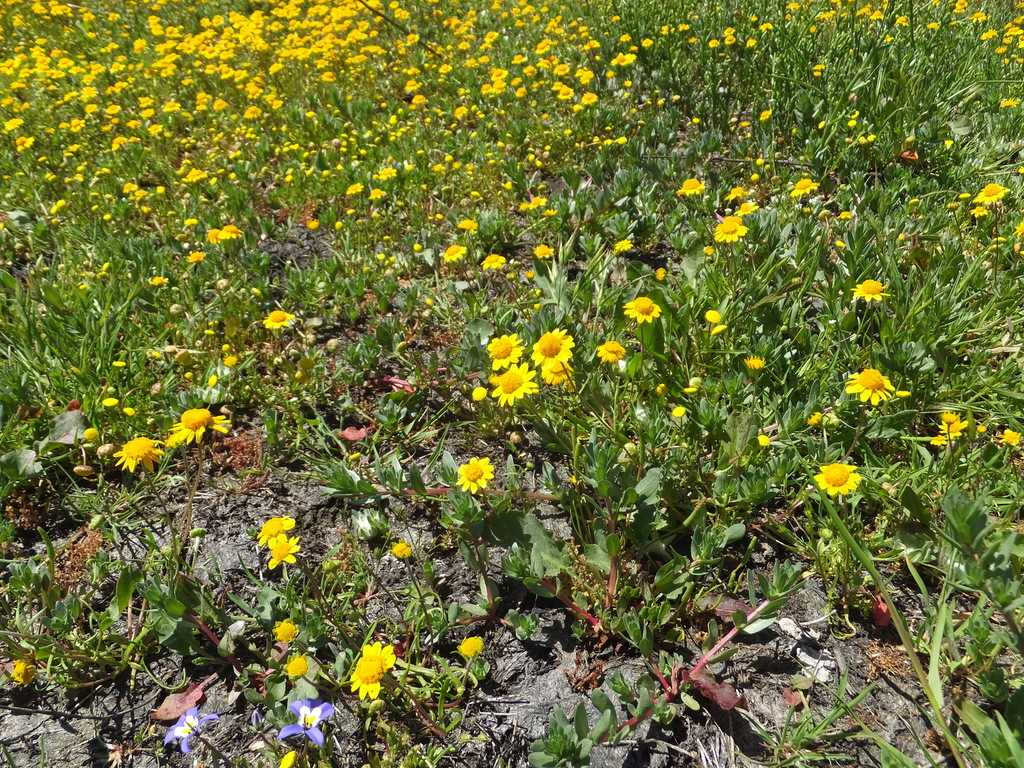
Contra Costa goldfields
Lasthenia conjugens
Lasthenia conjugens, commonly known as Contra Costa goldfields, is an endangered species of wildflower endemic to a limited range within the San Francisco Bay Area of the state of California, USA. Specifically this rare species occurs in Napa, Santa Barbara, Solano, Contra Costa, Santa Clara, Monterey and Alameda Counties. This annual herb typically flowers from March through June, and its colonies grow in vernal pool habitats at elevations not exceeding 100 meters above sea level. The Jepson Manual notes that the present distribution is limited to the deltaic Sacramento Valley, principally Napa and Solano Counties, but the historic range of L. conjugens is known to be significantly wider. In any case, historically the range has included parts of the North Coast, Sacramento Valley, and San Francisco Bay Area as well as the South Coast. Alternatively and less frequently this taxon has been referred to as Baeria fremontii var. conjugens.
Even though this plant is found almost exclusively in vernal pools, its behavior in controlled experiments indicates it prefers less than complete inundation. This implies that the plant actually prefers a theoretically drier environment, but is merely less successful than its competitors in surviving in drier (non-inundation) climate regimes.
From the article Lasthenia conjugens on Wikipedia (CC BY-SA), quoted section by section
Description
Lastenia conjugens is an herb whose stems are simple or freely branched and erect, attaining a height of less than 40 centimeters. Their glabrous leaves, of length of approximately eight centimeters, are entire to pinnately lobed. Inflorescences appear in the form of solitary heads, with twelve to eighteen phyllaries fused at one third to less than mid length, a distinguishing hallmark for identification of this species. An involucre structure measures six to ten millimeters and may be somewhat hemispheric. The receptacle presents as dome-shaped or obconic. The yellow ray flowers may number six to thirteen petals, and the five to ten millimeter ligules are yellow as well. The yellow disk flowers are numerous, and anther tips are linear to somewhat ovate. Style tips are triangular. The corollae are typically five-lobed. Style tips may be triangular or round, but typically hair-tufted. The glabrous club-shaped fruits are less than 1.5 millimeters across, black or gray in color, absent a pappus structure. The species is cross-pollinated. According to Greene, the chromosome characteristic is: 2n=12.
What it does
Lasthenia conjugens relies upon insect pollination for fertilization, and dispersal of seed is largely by gravity. In undisturbed habitats, this and other species of Lasthenia are pollinated by specialist bee species, primarily in the genus Andrena. Studies in Solano County natural and restoration habitats have shown variability between visitation rates to the two types of colonies; however, plant propagation rates were found to be similar between natural colonies and introduced ones, implying pollination is not a limiting factor of propagation. An alternative conclusion is that members of one particular insect family, Sciaridae, are also efficient pollinators of L. conjugens, since it was the only insect family to visit the restoration colonies in significant numbers (the specialist bees are absent from these areas).
Wikipedia: “Ecology”
Where it lives
Recorded sightings
—
geo-referenced records in GBIF, from museums, herbaria and field observers.
Drag the globe to turn it. Dots are where records exist, not a range map; darker means more records.
In the stacks
Searching the stacks…
Every page naming Lasthenia conjugens in the Biodiversity Heritage Library →
This page is assembled live from iNaturalist, GBIF, Wikipedia, the Source Library and the Internet Archive. It is not yet part of the hand-edited codex. iNaturalist taxon 77629.