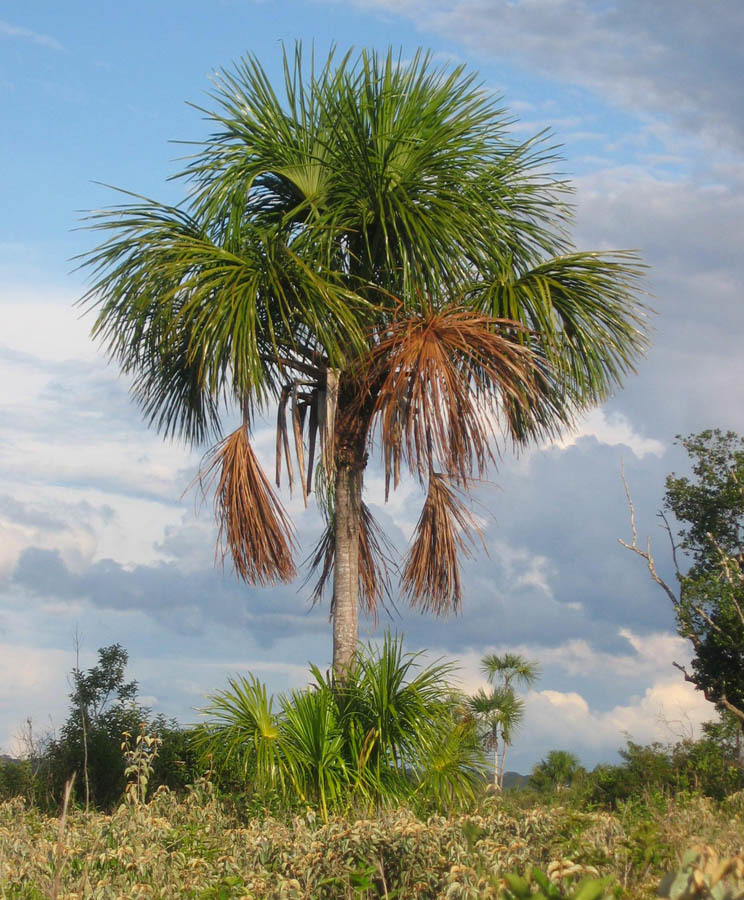
Calamoideae
Calamoideae is a subfamily of flowering plant in the palm family found throughout Central America, South America, Africa, India, China, Southeast Asia and Australia. It is represented by 21 genera - containing nearly a quarter of all species in the palm family - including the largest genus, Calamus, the type genus of the group. Only four are found in the New World while the rest are Old World denizens, usually found in equatorial swampland or along tropical coastlines.
While the many species show marked differences, the bracts of all orders are tubular, the flowers are almost always borne in dyads or dyad derivatives, but most marked as an identifier among these palms are the overlapping scales covering the fruit; occasionally small and irregular they are, in most cases, neatly aligned in vertical rows. Also common to the group are varying forms of armament: spines along leaf margins or on sheaths, root and stem spines, reflexed rachis cirri, or specialized hooks among the climbing species.
3 branches of this subfamily, most-observed first
See this branch on the Wheel of Life →


Where it lives
Recorded sightings
—
geo-referenced records in GBIF, from museums, herbaria and field observers.
Drag the globe to turn it. Dots are where records exist, not a range map; darker means more records.
In the stacks
Searching the stacks…
Every page naming Calamoideae in the Biodiversity Heritage Library →
This page is assembled live from iNaturalist, GBIF, Wikipedia, the Source Library and the Internet Archive. It is not yet part of the hand-edited codex. iNaturalist taxon 776360.