- Animals
- ›Cnidarians
- ›True Jellies
- ›Discomedusans
- ›Root-mouth Jellies
- ›Kolpophoran Jellies
- ›Krykomyaria
- ›Versurigid Jellies
- ›Versuriga
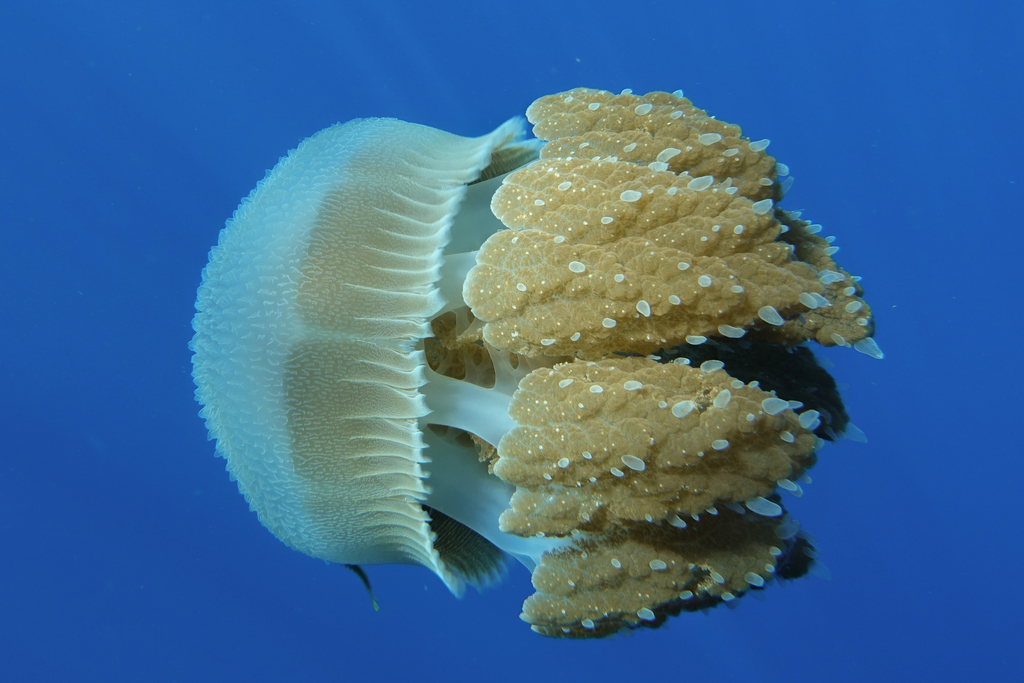
Warty Jellyfish
Versuriga anadyomene
Versuriga is a monotypic genus of jellyfishes belonging to the monotypic family Versurigidae. The only species is Versuriga anadyomene. This species is rare, only having been sighted in a limited region. However, it can be identified by its gradient-like coloration, as well as its umbrella shaped bell, which is common amongst other members of the class Scyphozoa. This species is important for many reasons, ranging from ecological interactions to socioeconomic benefits. Notably, Versuriga is able to form commensalistic relationships with other organisms, impacting biodiversity, as well as being a food source for humans and other predators.
From the article Versuriga on Wikipedia (CC BY-SA), quoted section by section
Description
Versuriga, like other members of the phylum Cnidaria, has its most notable feature being its umbrella shaped bell, reaching a diameter of up to 600 mm. Rather than being completely round or flat, its bell is made up of pointed grooves, growing in length closer to the center. Its body is mostly made up of umbrella and hemispherical shapes. This includes its muscular fields, which are also subumbrella shaped, as well as its canal features. Another of its identifiable features is its coloration, ranging from semi-translucently pink and purple at its center, eventually transitioning into a brown color. To distinguish between the Versuriga and other similar species, there are a few particular features to examine. There is a distinct difference between the shape of female and male genital double somites. Also, the structures of the appendages are discernible, specifically the antennae, maxillipeds, and legs. Between the female and male Versuriga, there are also morphological differences. Some of these differences include the male body being more slender, and that certain parts of the legs differ, in free segment length and endopod length.
Range & habitat
Versuriga is a very rare sight, and thus has seldom been studied or recorded. Until recently, the majority of Scyphozoa sightings, the class that Versuriga belongs to, were unreliable as they were mostly first hand accounts rather than scientific recordings. However, it has been found off the coasts of Malaysia, Philippines, Indonesia, and Australia, Vietnam. Versuriga is an occupant of nearshore waters, where its food is most abundant. Recent studies in regards to Versuriga distributions in the Philippines found that Versuriga had highest abundance in Leyte Gulf, which was the location with the highest observed mean temperatures. This suggests that Versuriga may prefer or best thrive in warmer climates.
Wikipedia: “Distribution”
What it does
The Versurgia begins its life as an egg, laid by an adult medusa. The egg is dispersed through the water column, developing into a free-living, free-floating planula. It remains floating until it locates hard substrate in which it will attach to. While attached to the hard substrate, it further grows and develops, going through more stages of its life cycle, a scyphistoma and then a strobila stage. Finally, it is able to detach from the hard surface and becomes a youth medusa.
Wikipedia: “Life cycle”
In human culture
The generic name Versuriga was derived from the genus Versura, originally described by Ernst Haeckel. The type species of the genus, Versura palmata, was found to instead be a specimen of Mastigias papua; the other species within Versura were regarded as doubtful and unidentifiable, rendering the genus name invalid. Paul Lassenius Kramp proposed Versuriga as a result in order to assign a genus to the previously described Crossostoma anadyomene, which Haeckel had earlier referred to Versura due to Crossostoma having been preoccupied. Versura is derived from the Latin versurus, meaning "about to turn (around)". The specific epithet derives from the Ancient Greek word ἀναδυομένος (anaduoménos), meaning "emerging, surfacing".
Wikipedia: “Etymology”
Where it lives
Recorded sightings
—
geo-referenced records in GBIF, from museums, herbaria and field observers.
Drag the globe to turn it. Dots are where records exist, not a range map; darker means more records.
In the stacks
Searching the stacks…
Every page naming Versuriga anadyomene in the Biodiversity Heritage Library →
This page is assembled live from iNaturalist, GBIF, Wikipedia, the Source Library and the Internet Archive. It is not yet part of the hand-edited codex. iNaturalist taxon 776823.