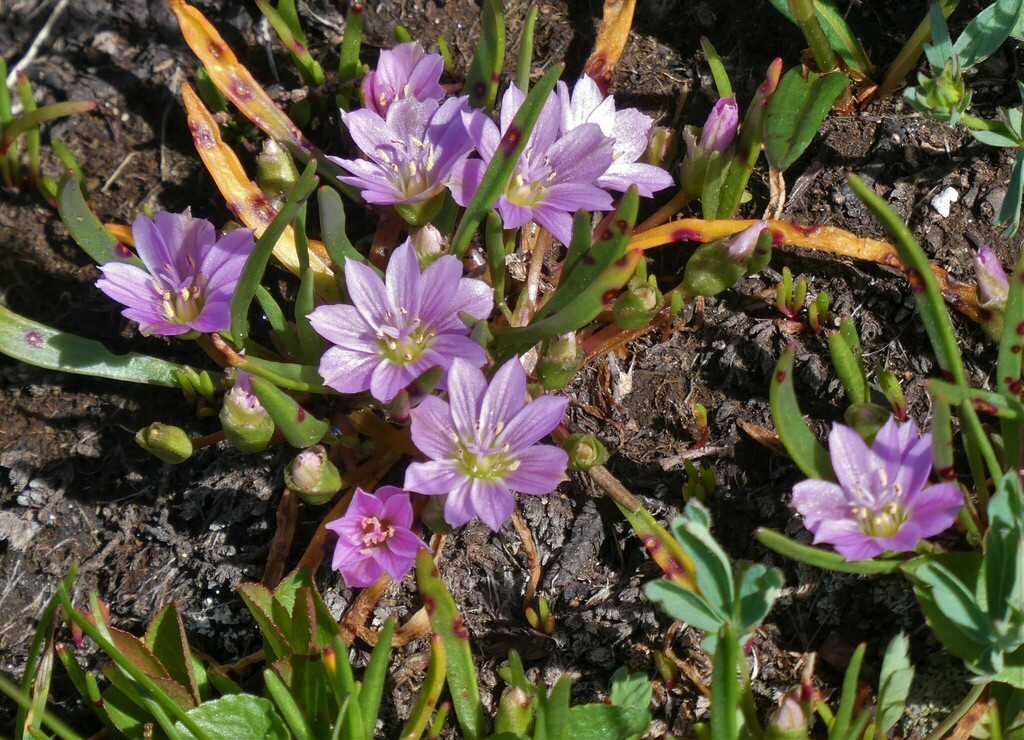
dwarf lewisia
Lewisia pygmaea
Lewisia pygmaea is a species of flowering plant in the Montiaceae family known by the common name alpine lewisia and pygmy bitterroot. It is native to western North America from Alaska and Alberta to California and New Mexico, where it grows in many types of moist, rocky mountain habitat, such as gravel beds and sandy meadows. This is a highly variable species with a wide distribution, and it often hybridizes with other Lewisia species, making identification...
From the article Lewisia pygmaea on Wikipedia (CC BY-SA), quoted section by section
Description
Lewisia pygmaea is a highly variable species with a wide distribution, and it often hybridizes with other Lewisia species, making identification difficult. In general, this is a petite perennial herb growing from a taproot and caudex unit, and producing a basal rosette of several leaves 2 to 8 centimeters (0.8 to 3.1 in) long. The leaves are narrow but thick and fleshy, blunt-tipped, and linear to lance-shaped. The inflorescence is usually made up of a few very short stems each bearing one or more flowers which appear to be sitting on or within the basal leaf rosette. Each flower has 5 to 9 white, pink or red petals which may or may not have dark veining or striping. The petals are 0.4 to 1 centimeter (0.16 to 0.39 in) long.
Range & habitat
Lewisia pygmaea grows in open areas with short turf and in gravelly or rocky soils. It can be found naturally growing in Alberta, British Columbia, Yukon, Arizona, California, Colorado, Idaho, Montana, Nevada, New Mexico, Oregon, Utah, Washington, and Wyoming.
Wikipedia: “Habitat and Range”
Where it lives
Recorded sightings
—
geo-referenced records in GBIF, from museums, herbaria and field observers.
Drag the globe to turn it. Dots are where records exist, not a range map; darker means more records.
In the stacks
Searching the stacks…
Every page naming Lewisia pygmaea in the Biodiversity Heritage Library →
This page is assembled live from iNaturalist, GBIF, Wikipedia, the Source Library and the Internet Archive. It is not yet part of the hand-edited codex. iNaturalist taxon 77732.