- Animals
- ›Arthropods
- ›Hexapods
- ›Insects
- ›Winged and Once-winged Insects
- ›Beetles
- ›Water, Rove, Scarab, Long-horned, Leaf, and Snout Beetles
- ›Cucujiform Beetles
- ›Darkling Beetles and Allies
- ›Blister Beetles
- ›Tetraonycinae
- ›Tetraonycini
- ›Meloetyphlus
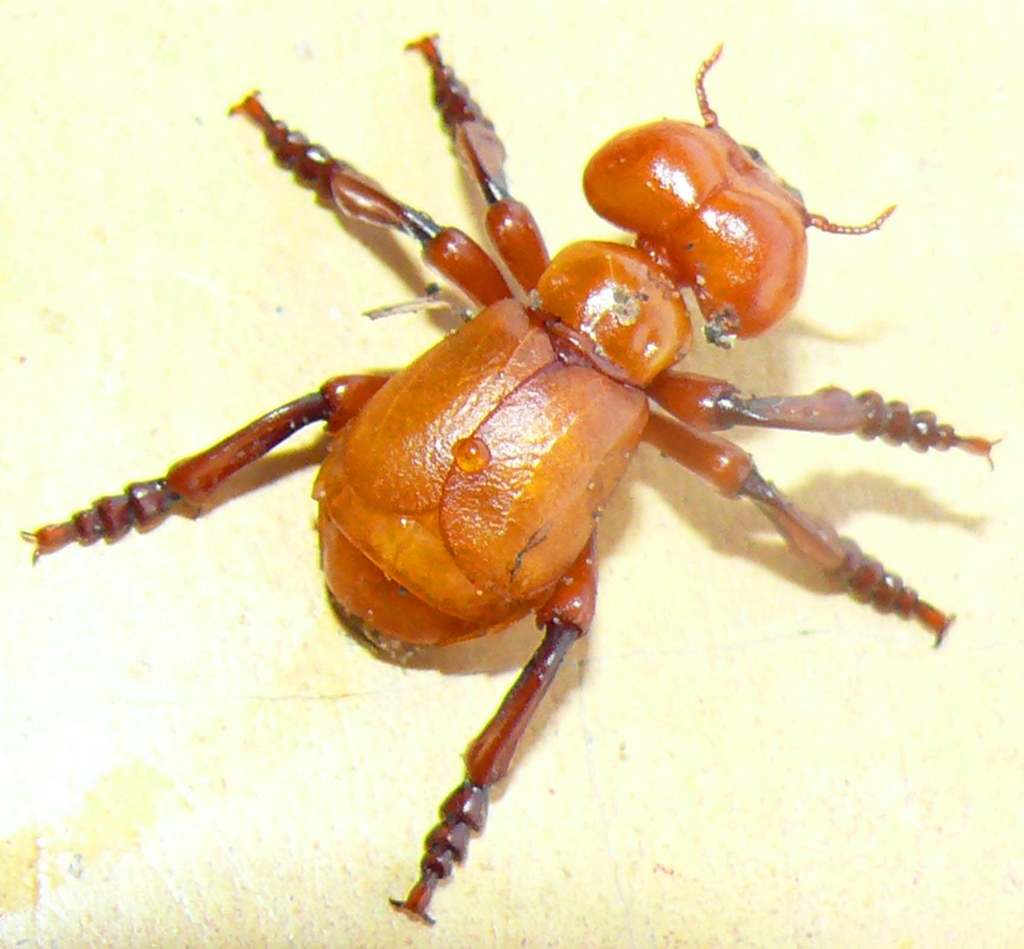
Meloetyphlus fuscatus
Meloetyphlus fuscatus, the blind blister beetle, is a species of blister beetle in the family Meloidae found in Central and South America. They are kleptoparasites of orchid bees and are entirely blind as adults. Unique among meloids, females do not lay their eggs near flowers, but rather within their hosts' nests.
From the article Meloetyphlus fuscatus on Wikipedia (CC BY-SA), quoted section by section
Description
Meloetyphlus fuscatus is a blind, dull, and robust blister beetle. The eyeless head is larger than is typical for blister beetles and provides more attachment area for mandibular muscles (this head shape is only observed once elsewhere in Meloidae, in the tribe Horiini). Length ranges from 12 to 17mm; males are typically larger and have more strongly modified legs than females.
Range & habitat
To date, M. fuscatus has been recorded in:
Honduras: Francisco Morazán Costa Rica: Limón, San José Colombia: Caldas, Cundinamarca Ecuador: Bolívar Trinidad Peru: Loreto Brazil: Pernambuco, São Paulo, Ceará
Wikipedia: “Range”
What it does
The life cycle of M. fuscatus begins when an adult female oviposits in an empty cell of its host's nest. The triungulins hatch within 20 day after oviposition and immediately set off looking for a provisioned bee nest to parasitize. This can be accomplished by attaching to a female bee to gain access to her nest. If a female emerges in a cell near that of the triungulins, they will attach to her. But in the instance of a male emerging near the triungulins, they will attach to him and transfer to a female during mating. Once a triungulin has infiltrated an active nest cell and the cell is sealed off, it will proceed to eat the bee egg and pollen privisions of that cell. After the triungulin pupates, it uses its strongly modified forelegs and mandibles to dig out of the sealed cell and look for a mate. Adult M. fuscatus do not feed, and the fecundity of females is determined by the amount of nutrition consumed as an immature.
Wikipedia: “Life cycle”
In human culture
The generic and specific names derive from Meloe + Greek τῠφλός (tuphlós) for blind, and Latin fusco for dusky.
Wikipedia: “Etymology”
Listen
Looking for field recordings…
Where it lives
Recorded sightings
—
geo-referenced records in GBIF, from museums, herbaria and field observers.
Drag the globe to turn it. Dots are where records exist, not a range map; darker means more records.
In the stacks
Searching the stacks…
Every page naming Meloetyphlus fuscatus in the Biodiversity Heritage Library →
This page is assembled live from iNaturalist, GBIF, Wikipedia, the Source Library and the Internet Archive. It is not yet part of the hand-edited codex. iNaturalist taxon 777330.