- Plants
- ›Vascular Plants
- ›flowering plants
- ›Dicots
- ›carrots, ivies, and allies
- ›carrot family
- ›Apioideae
- ›Selineae
- ›Lomatium
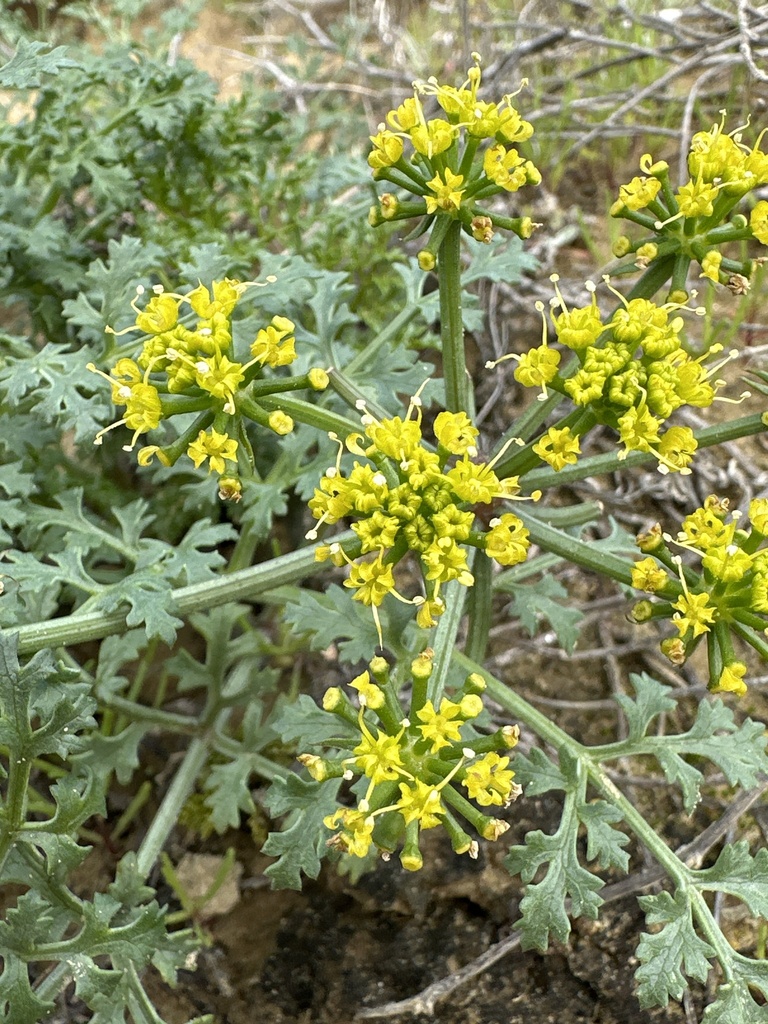
San Nicolas Island lomatium
Lomatium insulare
Lomatium is a genus in the family Apiaceae. It consists of about 100 species. Its common names include biscuitroot, Indian parsley, and desert parsley. It is in the family Apiaceae and therefore related to many familiar edible species such as carrots and celery. Native to western Northern America and northern Mexico, some Lomatium species are extensively used by Native Americans in the inland Pacific Northwest as a staple food.
From the article Lomatium on Wikipedia (CC BY-SA), quoted section by section
Description
Lomatium roots range from woody taproots to more fleshy underground tuberous-thickened roots. The plants are green and grow the most during the spring when water is available, and many species then set seed and dry out completely above ground before the hottest part of the year, while storing the energy they gained from photosynthesizing while water was available to them in their deep roots. For most of the year, the plant is not visible; the brown tops often are blown off or easily crushed, but it lies dormant underground for the next spring. The leaves are mainly basal and dissected (ternately, pinnately, or ternate-pinnately dissected or compound), many look like ferns or can be mistaken for them. The flowers are arranged in compound umbels, without involucral bracts (or with inconspicuous bracts). The flowers are white or yellow, more rarely a purple or maroon color. As with most Apiaceae, the fruit sets the genus apart from other yellow- or white-flowered look-alikes such as Cymopterus. Uniquely, they are dorsally flattened and winged, which can be papery or corky, but help the seed to disperse further on the wind. The dorsal ribs may or may not be on the fruit, but are narrowly winged if at all.
Range & habitat
The species is native to western Northern America and northern Mexico. Most lomatiums are desert species or grow on bluffs or mountain slopes where water is limited for most of the year.
Wikipedia: “Distribution and habitat”
What it does
It grows in a variety of habitats throughout western North America, from coastal bluffs to piles of basalt rock.
Wikipedia: “Ecology”
At the table
Several species, including L. cous, L. geyeri, and L. macrocarpum, are sometimes known as biscuit roots for their starchy edible roots. These are or have been traditional Native American foods, eaten cooked or dried and ground into flour. Some Native Americans ground Lomatium into mush and shaped it into cakes and stored them for later use. Their flavor has been compared to celery, parsnip, or stale biscuits. Lomatium continues to be harvested and eaten by Indigenous people, including members of the Confederated Tribes of the Umatilla Indian Reservation, the Confederated Tribes of the Warm Springs, and the Yakama Nation.
Wikipedia: “Uses”
Where it lives
Recorded sightings
—
geo-referenced records in GBIF, from museums, herbaria and field observers.
Drag the globe to turn it. Dots are where records exist, not a range map; darker means more records.
In the stacks
Searching the stacks…
Every page naming Lomatium insulare in the Biodiversity Heritage Library →
This page is assembled live from iNaturalist, GBIF, Wikipedia, the Source Library and the Internet Archive. It is not yet part of the hand-edited codex. iNaturalist taxon 77813.