- Fungi Including Lichens
- ›Basidiomycete Fungi
- ›Higher Basidiomycetes
- ›Mushrooms, Bracket Fungi, Puffballs, and Allies
- ›Agaricomycetidae
- ›boletes and allies
- ›boletes
- ›Suillelloideae
- ›Butyriboletus
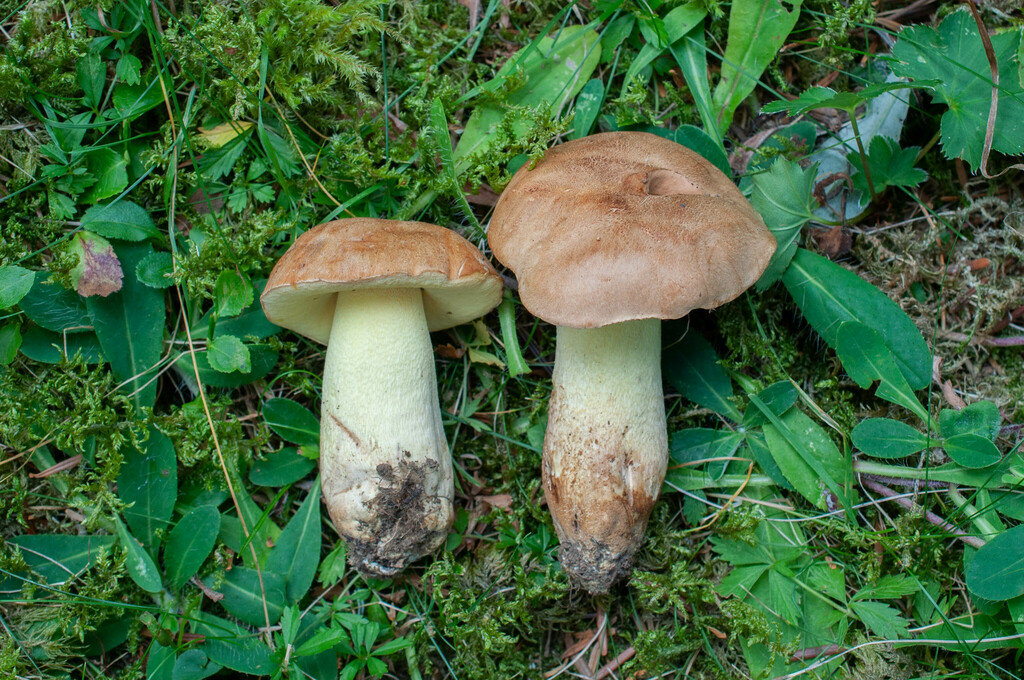
Butyriboletus subappendiculatus
Butyriboletus subappendiculatus is a pored mushroom in the family Boletaceae. It was originally described as a species of Boletus in 1979 before being reclassified in the genus Butyriboletus in 2014. The fungus produces medium-sized fruiting bodies with brownish-orange to buff-coloured caps up to 8 cm across, lemon-yellow tubes and pores that do not bruise blue when damaged, and yellowish stipes covered with a fine network pattern. It fruits in upper-montane coniferous or mixed forests across Europe and into Turkey, primarily under Norway spruce or silver fir on neutral to calcareous soils at elevations of 1,200–1,700 metres.
From the article Butyriboletus subappendiculatus on Wikipedia (CC BY-SA), quoted section by section
Description
Butyriboletus subappendiculatus produces a medium-sized basidiocarp with a cap (pileus) up to 8 cm across. The young cap is hemispherical, becoming convex to flat-convex and sometimes slightly depressed with age. Its surface is dry or, in older specimens, faintly viscid, smooth to finely fibrillose or cracked, and coloured from brownish orange or cinnamon to buff or grey buff. The cap flesh does not change colour when bruised, and the margin often retains fragments of the partial veil (appendiculate). The tubes are up to 1 cm long and lemon yellow, maturing to a yellow with a faint olive tint; neither tubes nor pores bruise blue. The stipe measures up to 13 cm long and 5.5 cm thick, initially subspherical or ovoid before becoming club-shaped or cylindrical, often with a rooting base. It is pale yellowish-white to pastel yellow, occasionally discolouring to whitish or brownish, and may bear a zone of pale red to brownish-orange. A fine, concolorous reticulation covers much of the stipe, which likewise remains unchanging when handled. The flesh of the stipe is lemon yellow under the surface and fades to straw or whitish in deeper tissues; it shows no bluing on exposure. …
Range & habitat
Butyriboletus subappendiculatus fruits in upper-montane coniferous or mixed forests, most commonly under Norway spruce (Picea abies) or silver fir (Abies alba), on neutral to calcareous soils at elevations of 1,200–1,700 m. Fruiting occurs in midsummer, typically from July through August. In Bulgaria, it is known from the high-elevation woodlands of the Pirin and Rila mountains. More broadly, the species has been recorded wherever its coniferous hosts grow across Europe (Austria, Czech Republic, Germany, Spain, United Kingdom, Greece, France, Italy, Montenegro, Norway, Poland, Serbia, Slovenia and Slovakia) and extending into Turkey. It is considered endangered in the Czech Republic.
== References ==
Wikipedia: “Habitat and distribution”
Where it lives
Recorded sightings
—
geo-referenced records in GBIF, from museums, herbaria and field observers.
Drag the globe to turn it. Dots are where records exist, not a range map; darker means more records.
In the stacks
This page is assembled live from iNaturalist, GBIF, Wikipedia, the Source Library and the Internet Archive. It is not yet part of the hand-edited codex. iNaturalist taxon 778494.