- Plants
- ›Vascular Plants
- ›flowering plants
- ›Dicots
- ›Sunflowers, Bellflowers, Fanflowers, and Allies
- ›Sunflowers, Daisies, Asters, and Allies
- ›Asteroideae
- ›tarweeds, silverswords, and allies
- ›Madia
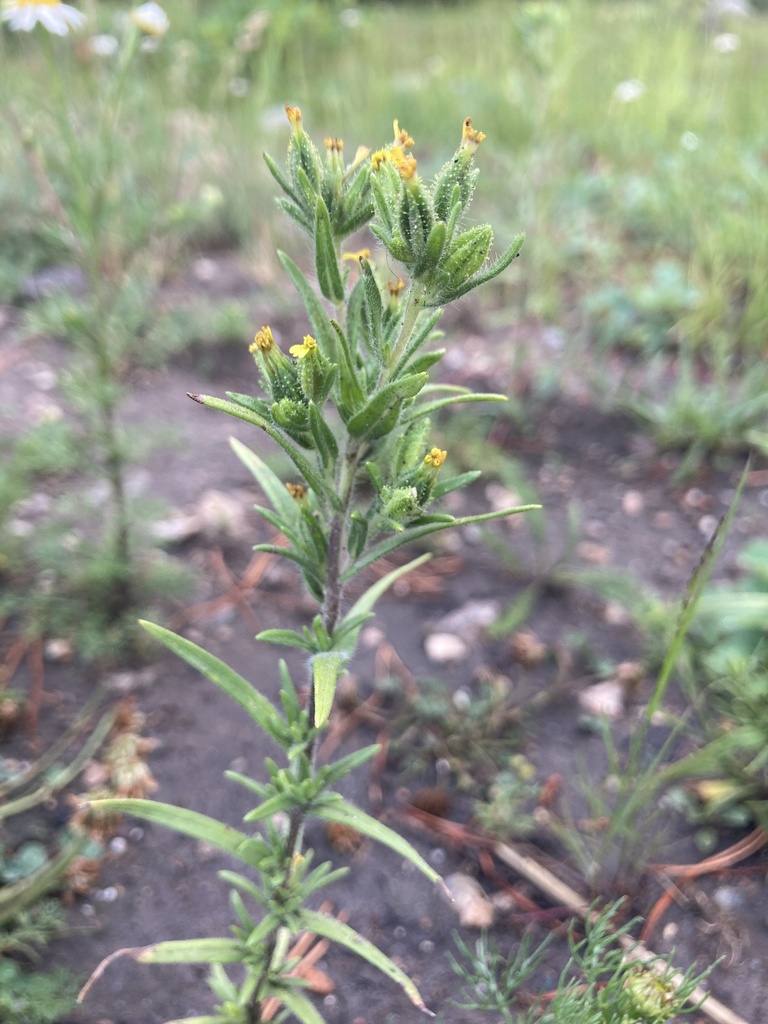
mountain tarweed
Madia glomerata
Madia glomerata is a species of flowering plant in the family Asteraceae known by the common name mountain tarweed.
From the article Madia glomerata on Wikipedia (CC BY-SA), quoted section by section
Description
Madia glomerata grows in a wide variety of habitat types, including disturbed areas such as roadsides. It is an annual herb sometimes exceeding a meter in height, its stem branched or not and covered in foliage. It is hairy to bristly in texture, studded with stalked yellow resin glands, and strongly aromatic with an unpleasant scent. The rough-haired leaves are up to 10 centimeters long. The inflorescence is generally a cluster of glandular flower heads with black-tipped yellow disc florets and sometimes one or more tiny greenish or purplish yellow ray florets. The fruit is a flat black achene with no pappus.
Range & habitat
Madia glomerata is the most widely distributed Madia, its native range covering much of western and northern North America from Alaska to the Southwestern United States, most of southern Canada and into the Great Lakes region. It grows in sagebrush plains and mountains.
Wikipedia: “Distribution and habitat”
Where it lives
Recorded sightings
—
geo-referenced records in GBIF, from museums, herbaria and field observers.
Drag the globe to turn it. Dots are where records exist, not a range map; darker means more records.
In the stacks
Searching the stacks…
Every page naming Madia glomerata in the Biodiversity Heritage Library →
This page is assembled live from iNaturalist, GBIF, Wikipedia, the Source Library and the Internet Archive. It is not yet part of the hand-edited codex. iNaturalist taxon 77923.