- Plants
- ›Vascular Plants
- ›flowering plants
- ›Dicots
- ›Mints, Plantains, Olives, and Allies
- ›Mint Family
- ›Nepetoideae
- ›Mentheae
- ›balms, mints, and thymes
- ›Mentha
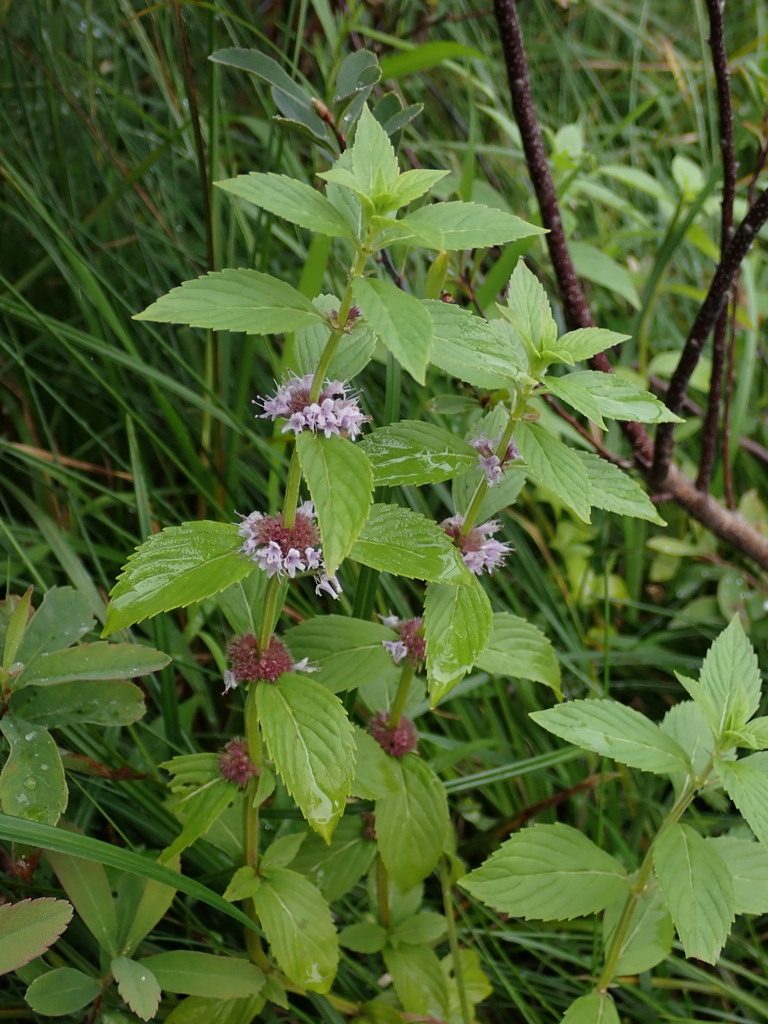
Canada mint
Mentha canadensis
Mentha canadensis is a species of mint native to North America (from the Northwest Territories to central Mexico) and the eastern part of Asia (from Siberia to Java). In North America, it is commonly known as Canada mint, American wild mint, and in Asia as Chinese mint, Sakhalin mint, Japanese mint, and East Asian wild mint. The flowers are bluish or have a slight violet tint. The plant is upright, growing to about 30–60 cm (12–24 in) tall. The leaves are opposite, and flower clusters appear in the upper leaf axils. This mint grows in wet areas but not directly in water, so it will be found near marshes, and lake and river edges. Plants bloom from July to August in their native habitats.
Some populations found in eastern Asia have been distinguished as Mentha sachalinensis, but this is treated as a synonym of M. canadensis by the Plants of the World Online database.
From the article Mentha canadensis on Wikipedia (CC BY-SA), quoted section by section
Description
Mentha canadensis is a perennial plant with an underground creeping rhizome and upright, much-branched shoots. It can grow to a height of about 60 centimetres (24 in). It has finely hairy stems bearing opposite pairs of leaves. Each leaf is borne on a short stalk and has a wedge-shaped base and is lanceolate or ovate, with a toothed margin and a hairy surface. The flowers are borne in spikes at the tips of the shoots. The flowers may be bluish, pink or white. They are arranged in a spiral around the inflorescence. Each flower has five sepals, four petals, four stamens and a superior ovary. The fruit is dry, and splits open when ripe releasing the two seeds.
Range & habitat
Mentha canadensis has been found as a native species of mint around the world. Below is a detailed list of countries and states in which Mentha canadensis is considered to be native. Asia (both temperate and tropical)
East Asia: China; Japan( Hokkaido, Honshu, Kyushu and Shikoku); Korea Russian Far East: Russian Federation (Kurile Islands, Khabarovsk, Primorye, Amur and Sakhalin) Siberia: Russian Federation (Buryatia, Tuva, Yakutia-Sakha, Krasnoyarsk, Chita and Irkutsk) Indian Subcontinent: India; Nepal; Sri Lanka Indo-China: Cambodia; Laos; Myanmar; Thailand; Vietnam Malesia: Indonesia; Malaysia; Philippines Northern America
Eastern Canada: Canada (Quebec, Nova Scotia, Ontario, Prince Edward Island, New Brunswick and Newfoundland) North-Central U.S.: United States (Illinois, Iowa, Kansas, Minnesota, Missouri, Nebraska, North Dakota, Oklahoma, South Dakota, Wisconsin) Northeastern U.S.: United States (Connecticut, Indiana, Maine, Massachusetts, Michigan, New Hampshire, New Jersey, New York, Ohio, Pennsylvania, Rhode Island, Vermont and West Virginia) Northwestern U.S.: United States (Colorado, Idaho, Montana, Oregon, Washington and Wyoming) South-Central U.S.: United States (New Mexico and Texas) Southeastern U.S.: United States (Kentucky, Maryland, North Carolina, Tennessee and Virginia) Southwestern U.S.: United States (Arizona, California, Nevada, Utah) Subarctic America: …
Wikipedia: “Distribution”
At the table
It is grown in Hungary for essential oil and menthol production. It also contains a significant amount of pulegone. The leaves have a distinct peppermint smell when pinched or crushed as the plant contains aromatic oils. The leaves can be picked at any time during plant growth, and may be dried. They are used in making mint jelly, mint tea, and mint leaf candy. First nations people use mint tea for bad breath or toothache, or to cure hiccups. The mint can also be used for fox or lynx bait. Mint essential oil is known to be effective as insect repellent for insects such as Drosophila melanogaster.
Wikipedia: “Uses”
In medicine
One of the most important essential oils used in medicine is Japanese mint oil. Mentha canadensis is rich in natural menthol compared to other mint species, and menthol is used extensively in a number of pharmaceutical preparations. Approximately 4000 tons of Japanese mint oil and 2000 tons of menthol were produced in the world in 1998. The major producing countries are Brazil, Paraguay, Taiwan, Japan, China, India, and Thailand.
== References ==
Wikipedia: “Medicinal uses”
Where it lives
Recorded sightings
—
geo-referenced records in GBIF, from museums, herbaria and field observers.
Drag the globe to turn it. Dots are where records exist, not a range map; darker means more records.
In the stacks
Searching the stacks…
Every page naming Mentha canadensis in the Biodiversity Heritage Library →
This page is assembled live from iNaturalist, GBIF, Wikipedia, the Source Library and the Internet Archive. It is not yet part of the hand-edited codex. iNaturalist taxon 77991.