- Animals
- ›Arthropods
- ›Crustaceans
- ›Typical Crustaceans
- ›Malacostracans
- ›Decapods, Isopods, and allies
- ›Decapods and Krill
- ›Decapods
- ›Crabs, Lobsters, Shrimps, and Allies
- ›Anomurans
- ›Hermit Crabs
- ›Land Hermit Crabs
- ›Coenobita
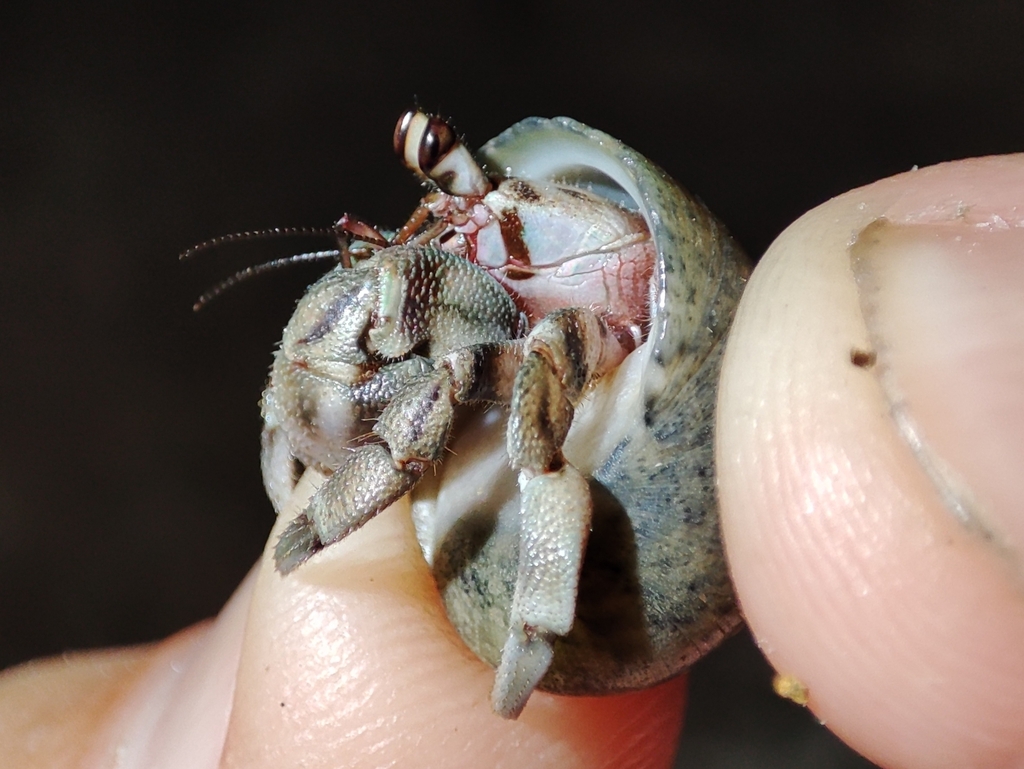
False Tawny Hermit Crab
Coenobita pseudorugosus
Coenobita pseudorugosus is a species of terrestrial hermit crab, family Coenobitidae.
From the article Coenobita pseudorugosus on Wikipedia (CC BY-SA), quoted section by section
Description
When first described, the adult (terrestrial, non-larval form) were noted to have shield length (i.e. the anterior-posterior length of the dorsal cephalothorax carapace) between 5.6 and 12.1 mm. Subsequent surveys described their shield length as anywhere between 5 mm to 30 mm, and body weight of 100 mg to about 25 g. Their coloration may vary from light-to-dark or reddish brown, to pink, to blue-gray. The anterior third of the shield may be marked with dark transverse stripe or paired dark patches (associated with posterior longitudinal stripes), with additional scattered dark colorations in ventral aspect of ocular peduncle as well as parts of second and third pereiopods (walking legs). Like all members of the Coenobitidae family, C. pseudorugosus’ left cheliped (i.e., first pereiopod) is notably larger than the right. The geometry and coloration of the chela, or pincer, is distinct from C. rugosus: the inferior margin of the propodus is distally straight and proximally angulated, approximating an irregular pentagonal shape. This is in contrast with C. rugosus, with convexly curved inferior margin of the propodus, forming a more rounded quadrangular shape. C. pseudorugosus specimens were initially noted to lack a dark brown patch on the lateral aspect of the chela, as commonly seen with C. …
Wikipedia: “Morphology”
Range & habitat
Coenobita pseudorugosus was first described in Cebu Island, Philippines, and has also been studied in Southwest Madagascar, as well as in Sumatra and central Sulawesi province of Indonesia.
Wikipedia: “Geographical distribution”
What it does
Coenobita pseudorugosus occupy the supralittoral region, in conjunction with other terrestrial hermit crabs such as C. cavipes, C. rugosus, and C. violascens. As with all terrestrial hermit crabs, they are subject to limited availability of empty gastropod shells that are suitable as a shelter, and thus an individual must compete with conspecifics as well as other species of terrestrial hermit crabs. Though described as preferring shells with short-to-mid height spire, they nonetheless occupy a wide variety of available shells. Although some subtle, species-specific shell and refuge preference has been reported, they closely occupy the same ecological niche as C. rugosus; despite the overlap, the niche difference is somewhat more pronounced when compared to C. cavipes (which preferentially seek mangroves). Similar to C. rugosus, they may seek refuge in fallen leaves under bushes, mangrove roots, algal deposits along the shoreline, under boulders and between rock crevices, and even taking advantage of anthropogenic constructs (such as tombs). In unfavorable climatic conditions they may burrow into the ground as deep as 5 cm. C. pseudorugosus regularly participate in short range migration near the shoreline to forage and seek empty gastropod shells, at times exceeding 100 meters per day. …
Wikipedia: “Behavior and ecology”
Where it lives
Recorded sightings
—
geo-referenced records in GBIF, from museums, herbaria and field observers.
Drag the globe to turn it. Dots are where records exist, not a range map; darker means more records.
In the stacks
Searching the stacks…
Every page naming Coenobita pseudorugosus in the Biodiversity Heritage Library →
This page is assembled live from iNaturalist, GBIF, Wikipedia, the Source Library and the Internet Archive. It is not yet part of the hand-edited codex. iNaturalist taxon 780251.