- Plants
- ›Vascular Plants
- ›flowering plants
- ›Dicots
- ›pinks, cactuses, and allies
- ›four o'clock family
- ›Mirabilis
- ›Oxybaphus
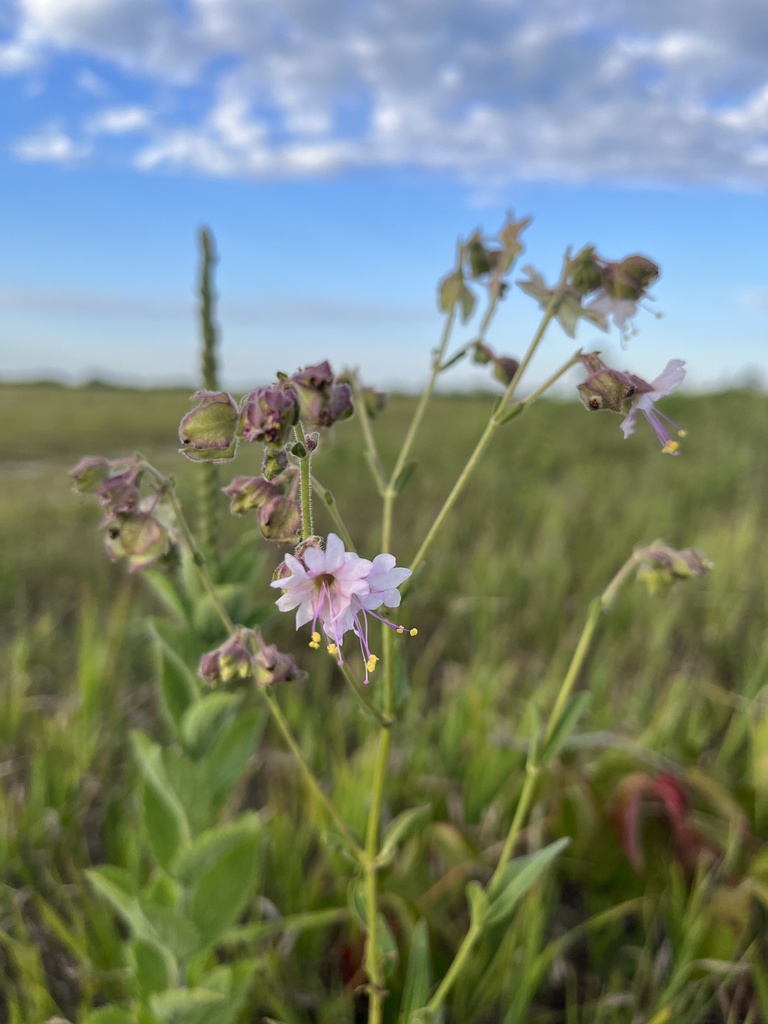
White Four o'Clock
Mirabilis albida
Mirabilis albida, called white four o'clock, mountain four o'clock, hairy four o'clock, hairy umbrellawort, pale four o'clock, pale umbrellawort, or dwarf four o'clock, is a perennial forb found in grassland throughout North America.
From the article Mirabilis albida on Wikipedia (CC BY-SA), quoted section by section
Description
Mirabilis albida varies widely throughout its range. Generally, it grows up to 5 feet long and the stems may stand erect or grow outward. The leaves are lance or egg shaped and are clustered mostly on the lowest part of the stem. The stem, leaves and flowers are hairy. The flowers are tubular and 5-lobed, and can be white, red, pink, or violet. M. albida blooms from August to October and, just like the rest of the four o'clock family, the flowers open only in the late afternoon. The fruit is a brown, hairy caryopsis.
Range & habitat
Mirabilis albida grows in dry, well-drained soil in open, sunny areas such as grassland, pasture, open woodland, and rocky bluffs.
Wikipedia: “Habitat”
What it does
Mirabilis albida is a larval host for the moth Neoheliodines nyctaginella and the leaf-footed bug Catorhintha mendica. It is a source of nectar for bees, hummingbirds, moths, and other pollinators.
Wikipedia: “Ecology”
Where it lives
Recorded sightings
—
geo-referenced records in GBIF, from museums, herbaria and field observers.
Drag the globe to turn it. Dots are where records exist, not a range map; darker means more records.
In the stacks
Searching the stacks…
Every page naming Mirabilis albida in the Biodiversity Heritage Library →
This page is assembled live from iNaturalist, GBIF, Wikipedia, the Source Library and the Internet Archive. It is not yet part of the hand-edited codex. iNaturalist taxon 78078.