- Plants
- ›Vascular Plants
- ›flowering plants
- ›Dicots
- ›Mustards, Capers, and Allies
- ›mustard family
- ›Brassicoideae
- ›Brassicodae
- ›Coluteocarpeae
- ›Noccaea
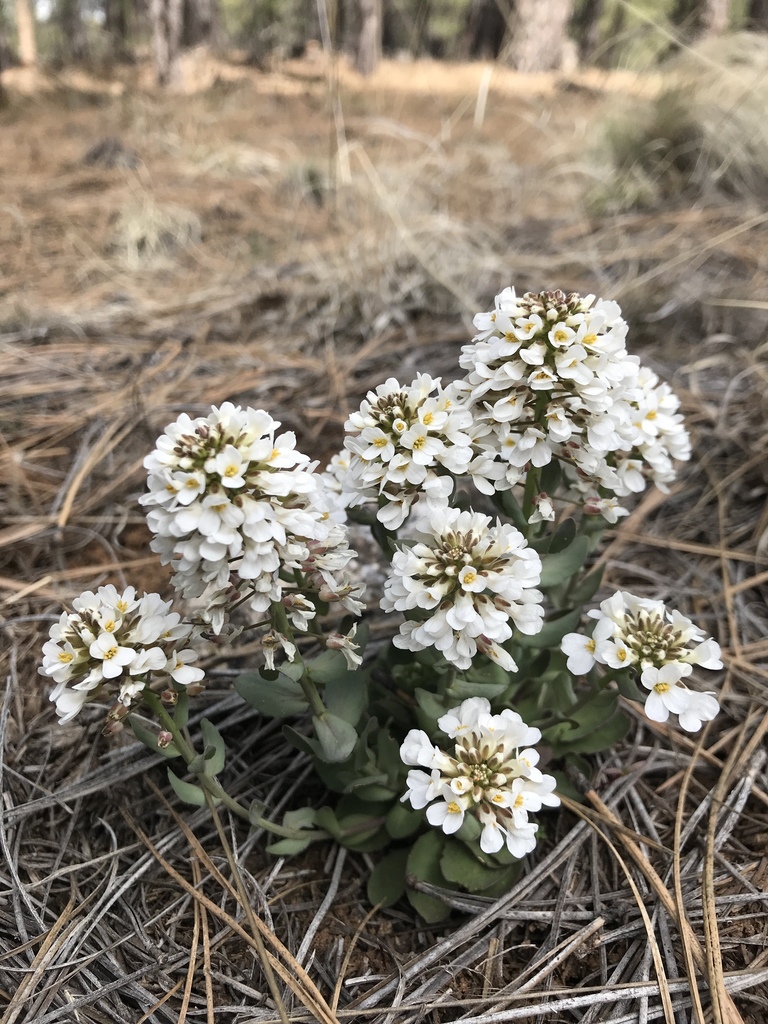
Fendler's pennycress
Noccaea fendleri
Noccaea fendleri more commonly known as wild candytuft and alpine pennycress is a wildflower in the mustard family from western North America. It grows in mountains from northern Mexico to the northern United States. It blooms early in the spring and provides nectar to butterflies.
From the article Noccaea fendleri on Wikipedia (CC BY-SA), quoted section by section
Description
Noccaea fendleri is a small perennial plant. They range in size from just 1 centimeter to as much as 45 centimeters in height, but are most often 4–32 centimeters tall. The stems may be without branches or be branched near their ends. Very often it will grow as a clump of plants, but may also be a single rosette. Plants have more basal leaves, ones that grow directly from the base of the plant, than ones on their stems. Leaves are dark green in color and have smooth edges, but are sometimes slightly purple. The leaf surface is smooth, without hairs, and sometimes covered in a waxy coating (glaucous). The shape of the basal leaves are quite variable and may be narrow and grass like (blade linear), a narrow rectangle with rounded corners (oblong leaf), resemble a spear head (oblanceolate), somewhat egg shaped (ovate leaf), be shaped like a teardrop with the stem the narrow end (obovate), or be shaped like a spoon (spatulate). They are also variable in size, 4–30 millimeters long and 2–20 millimeters wide. Leaves are attached to the base of the plant by a small stem (a petiole 0.4–7.3 centimeters long. The leaves on the stems are attached alternately to them and the bases of the leaves partially surround the stems (a clasping leaf). …
Range & habitat
Noccaea fendleri is native to western North America from Washington state and Montana in the US to Chihuahua, Coahuila, and Sonora in northern Mexico. It grows in alpine and montane ecosystems and prefers rocky slopes and forest openings. The most common of its subspecies, glauca, can be found at elevations of 300–4400 meters.
Wikipedia: “Range and habitat”
How it is grown
Wild candytuft is used in native plant gardens for its butterfly attracting white flowers. They are winter hardy in USDA zones 2–8 and are adaptable to many soil types. They also will grow in full sun or shade. They tolerate drought conditions by going dormant.
== References ==
Wikipedia: “Cultivation”
Where it lives
Recorded sightings
—
geo-referenced records in GBIF, from museums, herbaria and field observers.
Drag the globe to turn it. Dots are where records exist, not a range map; darker means more records.
In the stacks
Searching the stacks…
Every page naming Noccaea fendleri in the Biodiversity Heritage Library →
This page is assembled live from iNaturalist, GBIF, Wikipedia, the Source Library and the Internet Archive. It is not yet part of the hand-edited codex. iNaturalist taxon 78224.