- Plants
- ›Vascular Plants
- ›flowering plants
- ›Dicots
- ›Mints, Plantains, Olives, and Allies
- ›broomrape family
- ›Pedicularideae
- ›Orthocarpus
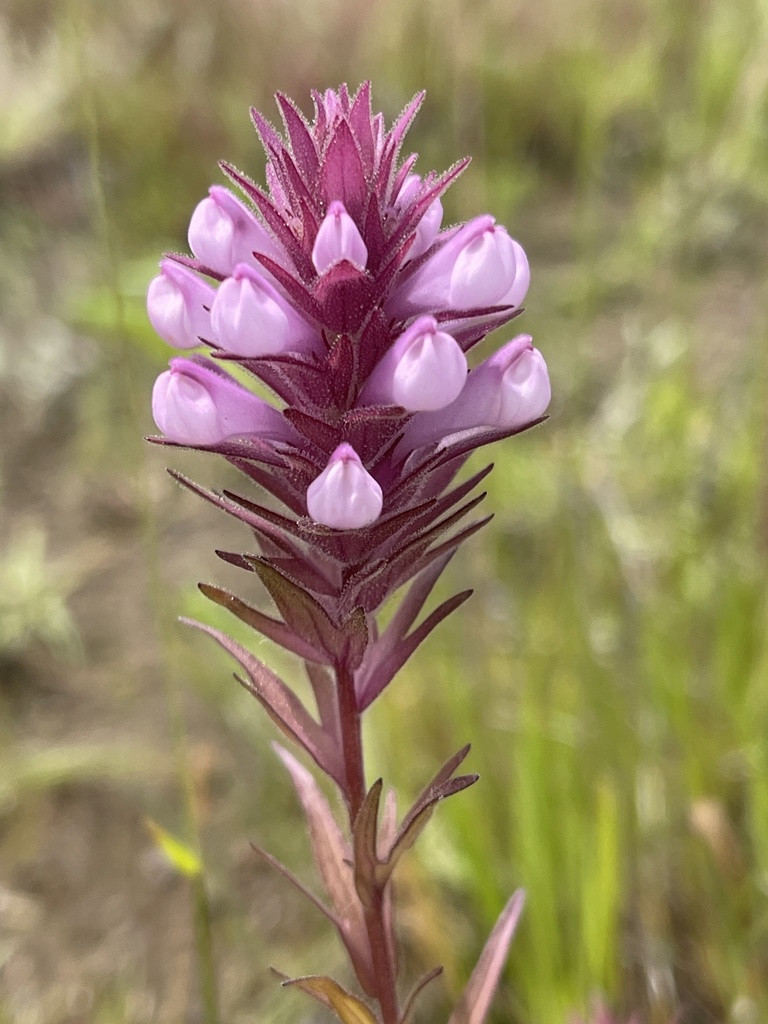
Rosy Owl's-clover
Orthocarpus bracteosus
Orthocarpus bracteosus, known by the common name rosy owl's-clover, is a species of flowering plant in the broomrape family (Orobanchaceae). It is native to western North America from British Columbia to northern California, where it grows in moist habitats, such as meadows and vernal pools. In the northern and southern portions of its range, O. bracteosus is considered endangered or threatened.
From the article Orthocarpus bracteosus on Wikipedia (CC BY-SA), quoted section by section
Range & habitat
Orthocarpus bracteosus is native to western North America, from Northern California northward to the Trial Islands in British Columbia. There is a significant gap in the distribution between the Columbia River in southern Washington (Klickitat and Skamania Counties) and the populations in northwestern Washington and Vancouver Island. In Oregon, the plant is found on both sides of the Cascade Range. Its elevational range is 100–2,000 m (330–6,560 ft).
O. bracteosus is restricted to vernally wet meadows. It grows in graminoid-dominated habitats that experience summer drought and have high water tables in winter and spring, including vernal pools, wet meadows, depressions, and channels. Outside its native range, O. bracteosus has been documented once in Cayuga County, New York (in 1918) and once in Maryland (in 2001). The New York plant was a waif that did not reproduce.
Wikipedia: “Geographic range”
Where it lives
Recorded sightings
—
geo-referenced records in GBIF, from museums, herbaria and field observers.
Drag the globe to turn it. Dots are where records exist, not a range map; darker means more records.
In the stacks
Searching the stacks…
Every page naming Orthocarpus bracteosus in the Biodiversity Heritage Library →
This page is assembled live from iNaturalist, GBIF, Wikipedia, the Source Library and the Internet Archive. It is not yet part of the hand-edited codex. iNaturalist taxon 78289.