- Plants
- ›Vascular Plants
- ›flowering plants
- ›monocots
- ›Aroids, Water Plantains, Seagrass, and allies
- ›Arum Family
- ›Aroideae
- ›Peltandreae
- ›Peltandra
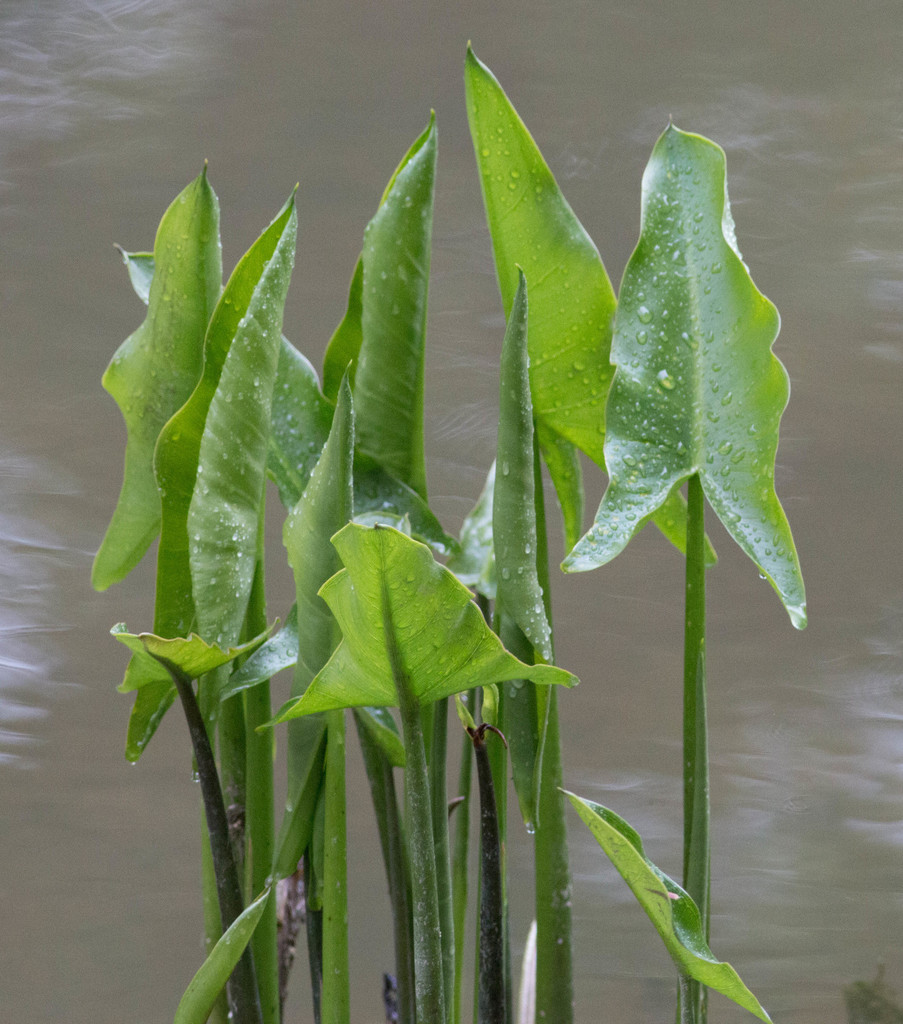
Green Arrow Arum
Peltandra virginica
Peltandra virginica is a plant of the arum family known as green arrow arum and tuckahoe. It is widely distributed in wetlands in the eastern United States, as well as in Quebec, Ontario, and Cuba. It is common in central Florida including the Everglades and along the Gulf Coast. Its rhizomes are tolerant to low oxygen levels found in wetland soils.
P. virginica is a hydrophytic marshland aquatic plant pollinated by a chloropid fly through providing a brood site and releasing the pollen onto them. The primary dispersal mechanisms are via water and animals.
From the article Peltandra virginica on Wikipedia (CC BY-SA), quoted section by section
Description
This is an emergent perennial herb growing from a large rhizome and producing many large leaves. An individual leaf may have a petiole nearly a meter long and a blade half a meter in length. The leaves are quite variable in shape and size, but they are often generally arrowhead-shaped. The inflorescence bears male and female flowers, as well as sterile flowers. The flower varies from whitish to greenish to yellow. The fruit is a brown berry containing a few seeds within a clear gelatinous pulp. Large number of seeds can accumulate in the soil of wetlands. Peltandra virginica is a marshland aquatic plant, growing in North America bogs, ponds, and marshes. The roots and base grow into the submerged substrate, and the leaves and inflorescences project up and out of the water. The roots form a perennial rhizome. Various forms of leaf blades have been observed, both in larger ranges and smaller individual populations. Petioles range from green to green-purple to purple with a medium green blade petiole lengths between 38 and 98 centimeters and blade length being between 9 and 57 centimeters. Lateral veins also have variable thicknesses. Inflorescences are generally pale green to white, being lighter within the spathe. …
Range & habitat
Peltandra virginica is a native to North America; its range spans the entire eastern coast of the United States and goes as far west as Texas. It is also naturalized in areas of California up to Oregon and is present in eastern regions of Canada. It mostly inhabits the wetlands and swamps, including marshes and bogs. It can be found elsewhere in North America as an introduced species and often an invasive plant.
Wikipedia: “Distribution and habitat”
What it does
In the pistillate stage the spadix of P. virginica is entirely covered by the spathe, not allowing insects to pollinate female flowers. Pollination is achieved by the plant's utilizing brood-site-based pollination. The chloropid fly Elachiptera formosa forms a symbiotic relationship with the inflorescence. The flies are attracted to the odor of the male flowers in an inflorescence's staminate stage where they feed on pollen and mate then find oviposition sites, followed by the development of the larvae and maturity of the flies.
Wikipedia: “Pollination biology”
Toxicity
The non-reproductive structures of Peltandra virginica are known to contain calcium oxalate crystals, that can irritate the gastrointestinal system of animals and people and has been linked to the development of kidney stones.
Where it lives
Recorded sightings
—
geo-referenced records in GBIF, from museums, herbaria and field observers.
Drag the globe to turn it. Dots are where records exist, not a range map; darker means more records.
In the stacks
Searching the stacks…
Every page naming Peltandra virginica in the Biodiversity Heritage Library →
This page is assembled live from iNaturalist, GBIF, Wikipedia, the Source Library and the Internet Archive. It is not yet part of the hand-edited codex. iNaturalist taxon 78387.