- Plants
- ›Vascular Plants
- ›flowering plants
- ›Dicots
- ›Soapberries, Cashews, Mahoganies, and Allies
- ›soapberry family
- ›Alectryon
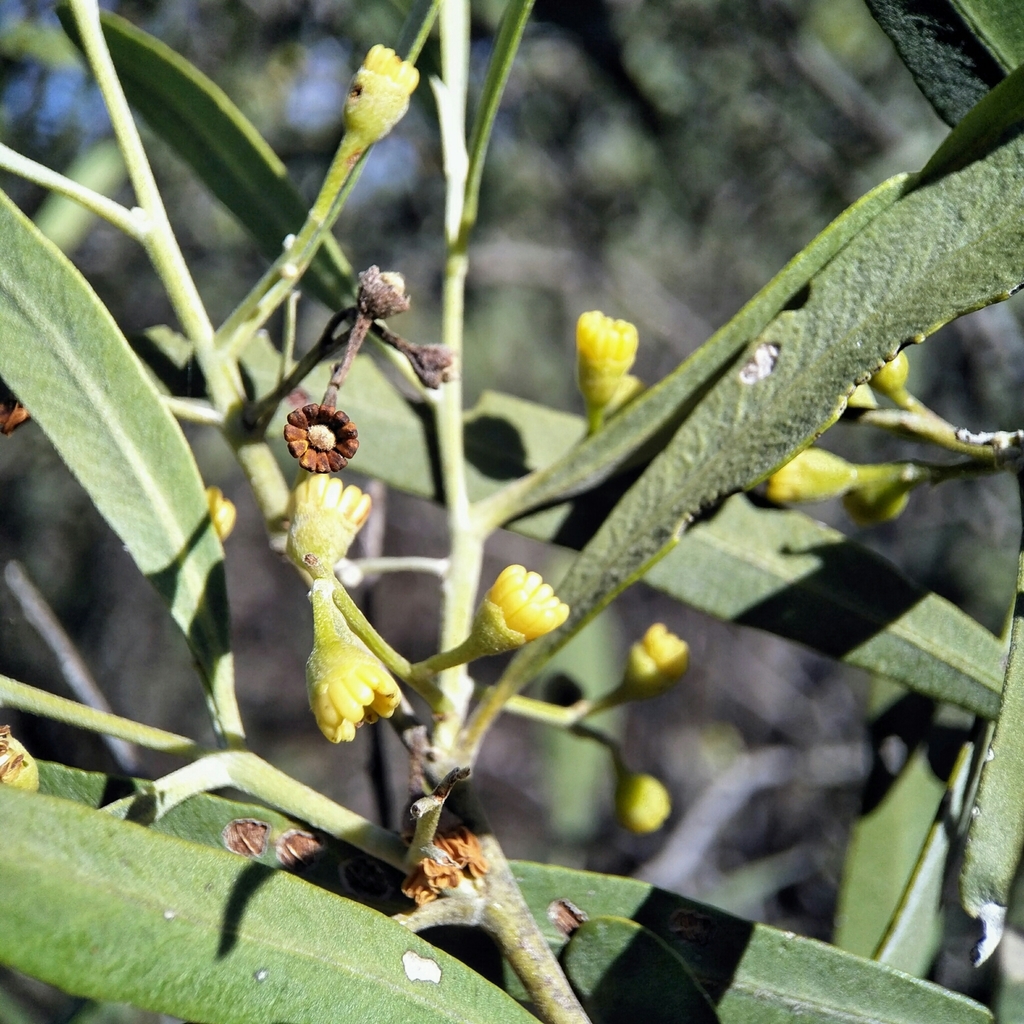
Cattle Bush
Alectryon oleifolius
Alectryon oleifolius, commonly known as boonaree, inland rosewood or bullock bush (South Australia), is a species of small tree of the soapberry family Sapindaceae, native to Australia.
From the article Alectryon oleifolius on Wikipedia (CC BY-SA), quoted section by section
Description
Alectryon oleifolius grows as a large shrub to medium-size tree to 9 m (30 ft) high, with drooping branches. The trunk has deeply furrowed grey to brown bark. The stiff long narrow leaves are greyish green and measure 3.5–14 cm long and 0.6–1.2 mm wide.
Range & habitat
The range is across all states of inland Australia. In New South Wales it is found throughout the dryer parts of interior and west of the state, most commonly on sandy soils with limestone associated with belah (Casuarina cristata).
Wikipedia: “Distribution and habitat”
What it does
Alectryon oleifolius sheds leaves, more commonly over the summer months. Although palatable and formerly lopped for drought fodder, Alectryon oleifolius is toxic to livestock (particularly ruminants), as it contains cyanogenic glycosides which are converted to hydrogen cyanide when digested. Poisoning is much more likely to occur with starving stock, and when new growth is consumed. At other times, the foliage has been eaten without ill-effects. Some populations of Alectryon oleifolius reproduce by suckering, forming small stands of clonal plants.
== References ==
Wikipedia: “Ecology and toxicity”
Where it lives
Recorded sightings
—
geo-referenced records in GBIF, from museums, herbaria and field observers.
Drag the globe to turn it. Dots are where records exist, not a range map; darker means more records.
In the stacks
Searching the stacks…
Every page naming Alectryon oleifolius in the Biodiversity Heritage Library →
This page is assembled live from iNaturalist, GBIF, Wikipedia, the Source Library and the Internet Archive. It is not yet part of the hand-edited codex. iNaturalist taxon 783975.