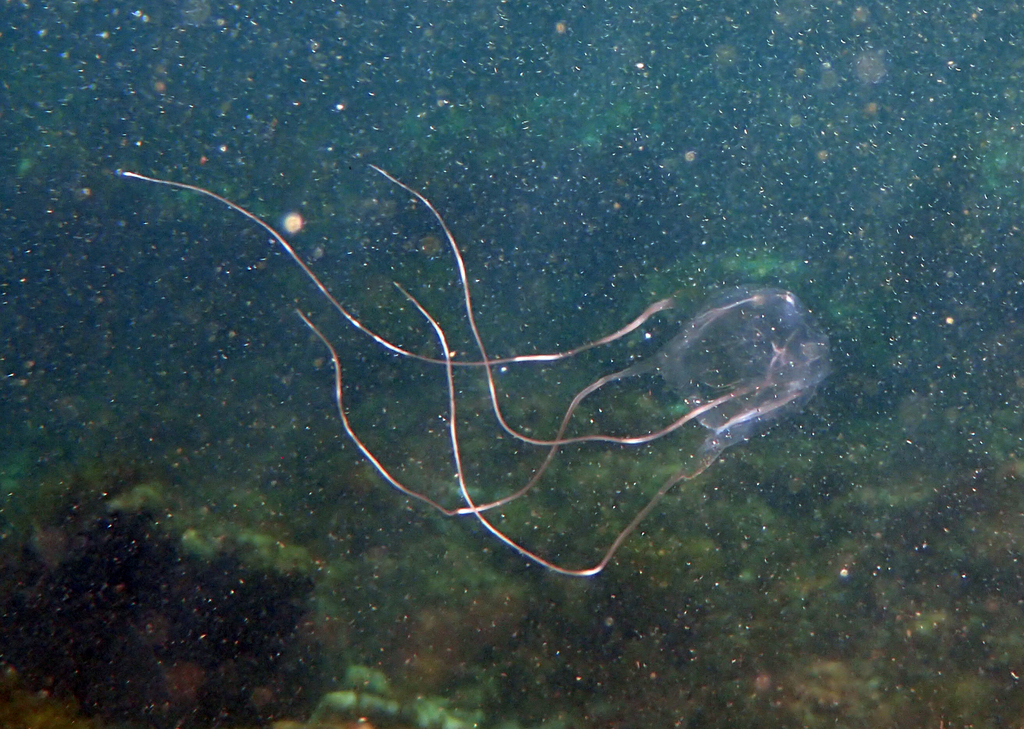
Carybdea brevipedalia
Carybdea brevipedalia are a species of box jellyfish, originally found within the coastal waters of Japan, where it is one of the most common Cubozoans. This organism can be located off the islands of Hokkaido, Honshu, Shikoku, and Kyushu. Their distribution has recently expanded to Korean coastal waters.
C. brevipedalia was given the common name "Andon-Kurage" in Japan, as their body figure resembles a Japanese lamp structure. They are nocturnal predators known for their active swimming behavior, helping distinguish it from other box jellyfish. These species are active predators in the waters they reside in, using their highly toxic venom to capture prey. This predatory behavior reflects their role within marine ecosystems, influencing trophic dynamic and distribution of populations.
From the article Carybdea brevipedalia on Wikipedia (CC BY-SA), quoted section by section
Range & habitat
C. brevipedalia can primarily be found in shallow tropical waters around 3m deep, at preferred temperatures around 25 °C. They commonly gravitate towards sand and small rocks, for desired environmental conditions, prey availability, and protection. The presence of this species can fluctuate based on their environment's salinity levels. Consistent with other Cubozoans, Carybdea brevipedalia are most active during warm summer months, under salinity conditions that range from 26 to 28 PSU. Salinities dropping below 20 can lead to impaired movement and weakened activity for all jellyfish.
Wikipedia: “Habitat”
What it does
Carybdea brevipedalia belong to the Phylum Cnidaria, which are known for their uniquely diverse life cycle. They are a part of the class Cubozoa, characterized by their cube/bell shaped body structure. Their order, Carybdeida and family, Carybdeidae are notorious for their aggressive predatory behavior and advanced locomotion. This species belongs to the phylum Cnidaria, acquiring its name from a defining feature of its tentacles, cnidae. C. brevipedalia sustain a metagenic life cycle, consisting of an asexual polyp stage and sexual reproducing medusa. This process is initiated when fertilized eggs attach to benthic substrates. They tend to favor hard surfaces such as rocks or shells, which offer stability during polyp formation. On these surfaces where larvae transform into polyps, they reproduce asexually through budding. As they progress through their life cycle, polyps develop into medusae. Medusae are able to expand their distribution through their mobility, which is not observed in earlier life stages.
Wikipedia: “Taxonomy and life cycle”
Where it lives
Recorded sightings
—
geo-referenced records in GBIF, from museums, herbaria and field observers.
Drag the globe to turn it. Dots are where records exist, not a range map; darker means more records.
In the stacks
Searching the stacks…
Every page naming Carybdea brevipedalia in the Biodiversity Heritage Library →
This page is assembled live from iNaturalist, GBIF, Wikipedia, the Source Library and the Internet Archive. It is not yet part of the hand-edited codex. iNaturalist taxon 784488.