- Plants
- ›Vascular Plants
- ›flowering plants
- ›Dicots
- ›borages
- ›borage family
- ›baby blue eyes, Phacelias, and waterleaves
- ›Phacelia
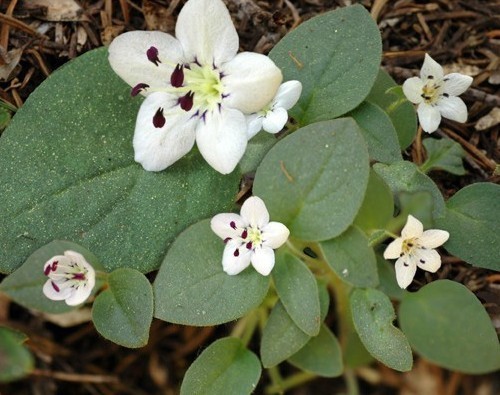
scott mountain phacelia
Phacelia dalesiana
Howellanthus is a monotypic genus of flowering plants in the borage family containing the single species Howellanthus dalesianus, commonly known as Scott Mountain phacelia or Howell's phacelia. Until 2010 the plant was known as Phacelia dalesiana. It is endemic to the southern Klamath Mountains of northern California, including the Scott Mountains for which it is named. It grows in mountain forests and meadows.
From the article Phacelia dalesiana on Wikipedia (CC BY-SA), quoted section by section
Description
Phacelia dalesiana is a perennial herb producing a few decumbent stems up to about 15 centimeters long, forming a patch on the ground. It is glandular and hairy in texture. The leaves are located in a rosette, with a few smaller ones along the stems. They are oval and smooth-edged. The inflorescence is a small curving cluster of flowers each just under a centimeter wide. The flower is white with small purple streaks at the throat. There are five protruding stamens tipped with large purple anthers. It blooms between May and August, the timing dependent on snowmelt.
Range & habitat
It is endemic to the southern Klamath Mountains of northern California, including the Scott Mountains for which it is named. It grows in mountain forests and meadows often on serpentine soils. The plant is a paleoendemic, its morphology unique among the phacelias, and probably a relict persisting in areas of ultramafic rock substrate in a small section of the Siskiyou-Trinity Mountains.
Wikipedia: “Distribution and habitat”
Where it lives
Recorded sightings
—
geo-referenced records in GBIF, from museums, herbaria and field observers.
Drag the globe to turn it. Dots are where records exist, not a range map; darker means more records.
In the stacks
Searching the stacks…
Every page naming Phacelia dalesiana in the Biodiversity Heritage Library →
This page is assembled live from iNaturalist, GBIF, Wikipedia, the Source Library and the Internet Archive. It is not yet part of the hand-edited codex. iNaturalist taxon 78479.