- Plants
- ›Vascular Plants
- ›flowering plants
- ›Dicots
- ›Heathers, Balsams, Primroses, and Allies
- ›heath family
- ›typical heathers, azaleas, and allies
- ›Phyllodoceae
- ›Phyllodoce
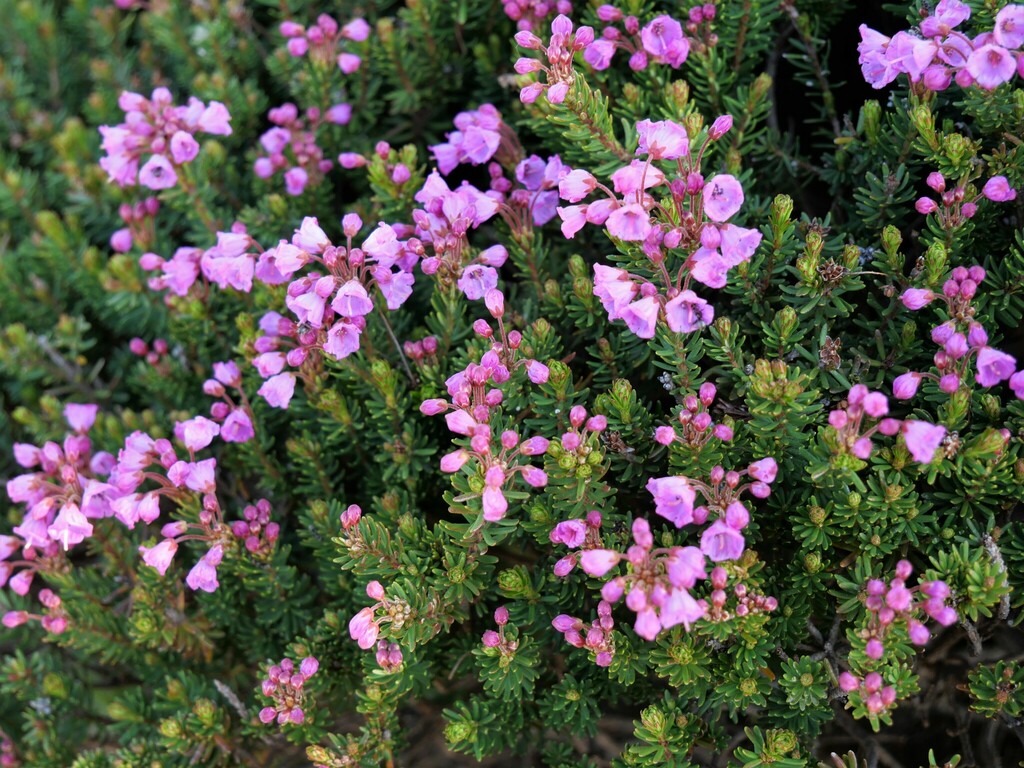
pink mountainheath
Phyllodoce empetriformis
Phyllodoce empetriformis, also known by the common name pink mountain heather, is a flowering plant species in the family Ericaceae which is found in alpine environments in the Rocky Mountains of the Northwestern United States and Western Canada. It is a low matting shrub with distinctive, needle-like evergreen leaves and gets its name from its attractive bell-shaped flowers in shades of red, pink, and purple.
P. empetriformis is one of the parents of the artificial hybrid × Phyllothamnus erectus, the other being Rhodothamnus chamaecistus.
From the article Phyllodoce empetriformis on Wikipedia (CC BY-SA), quoted section by section
Description
This common evergreen alpine shrub bears a red-purple flower clustered at the end of the stem. The flowers of Phyllodoce empetriformis can grow in clusters of many to as little as one. The leaves alternate on the stem and roll under themselves so tightly they resemble pine needles. It is a fairly short shrub that grows from 10–40 cm tall. The dwarf shrub can survive in subalpine to alpine regions because of its ability to minimize water loss through evaporation. It thrives under heavy snow cover which then waters the plant in the summer when the snow melts.
Where it lives
Recorded sightings
—
geo-referenced records in GBIF, from museums, herbaria and field observers.
Drag the globe to turn it. Dots are where records exist, not a range map; darker means more records.
In the stacks
Searching the stacks…
Every page naming Phyllodoce empetriformis in the Biodiversity Heritage Library →
This page is assembled live from iNaturalist, GBIF, Wikipedia, the Source Library and the Internet Archive. It is not yet part of the hand-edited codex. iNaturalist taxon 78560.