- Plants
- ›Vascular Plants
- ›flowering plants
- ›Dicots
- ›Soapberries, Cashews, Mahoganies, and Allies
- ›Torchwoods
- ›Canarium
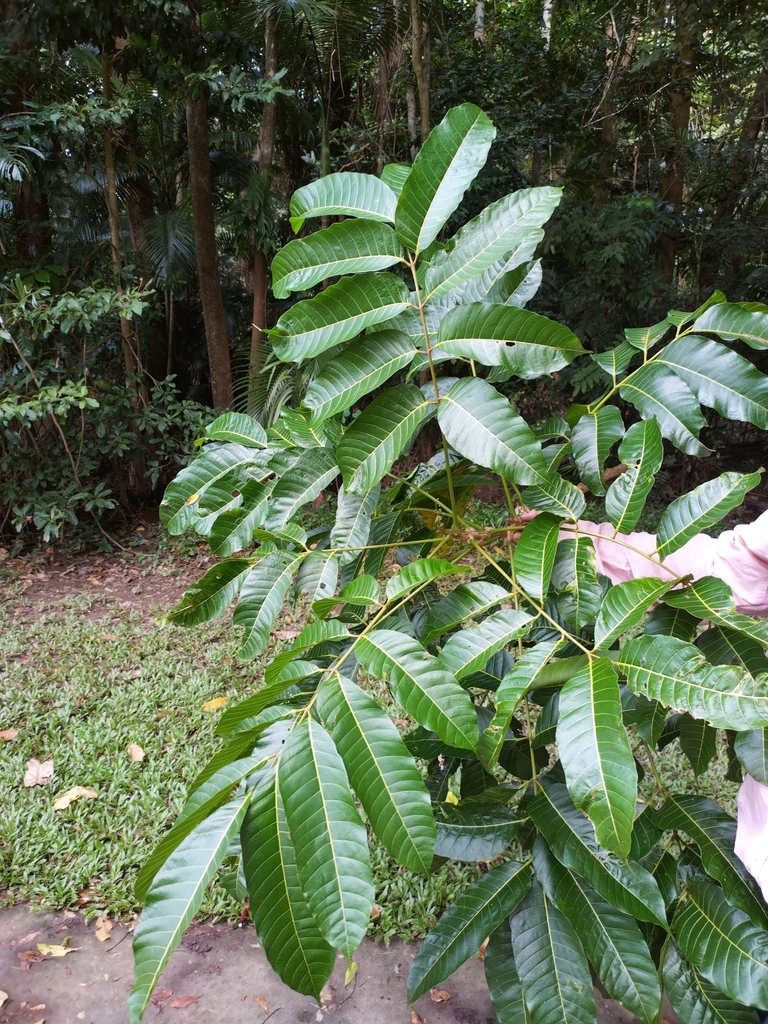
Canarium acutifolium
Canarium acutifolium is a species of plant in the family Burseraceae, native to eastern Malesia, Papuasia and Queensland.
From the article Canarium acutifolium on Wikipedia (CC BY-SA), quoted section by section
Description
It is a large tree up 40 m high and a trunk diameter of up to 70 cm. The bark is grey or brown with lenticels arranged vertically. The large compound leaves, which may reach 60 cm in length (including the petiole), are arranged spirally on the branches. They have 4–6 pairs of leaflets plus a terminal leaflet. The petiole is swollen at the base and there are two quite large, linear stipules about 2 cm long which are shed after a short time. The leaflets are glossy dark green above and dull green below; they are held on petiolules about 5–15 mm long (45 mm for the terminal leaflet) with pulvini at both ends. The leaflets measure up to 30 cm long and 12 cm wide and have between 15 and 17 pairs of lateral veins. The veins are pale yellow or cream, a striking contrast against the dark green of the blade, and are raised on both the upper and lower surfaces. This species is dioecious, meaning that male and female flowers are borne on separate plants. The inflorescences are panicles produced in the leaf axils. Flowers are very small with three pale petals about 3 mm long. The fruit is a blue ellipsoid drupe about 15 mm long containing a single seed.
Where it lives
Recorded sightings
—
geo-referenced records in GBIF, from museums, herbaria and field observers.
Drag the globe to turn it. Dots are where records exist, not a range map; darker means more records.
In the stacks
Searching the stacks…
Every page naming Canarium acutifolium in the Biodiversity Heritage Library →
This page is assembled live from iNaturalist, GBIF, Wikipedia, the Source Library and the Internet Archive. It is not yet part of the hand-edited codex. iNaturalist taxon 786090.