- Plants
- ›Vascular Plants
- ›flowering plants
- ›Dicots
- ›Mints, Plantains, Olives, and Allies
- ›Plantain Family
- ›Plantagineae
- ›Plantago
- ›Albicans
- ›Gnaphaloides
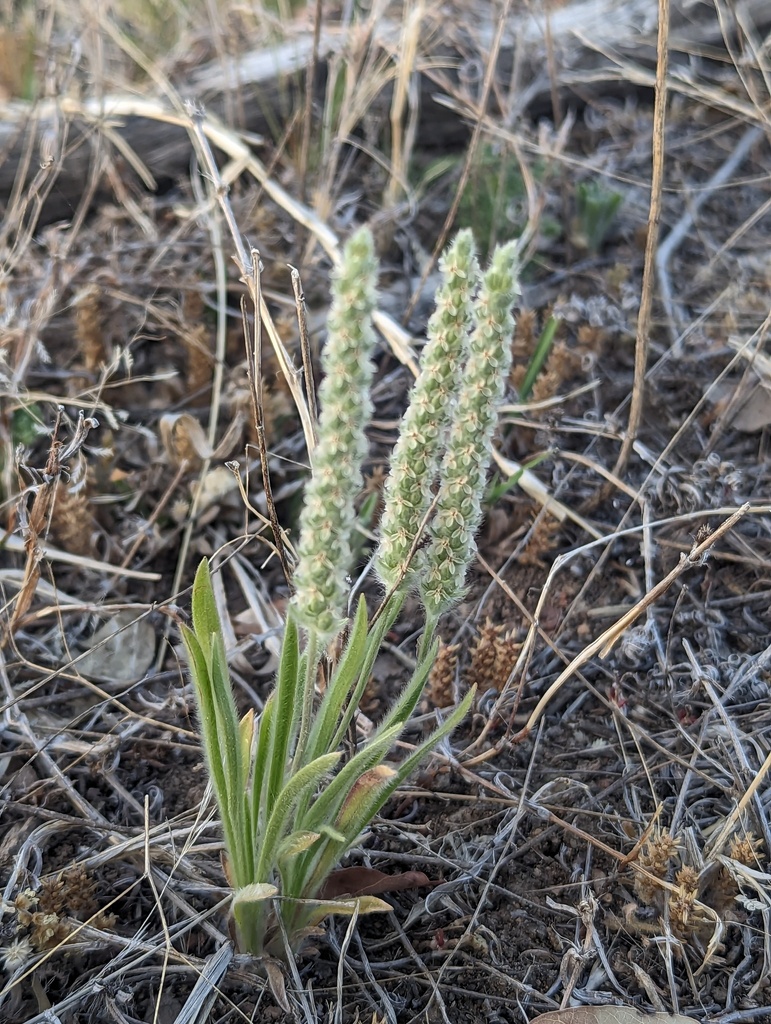
Woolly Plantain
Plantago patagonica
Plantago patagonica is a species of plantain known by the common name woolly plantain. It is native to much of North America, including the southern half of Canada, the western and central United States, and northern Mexico, and parts of southern South America. It grows in many types of habitat, including grassland and woodlands. It is a hairy annual herb producing linear or very narrowly lance-shaped basal leaves up to 10 centimeters long. There are usually...
From the article Plantago patagonica on Wikipedia (CC BY-SA), quoted section by section
Description
Woolly plantain is a small plant with a thin taproot and usually covered in woolly hairs. It can be an annual, a winter annual, a biennial, and might rarely grow as a short-lived perennial. They can have simple crown or a caudex with as many as four branches, each producing a rosette of narrow leaves. It can have a very short true stem up to 4 centimeters (1.6 in) long, but can also lack one. Almost all the leaves are basal, with the winter rosette leaves just 0.3 to 3 cm long. The later, principal leaves are linear-oblanceolate, a narrow and almost grass-like reversed spear head. Each typically measuring 2 to 15 centimeters (1–6 in) long, though rarely reaching 20 cm (8 in). They are just 0.5–7 millimeters wide, though sometimes as much as 15 mm. Leaf tips are sharply pointed to long and drawn out and the leaf may have one to three noticeable veins. When flowering each plant grows 1 to 20 inflorescences that are spikes, the flowers being attached directly to the main stem rather than by a peduncle. Each spike is atop a scape, a leafless flower stem, 4 to 24 centimeters (1.6–9.4 in) tall, but occasionally just 1 cm or as much as 26 cm. The spikes are densely packed with tiny flowers and 1 to 15 cm (0.5–6 in) long, though typically 5 to 10 cm (2–4 in). …
Range & habitat
In the northern hemisphere woolly plantain is native to western Canada, most of the contiguous United States, and northern Mexico. In South America it is native to much of Argentina. It is not found in the tropical areas of the Americas between these two highly disjunct populations. It has been found in Kentucky, but is not thought to be native to the state and has also been found growing in both Germany and Italy. In Canada it grows in the four western provinces of Manitoba, Saskatchewan, Alberta, and British Columbia. In US it is native to all the contiguous states except for Alabama, Mississippi, Florida, Kentucky, Maryland, Delaware, Pennsylvania, and Connecticut. In Mexico it is found in the northern states of Baja California, Sonora, Chihuahua, Coahuila, and Nuevo León.
Wikipedia: “Range and habitat”
Where it lives
Recorded sightings
—
geo-referenced records in GBIF, from museums, herbaria and field observers.
Drag the globe to turn it. Dots are where records exist, not a range map; darker means more records.
In the stacks
Searching the stacks…
Every page naming Plantago patagonica in the Biodiversity Heritage Library →
This page is assembled live from iNaturalist, GBIF, Wikipedia, the Source Library and the Internet Archive. It is not yet part of the hand-edited codex. iNaturalist taxon 78618.