- Plants
- ›Vascular Plants
- ›flowering plants
- ›monocots
- ›grasses, sedges, cattails, and allies
- ›grasses
- ›Pooideae
- ›Poeae
- ›bluegrasses, timothies, foxtails, and allies
- ›Poa
- ›Stenopoa
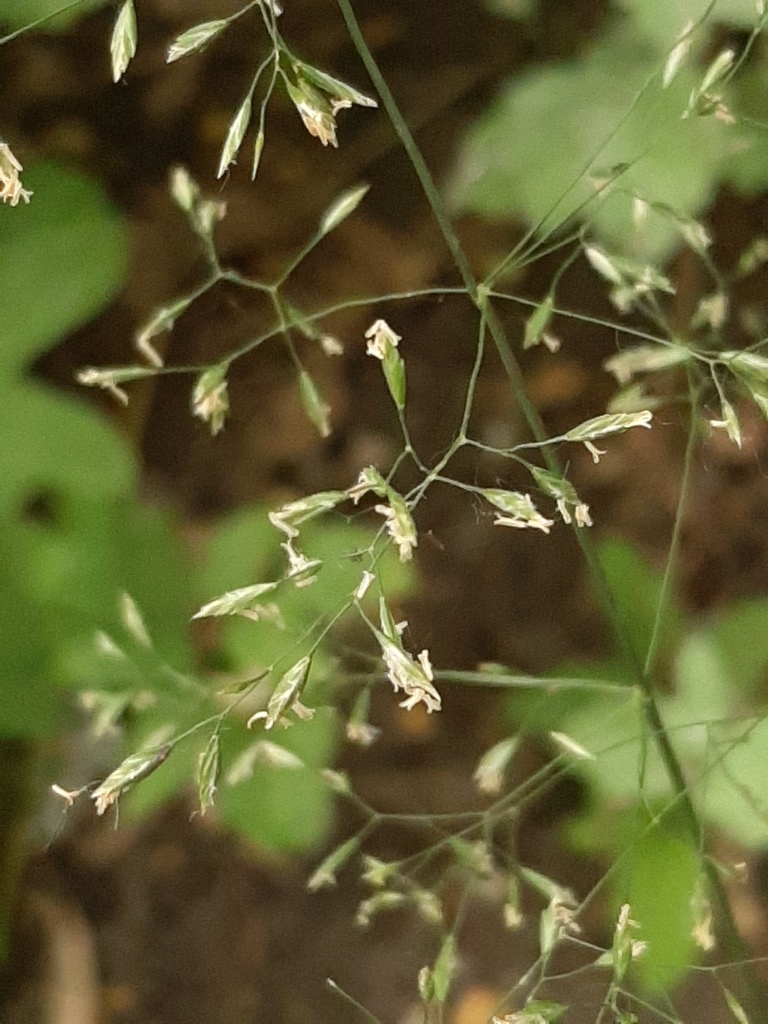
Wood Meadow-grass
Poa nemoralis
Poa nemoralis, the wood bluegrass, is a perennial plant in the family Poaceae. The late-growing grass is fairly nutritious for livestock, which feed on it in the autumn, and it is used as a lawn grass for shady situations.
From the article Poa nemoralis on Wikipedia (CC BY-SA), quoted section by section
Description
It forms loose tufts, and is of a more delicate, slender appearance than other meadow grasses. It is slightly creeping. The leaves are narrow, tapering to a point. The ligules are short (0.5 mm). The stem is slender, 30–60 cm (12–24 in) high. The panicle is slender, loose and branched. The spikelets are few and egg-shaped. They have one to five flowers. This grass is in flower from June to August in the Northern Hemisphere. It can produce asexual seeds by means of apomixis and can also reproduce vegetatively. Because of the characteristic lamina, similar to a stretched out arm, it is sometimes called "Wegweisergras" (signpost grass) in Germany.
Range & habitat
Wood bluegrass is native to Europe, where its range extends from Portugal to Bulgaria, and Asia where its range extends from Iran to Japan. It has been introduced in Australia and New Zealand, and to North America where it has become naturalised in southeastern Canada and northeastern United States. Shade tolerant, it is often found in forests and grows up to half a metre tall. It is generally distributed in Britain in dry woods, thickets and shady hedge banks on well drained soils. In its invasive range in America, it sometimes grows in coniferous forests, where its presence is thought to increase the risk of fires, and on floodplains, the banks of rivers and lakes, and disturbed sites. In the British Isles, it is found throughout the United Kingdom but at more scattered locations in Ireland, where it may have been introduced.
Wikipedia: “Distribution and habitat”
Where it lives
Recorded sightings
—
geo-referenced records in GBIF, from museums, herbaria and field observers.
Drag the globe to turn it. Dots are where records exist, not a range map; darker means more records.
In the stacks
Searching the stacks…
Every page naming Poa nemoralis in the Biodiversity Heritage Library →
This page is assembled live from iNaturalist, GBIF, Wikipedia, the Source Library and the Internet Archive. It is not yet part of the hand-edited codex. iNaturalist taxon 78649.