- Plants
- ›Vascular Plants
- ›flowering plants
- ›monocots
- ›Aroids, Water Plantains, Seagrass, and allies
- ›pondweed family
- ›Potamogeton
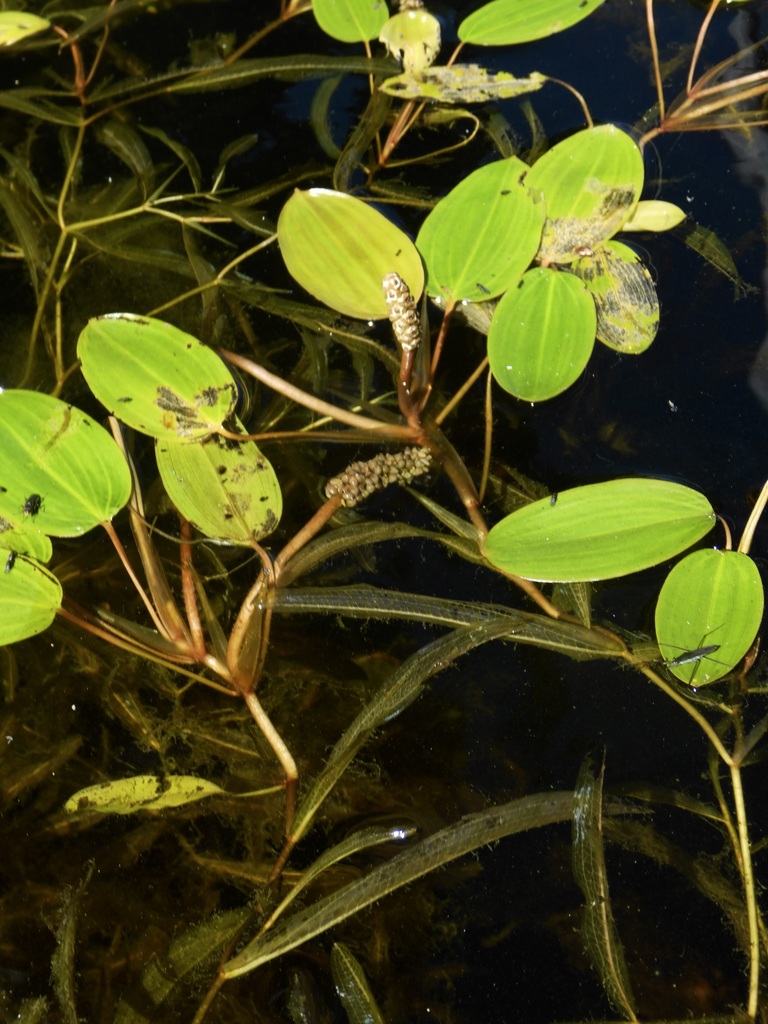
grass-leaved pondweed
Potamogeton gramineus
Potamogeton gramineus is a species of aquatic plant known by the common name various-leaved pondweed, variableleaf pondweed, grass-leaved pondweed or grassy pondweed, native to the northern hemisphere where it grows in shallow, clean water.
From the article Potamogeton gramineus on Wikipedia (CC BY-SA), quoted section by section
Description
This is an aquatic perennial growing from a creeping rhizome that anchors in wet substrate. It produces thin, cylindrical, heavily branching stems usually less than a metre in length. The submerged leaves are sessile, relatively narrow, typically 40–90 mm long and 5–12 mm wide along the main stem but smaller on the side branches. They are translucent and pale green with a white midrib, and finely toothed. Floating leaves are more oval in shape, 20–70 mm long by 7–34 mm wide, and borne on long petioles. The inflorescence is a short spike of many flowers arising from the water on a stout peduncle. This species readily hybridizes with many other species of Potamogeton. Hybrids have been recorded with P. perfoliatus (P. × nitens Weber), P. lucens (P. × angustifolius J.Presl.), P. natans (P. × sparganiifolius Laest. ex Fr.), P. coloratus (P. × billupsii Fryer), P. maackianus (P. × biwaensis Miki), P. illinoensis (P. × spathuliformis (J.W.Robbins) Morong), P. richardsonii (P. × hagstromii A.Benn.), P. alpinus (P. × nericius Hagstr.), P. nodosus (P. × lanceolatifolius (Tiselius) C.D.Preston), P. oakesianus (P. × mirabilis Z.Kaplan, Hellq. & Fehrer) and P. polygonifolius. In Britain, P. x nitens and P. x angustifolius are quite common. Recent molecular analysis has shown that Swedish collections of the putative hybrid P. gramineus x P. polygonifolius are in fact P. gramineus x P. …
Range & habitat
Potamogeton gramineus is native to much of the Northern Hemisphere, with a Holarctic distribution. It occurs in northern Europe (Britain, Ireland, Iceland, Scandinavia, Germany, Switzerland, France, Poland, Russia, the Baltic States), Greenland, North America (US except for the southeast, Canada). There are outlying populations in southern Europe (Iberia, Corsica, Italy), Caucasus, Pyrenees, and western US.
Wikipedia: “Distribution”
What it does
Various-leaved pondweed grows in various water body types including ponds, lakes, bogs, ditches and streams. It is usually restricted to shallower water <1 m deep, though it has been recorded growing at more than 5 m depth in very clear, oligotrophic water in Llynnau Cregennen, Wales. It is intolerant of nutrient pollution and is not usually found in base-poor water of alkalinity less than about 200 μEq/L. The roots penetrate to a depth of about 10 cm. In Michigan streams, P. gramineus is restricted to riffles with warmer interstitial temperatures. Grazing by waterfowl can have a significant effect on various-leaved pondweed. In Sentiz Lake (Leon, Spain), P. gramineus was sparse and the dominant plants were Ceratophyllum demersum and Myriophyllum spicatum. However, within experimental cages from which waterfowl were excluded, P. gramineus became co-dominant and developed both flowers and floating leaves. In Britain, it has shown the same pattern of decline as other broad-leaved pondweeds such as P. praelongus and P. alpinus, with most losses occurring in southern Britain, and is now classed as near threatened in England. This likely reflects increasing eutrophication, canalization of rivers leading to loss of backwater habitats and other floodplain standing waters, and degradation or loss of pond and lake habitats. P. …
Wikipedia: “Ecology and conservation”
How it is grown
Potamogeton gramineus is not in general cultivation, though it is an attractive plant and grows well in a garden pond or barrel. Its slower growth than most submerged species, attractive leaves and habit of producing a limited number of floating leaves make it very ornamental and suitable for garden ponds, and its smaller size than many other pondweeds is also a benefit. In common with other pondweeds of this group it roots poorly from stem cuttings and is best propagated by division of the rhizomes.
Wikipedia: “Cultivation”
Where it lives
Recorded sightings
—
geo-referenced records in GBIF, from museums, herbaria and field observers.
Drag the globe to turn it. Dots are where records exist, not a range map; darker means more records.
In the stacks
Searching the stacks…
Every page naming Potamogeton gramineus in the Biodiversity Heritage Library →
This page is assembled live from iNaturalist, GBIF, Wikipedia, the Source Library and the Internet Archive. It is not yet part of the hand-edited codex. iNaturalist taxon 78710.