Boquila
Boquila is a genus of flowering plants in the family Lardizabalaceae, endemic to temperate forests of central and southern Chile and Argentina. It is monotypic, being represented by the single species Boquila trifoliolata, locally known as voqui blanco or pilpil in its native range, or the chameleon vine since a 2014 report on leaf mimicry. The species was first described in 1782 by Juan Ignacio Molina, and the genus was established in 1839 by Joseph Decaisne. B. trifoliolata forms non-parasitic vines that wind around host plants, using them for structure and protection. B. trifoliolata is monoecious, a sexual system in seed plants where separate male and female cones or flowers are present on the same plant. Its flowers are off-white and it bears an edible fruit. The vine has been historically used in rope and basket making.
Boquila trifoliolata is the only known plant species that engages in mimetic polymorphism, or the ability to mimic multiple host species, often simultaneously. This is a form of Batesian mimicry, when a harmless species mimics a harmful one to ward off predators. Contact between the vines and host trees was reported not to be necessary for mimicking to commence. However, in the decade following the original study describing the species mimicry capabilities in 2014, no independent research groups have verified the field observations. The mechanism by which this mimicry occurs is still unknown.
1 branches of this genus, most-observed first
See this branch on the Wheel of Life →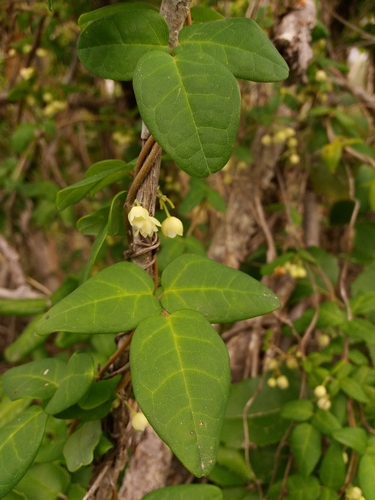
Where it lives
Recorded sightings
—
geo-referenced records in GBIF, from museums, herbaria and field observers.
Drag the globe to turn it. Dots are where records exist, not a range map; darker means more records.
In the stacks
Searching the stacks…
Every page naming Boquila in the Biodiversity Heritage Library →
This page is assembled live from iNaturalist, GBIF, Wikipedia, the Source Library and the Internet Archive. It is not yet part of the hand-edited codex. iNaturalist taxon 787206.