- Plants
- ›Vascular Plants
- ›flowering plants
- ›Dicots
- ›Legumes, Milkworts, and Allies
- ›Legumes
- ›Faboideae
- ›Dalbergieae
- ›Smithia
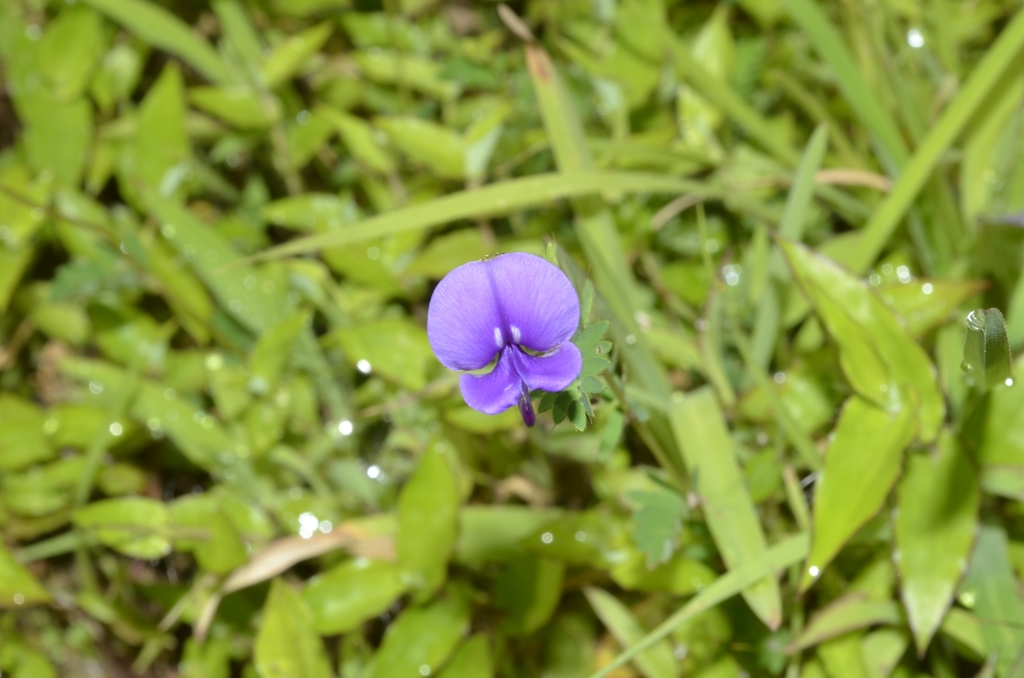
Smithia purpurea
Smithia purpurea is a species of plant in the Fabaceae family.
From the article Smithia purpurea on Wikipedia (CC BY-SA), quoted section by section
Description
A small annual herb with an erect stem that grows to a height of 0.5 to 1 ft (0.15 to 0.30 m) and has spreading branches. Leaves are pinnate, leaflets with a bristle at the tip. Flowers purple, about 1 cm across, occur in racemes of 6-12 flowers. The standard petal has two bright white dots.
Range & habitat
In open moist sunny areas on basaltic outcrops and is abundant on basalt mesas with an elevation of 800 m (2,600 ft) above sea level.
Wikipedia: “Habitat”
What it does
In patches on open plateaux, banks of streamlets, road sides and farm bunds of Ghat regions. More frequently encountered near village environs and disturbed places.
Wikipedia: “Ecology”
In human culture
The genus is named after British botanist and physician Sir James Edward Smith and the specific epithet refers to the purple colour of the flower.
== References ==
Wikipedia: “Etymology”
Where it lives
Recorded sightings
—
geo-referenced records in GBIF, from museums, herbaria and field observers.
Drag the globe to turn it. Dots are where records exist, not a range map; darker means more records.
In the stacks
Searching the stacks…
Every page naming Smithia purpurea in the Biodiversity Heritage Library →
This page is assembled live from iNaturalist, GBIF, Wikipedia, the Source Library and the Internet Archive. It is not yet part of the hand-edited codex. iNaturalist taxon 787367.