- Plants
- ›Vascular Plants
- ›flowering plants
- ›Dicots
- ›Sunflowers, Bellflowers, Fanflowers, and Allies
- ›Sunflowers, Daisies, Asters, and Allies
- ›Asteroideae
- ›tarweeds, silverswords, and allies
- ›Eriophyllinae
- ›Pseudobahia
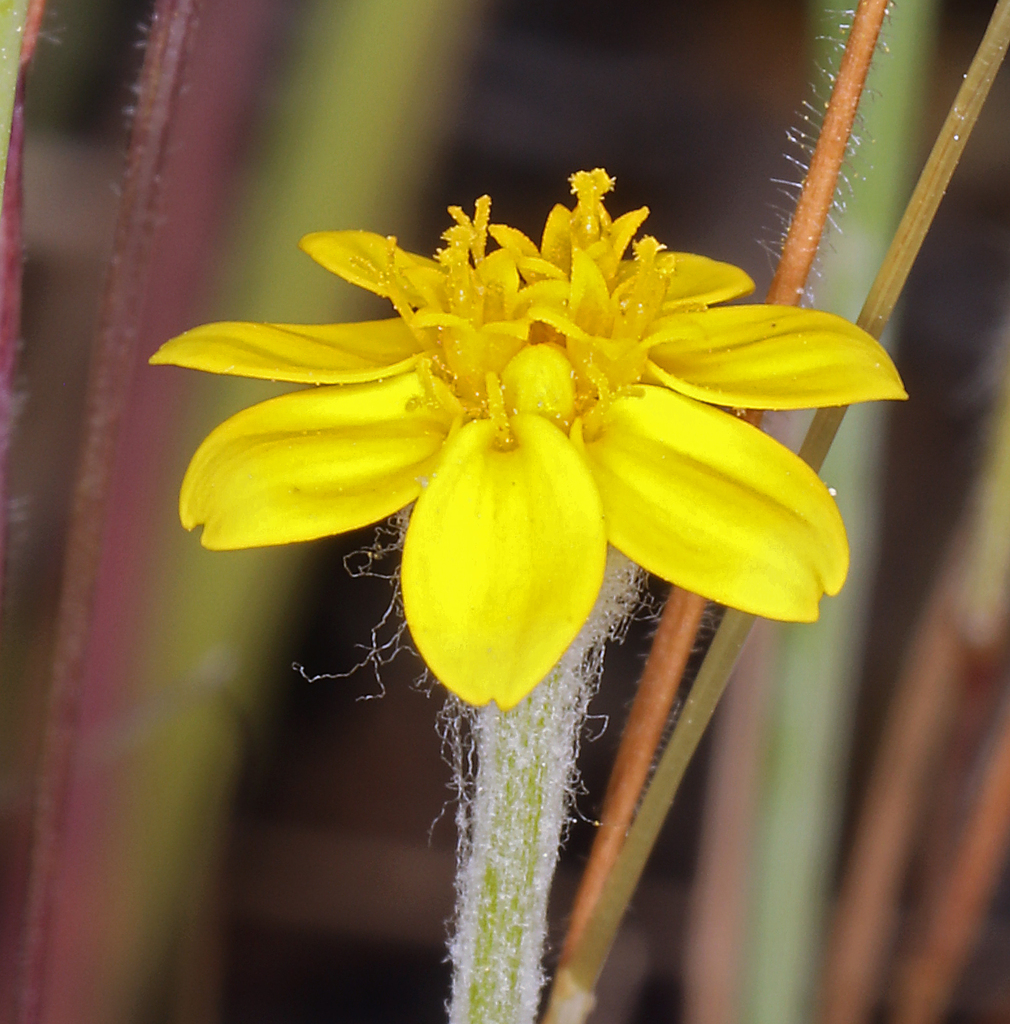
Hartweg's Golden Sunburst
Pseudobahia bahiifolia
Pseudobahia bahiifolia is a rare species of flowering plant in the family Asteraceae known by the common name Hartweg's golden sunburst.
From the article Pseudobahia bahiifolia on Wikipedia (CC BY-SA), quoted section by section
Description
This species, Pseudobahia bahiifolia, is an annual herb growing 5 to 20 centimeters tall. It has a thin coating of woolly hairs. The linear or lance-shaped leaves are up to 2.5 centimeters long and often have three small lobes near the tips. The inflorescence is a solitary sunflowerlike flower head lined with three to eight phyllaries. There is one golden ray floret per phyllary, up to a centimeter in length and sometimes faintly toothed at the tip. At the center of the head are yellow disc florets. The blooming period is 3 to 4 weeks long, occurring in March and April. The fruit is an achene about 2 millimeters long.
Range & habitat
Pseudobahia bahiifolia is endemic to California, where it is known from a few small occurrences along the eastern side of the Central Valley and the lower central Sierra Nevada foothills. It grows in grassland and oak woodland habitat. It prefers heavy clay soils, particularly along the tops of Mima mounds. The plant's native range is on land that has been heavily altered by agriculture, leaving little habitat intact, and the plant became a federally listed endangered species of the United States in 1997.
Wikipedia: “Distribution”
Where it lives
Recorded sightings
—
geo-referenced records in GBIF, from museums, herbaria and field observers.
Drag the globe to turn it. Dots are where records exist, not a range map; darker means more records.
In the stacks
Searching the stacks…
Every page naming Pseudobahia bahiifolia in the Biodiversity Heritage Library →
This page is assembled live from iNaturalist, GBIF, Wikipedia, the Source Library and the Internet Archive. It is not yet part of the hand-edited codex. iNaturalist taxon 78758.