- Plants
- ›Vascular Plants
- ›flowering plants
- ›Dicots
- ›Sunflowers, Bellflowers, Fanflowers, and Allies
- ›Sunflowers, Daisies, Asters, and Allies
- ›Asteroideae
- ›asters and allies
- ›Celmisiinae
- ›Olearia
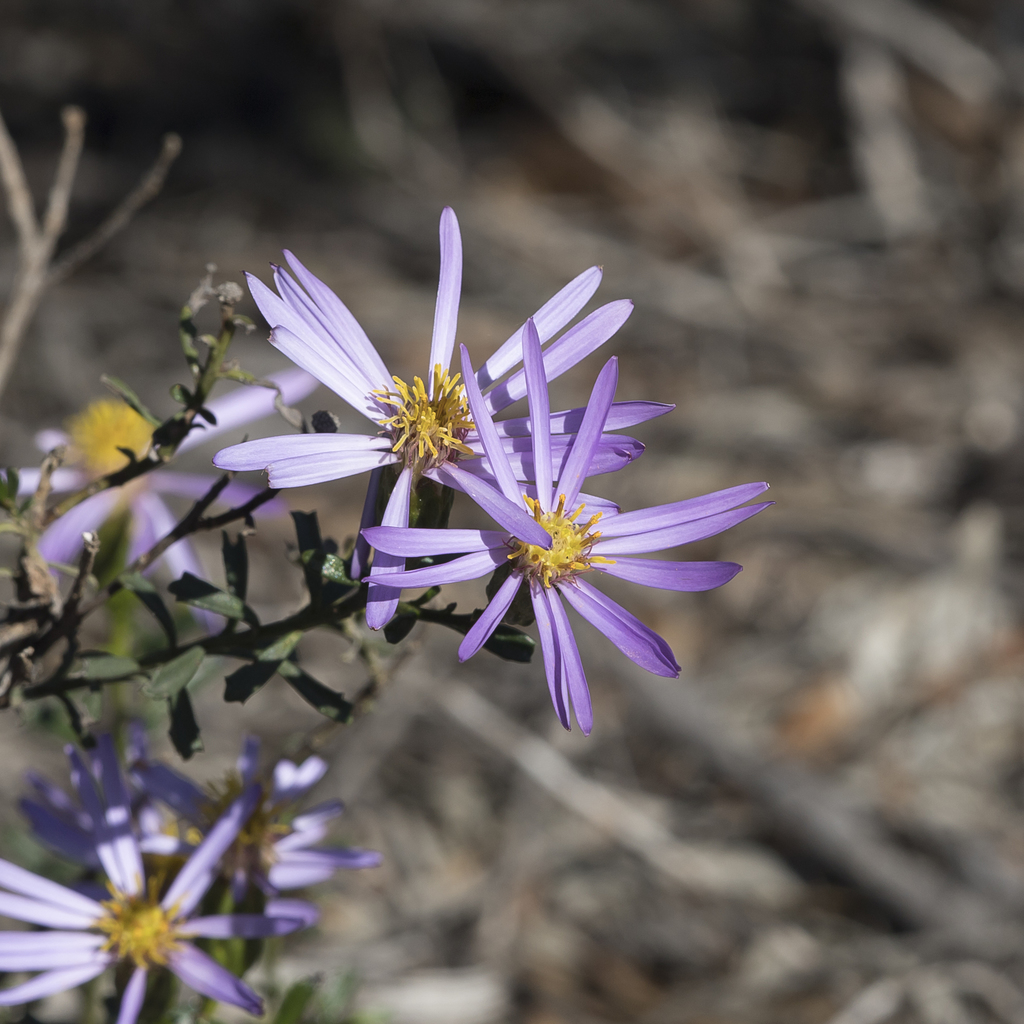
Splendid Daisy-bush
Olearia magniflora
Walsholaria magniflora, commonly known as splendid daisy-bush, is a small shrub with clusters of deep mauve to purple flowers.
From the article Walsholaria magniflora on Wikipedia (CC BY-SA), quoted section by section
Description
Walsholaria magniflora is sprawling upright shrub to 1.5 m (4.9 ft) high with upright stems and an open habit. The branches are smooth and more or less woody. The sessile leaves are dark green above and paler underneath, smooth, slightly sticky and sparsely arranged alternately along the stem. The leaves vary from wedge-shaped or broader at the apex narrowing at the base, 8–18 mm (0.31–0.71 in) long and 2–5 mm (0.079–0.20 in) wide with a prominent mid-vein, usually 3-5 toothed edges at the apex and rolled margins. The single cluster of 14-20 flowers appear at the end of branches on a short stem less than 1 cm (0.39 in) long. The mauve to purple "petals" (strictly ligules of the ray florets) are linear and 18–24 mm (0.71–0.94 in) long. The flower centre is a yellow disk of 30-56 florets. The oval to linear overlapping bracts are arranged in rows of 4-5 and 15–20 mm (0.59–0.79 in) long, smooth and finely fringed. The dry fruit are one-seeded, smooth, compressed needle-shaped, 3–5 mm (0.12–0.20 in) long and with fine longitudinal lines. The seed is dispersed at maturity. Flowers from July to January.
Range & habitat
The splendid daisy-bush grows in New South Wales, Victoria, Western Australia and South Australia. In New South Wales it is found mainly growing from Balranald and Wentworth areas and north to Wilcannia. It grows in heath, woodland and mallee in well-drained, sandy loam soils.
== References ==
Wikipedia: “Distribution and habitat”
Where it lives
Recorded sightings
—
geo-referenced records in GBIF, from museums, herbaria and field observers.
Drag the globe to turn it. Dots are where records exist, not a range map; darker means more records.
In the stacks
Searching the stacks…
Every page naming Olearia magniflora in the Biodiversity Heritage Library →
This page is assembled live from iNaturalist, GBIF, Wikipedia, the Source Library and the Internet Archive. It is not yet part of the hand-edited codex. iNaturalist taxon 787671.