- Plants
- ›Vascular Plants
- ›flowering plants
- ›monocots
- ›lilies, supplejacks, and allies
- ›Herb-Paris, False Hellebores, Trilliums and allies
- ›Parideae
- ›Pseudotrillium
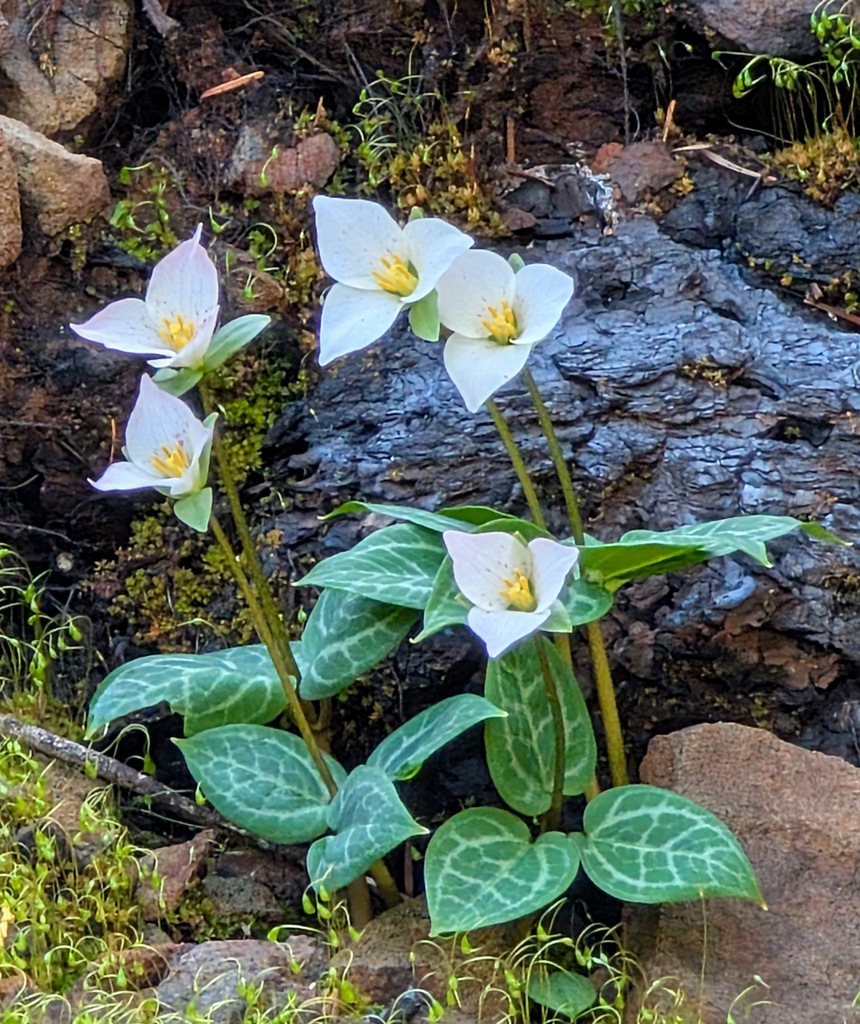
brook wakerobin
Pseudotrillium rivale
Pseudotrillium is a monotypic genus in the bunchflower family Melanthiaceae. Its sole species, the flowering plant Pseudotrillium rivale, is commonly known as the brook wakerobin. It is endemic to the Siskiyou Mountains of southern Oregon and northern California. The Latin specific epithet rivale means "growing by streams", a reference to a preferred habitat.
From the article Pseudotrillium on Wikipedia (CC BY-SA), quoted section by section
Description
Pseudotrillium rivale is a perennial, herbaceous, flowering plant that persists by means of an underground rhizome. In general appearance, it is similar to a Trillium (and at one time, it belonged to that genus). It has a whorl of three bracts (leaves) and a single trimerous flower with three sepals, three petals, two whorls of three stamens each, and three carpels (fused into a single ovary with three stigmas). It differs from Trillium in that it has spotted petals, leathery leaves with a cordate base, and a continuously elongating pedicel. At the onset of anthesis, the pedicel rises above the leaves, but once the flower is pollinated, the pedicel elongates and declines below the leaves. Pseudotrillium rivale grows up to 20 cm (7.9 in) tall. The lance-shaped leaves are up to 11 cm (4.3 in) long with leaf stalks (called petioles) 1 to 3 cm (0.4 to 1.2 in) in length. The leaves are glossy blue-green with conspicuous silvery veins. The plant has a nodding, non-fragrant flower on a pedicel 2.5 to 11 cm (1.0 to 4.3 in) long. The flower has green sepals and pink-blushed white petals up to 3 cm (1.2 in) long and 2 cm (0.8 in) wide.
Range & habitat
Pseudotrillium rivale is endemic to the Siskiyou Mountains of southern Oregon (Josephine, Coos, Douglas, and Curry counties) and northern California (Siskiyou and Del Norte counties), usually on soils of ultramafic origin, such as serpentine. California plants, growing in a dense damp woods, are larger than Oregon plants in all respects with a strong tendency to produce colored flowers. In contrast, Oregon plants found in dry open woods are tiny plants with freckled white flowers.
Wikipedia: “Distribution”
What it does
Pseudotrillium rivale flowers April to June, with northern California plants flowering somewhat later than those in Oregon. At higher elevations, the onset of flowering may be delayed until early May. After flowering, the entire plant may enlarge and become more robust and turgid with very glossy leaves. Initially the pedicel is of moderate length but it soon begins to lengthen and twist in a most unusual way. If fertilization is successful, the pedicel arches downward so that the fruit comes in contact with the soil. By mid-July, the entire plant withers and goes dormant.
Wikipedia: “Ecology”
At the table
Under its former name, Trillium rivale, this plant has gained the Royal Horticultural Society's Award of Garden Merit. Hardy down to −10 °C (14 °F), it requires a sheltered position in partial or full shade.
Wikipedia: “Uses”
Where it lives
Recorded sightings
—
geo-referenced records in GBIF, from museums, herbaria and field observers.
Drag the globe to turn it. Dots are where records exist, not a range map; darker means more records.
In the stacks
Searching the stacks…
Every page naming Pseudotrillium rivale in the Biodiversity Heritage Library →
This page is assembled live from iNaturalist, GBIF, Wikipedia, the Source Library and the Internet Archive. It is not yet part of the hand-edited codex. iNaturalist taxon 78769.