- Plants
- ›Vascular Plants
- ›flowering plants
- ›Dicots
- ›Mints, Plantains, Olives, and Allies
- ›figwort family
- ›Myoporeae
- ›Myoporum
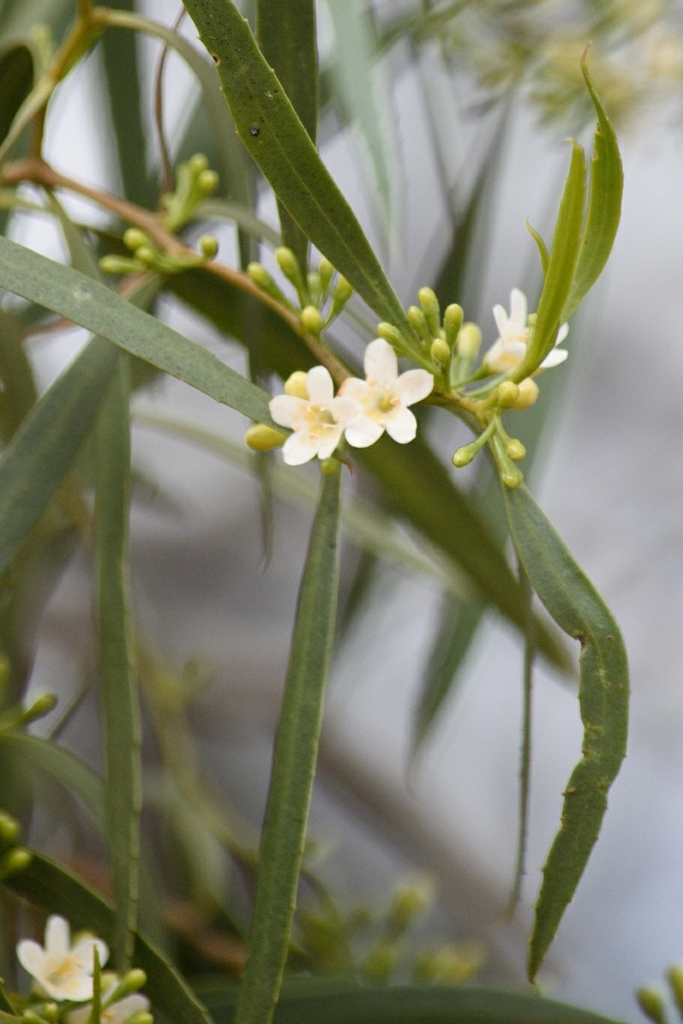
Sugarwood
Myoporum platycarpum
Myoporum platycarpum, known by a several common names including sugarwood, false sandalwood and ngural is a plant in the figwort family, Scrophulariaceae. It is rounded with bright green foliage as a young shrub and roughly fissured, dark grey bark when mature. Sugarwood is endemic to the southern half of continental Australia.
From the article Myoporum platycarpum on Wikipedia (CC BY-SA), quoted section by section
Description
Sugarwood is a rounded shrub or small tree growing to a height of 10 m (30 ft) with foliage and branches that are glabrous but often covered with small raised, wart-like tubercles. The bark on mature specimens is rough, dark grey, flaky bark. Its leaves are arranged alternately and are usually 37–72 mm (1–3 in) long, 4–9 mm (0.2–0.4 in) wide, linear to elliptic in shape and usually have small teeth or serrations in the outer half. The leaves are often curved or have a hook on the end and both surfaces are deep green in colour. The flowers are borne in groups of about 5 to 8 (sometimes more or fewer) on a stalk 3.8–7.2 mm (0.1–0.3 in) long. The flowers have five triangular sepals and five petals, joined at their bases to form a tube. The petals are white or very pale pink to purple sometimes spotted orange or yellow. The tube is about 1.9–4 mm (0.07–0.2 in) long and the lobes are spreading, blunt and 1.6–4.8 mm (0.06–0.2 in) long. The inside of the tube and part of the lobes are hairy. There are 4 stamens which extend beyond the petals. The main flowering season is from August to November and the fruits that follow are green and fleshy at first but dry when mature.
Range & habitat
Both subspecies of M. platycarpum occur in inland areas of New South Wales, north-western Victoria and the southern half of South Australia. Only subspecies platycarpum occurs in south-eastern Western Australia and in the far south east of Queensland. It often grows in mallee or Belah woodland.
Wikipedia: “Distribution and habitat”
How it is grown
Sugarwood is a hardy and attractive plant useful for shade, shelter or as a screening plant in drier climates.
Wikipedia: “Horticulture”
Where it lives
Recorded sightings
—
geo-referenced records in GBIF, from museums, herbaria and field observers.
Drag the globe to turn it. Dots are where records exist, not a range map; darker means more records.
In the stacks
Searching the stacks…
Every page naming Myoporum platycarpum in the Biodiversity Heritage Library →
This page is assembled live from iNaturalist, GBIF, Wikipedia, the Source Library and the Internet Archive. It is not yet part of the hand-edited codex. iNaturalist taxon 787861.