- Plants
- ›Vascular Plants
- ›flowering plants
- ›Dicots
- ›beeches, oaks, walnuts, and allies
- ›beech family
- ›Quercus
- ›Quercus
- ›Lobatae
- ›Agrifoliae
- ›Quercus agrifolia
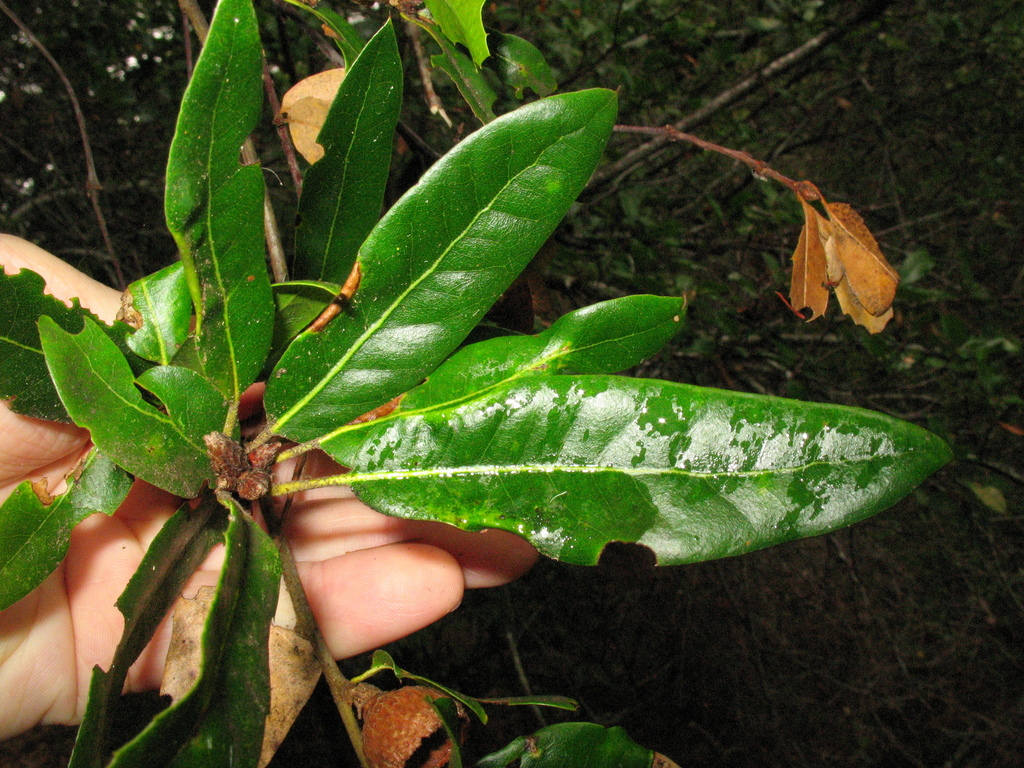
coast oak
Quercus parvula
Quercus parvula, the Santa Cruz Island oak, is an evergreen red oak found on north-facing Santa Cruz Island slopes and in the California Coast Ranges from Santa Barbara County north to Mendocino County. It was taxonomically combined with Quercus wislizeni until resurrected as a separate species by Kevin Nixon in 1980. The type locality of Q. parvula var. shrevei (originally described by C.H. Muller as Q. shrevei) is Palo Colorado Canyon in Monterey County. It is placed in Quercus section Lobatae.
Three varieties of Q. parvula are currently recognized:
From the article Quercus parvula on Wikipedia (CC BY-SA), quoted section by section
What it does
Mainland Q. parvula is commonly found with or near Sequoia sempervirens (coast redwood), and often near Q. agrifolia var. agrifolia (coast live oak) and Notholithocarpus densiflorus (tanoak). Q. parvula differs ecologically from Q. wislizeni in the following ways:
Island or coastal habitat rather than Sierra foothills Associates with Sequoia sempervirens rather than Pinus sabiniana
Hybridization. Quercus parvula is theoretically capable of hybridizing with all of the other California red oaks except the higher elevation southern California Quercus agrifolia var. oxyadenia (sharpacorn oak) from which it is separated by the Transverse Ranges. However Q. parvula's generally later flowering time (April–May versus February–April for Q. kelloggii, Q. wislizeni and Q. agrifolia) may limit genetic exchange with other Lobatae.
== References ==
Wikipedia: “Ecology”
Where it lives
Recorded sightings
—
geo-referenced records in GBIF, from museums, herbaria and field observers.
Drag the globe to turn it. Dots are where records exist, not a range map; darker means more records.
In the stacks
Searching the stacks…
Every page naming Quercus parvula in the Biodiversity Heritage Library →
This page is assembled live from iNaturalist, GBIF, Wikipedia, the Source Library and the Internet Archive. It is not yet part of the hand-edited codex. iNaturalist taxon 78808.