- Plants
- ›Vascular Plants
- ›flowering plants
- ›Dicots
- ›Roses, Elms, Figs, and Allies
- ›rose family
- ›brambles, roses, strawberries, and allies
- ›rose tribe
- ›Rosa
- ›Rosa
- ›Caninae
- ›Rubigineae
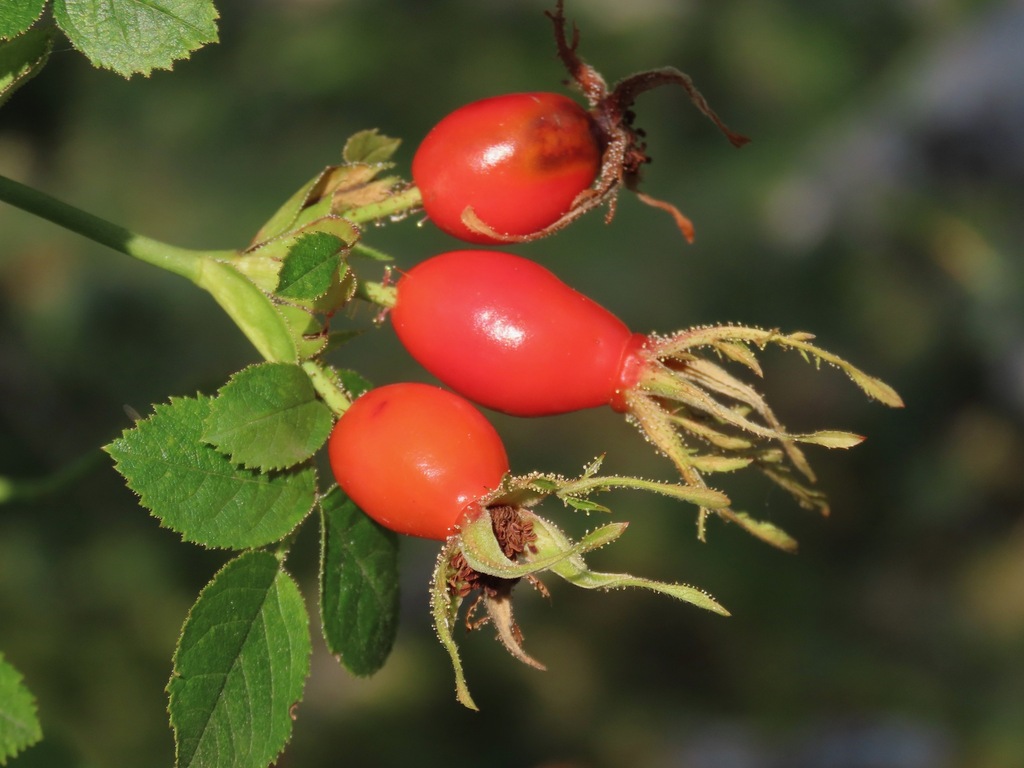
Sweet-brier
Rosa rubiginosa
Rosa rubiginosa (sweet briar, sweetbriar rose, sweet brier or eglantine; syn. R. eglanteria) is a species of rose native to Europe and western Asia.
From the article Rosa rubiginosa on Wikipedia (CC BY-SA), quoted section by section
Description
It is a dense deciduous shrub 2–3 meters (6.6–9.8 ft) high and across, with the stems bearing numerously hooked prickles. The foliage has a strong apple-like fragrance. The leaves are pinnately compound, 5–9 cm (2.0–3.5 in) long, with 5–9 rounded to oval leaflets with a serrated margin, and numerous glandular hairs. The flowers are 1.8–3 cm in diameter, the five petals being pink with a white base, and the numerous stamens yellow; the flowers are produced in clusters of 2–7 together, from late spring to mid-summer. The fruit is a globose to oblong red hip 1–2 cm in diameter.
Range & habitat
Rosa rubiginosa is native to most of Europe with the exception of the extreme north (above 61°N), where it inhabits pastures and thorny bushes from the montane to the subalpine floor, with a sunny, continental climate. It is somewhat rare, with isolated specimens near roads and pastures frequented by cattle. Its presence is doubtful in western Asia. In Southern Europe it lives in higher altitudes, usually 1,000 to 1,700 m (3,300 to 5,600 ft). In Portugal it is classified as Critically Endangered and is restricted to the Serra da Estrela range.
Wikipedia: “Distribution and habitat”
At the table
In addition to its pink flowers, it is valued for its scent and the hips that form after the flowers and persist well into the winter. During World War II, the British relied on rose hips and hops as presumed sources of vitamins A and C, leading to the British wartime expression: "We are getting by on our hips and hops."
Wikipedia: “Cultivation and uses”
In human culture
Its name eglantine is from Middle English eglentyn, from Old French aiglantin (adj.), from aiglent 'sweetbrier', from Vulgar Latin *aculentus (with the ending of spinulentus 'thorny, prickly'), from Latin aculeus 'prickle', from acus 'needle'. Sweet refers to the sweet, apple fragrance of the leaves, while briar ~ brier refers to it being a thorny bush.
Wikipedia: “Etymology”
Where it lives
Recorded sightings
—
geo-referenced records in GBIF, from museums, herbaria and field observers.
Drag the globe to turn it. Dots are where records exist, not a range map; darker means more records.
In the stacks
Searching the stacks…
Every page naming Rosa rubiginosa in the Biodiversity Heritage Library →
This page is assembled live from iNaturalist, GBIF, Wikipedia, the Source Library and the Internet Archive. It is not yet part of the hand-edited codex. iNaturalist taxon 78886.