- Plants
- ›Vascular Plants
- ›flowering plants
- ›Dicots
- ›myrtles, evening primroses, and allies
- ›lythrum family
- ›Rotala
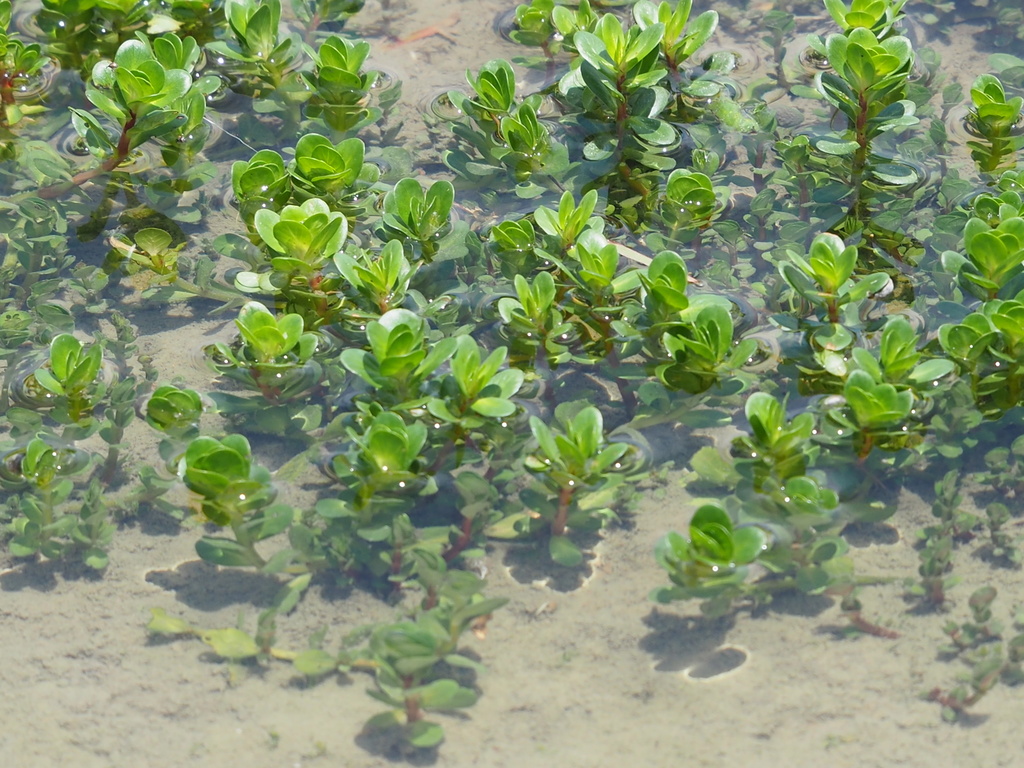
Indian rotala
Rotala indica
Rotala indica is a species of flowering plant in the loosestrife family known by the common name Indian toothcup. It is native to Southeast Asia. This aquatic plant is best known as a popular aquarium plant and as a weed of rice fields. It is known as an introduced species and a weed in rice-growing regions in Congo, Italy, and Portugal, and California and Louisiana in the United States.
The stems of the plant grow up to 30 or 40 cm long. Leaves are decussate, arranged oppositely in perpendicular pairs along the stems. The leaves are oval with thick, whitish, cartilaginous margins and measure up to 2 cm long. Flowers occur in leaf axils singly or in short, spikelike inflorescences. Each has four triangular sepals and four tiny pink petals.
Where it lives
Recorded sightings
—
geo-referenced records in GBIF, from museums, herbaria and field observers.
Drag the globe to turn it. Dots are where records exist, not a range map; darker means more records.
In the stacks
Searching the stacks…
Every page naming Rotala indica in the Biodiversity Heritage Library →
This page is assembled live from iNaturalist, GBIF, Wikipedia, the Source Library and the Internet Archive. It is not yet part of the hand-edited codex. iNaturalist taxon 78888.