- Plants
- ›Vascular Plants
- ›flowering plants
- ›monocots
- ›grasses, sedges, cattails, and allies
- ›grasses
- ›Oatgrasses, Pampasgrasses, and allies
- ›Oatgrasses, Pampasgrasses, and allies
- ›Rytidosperma
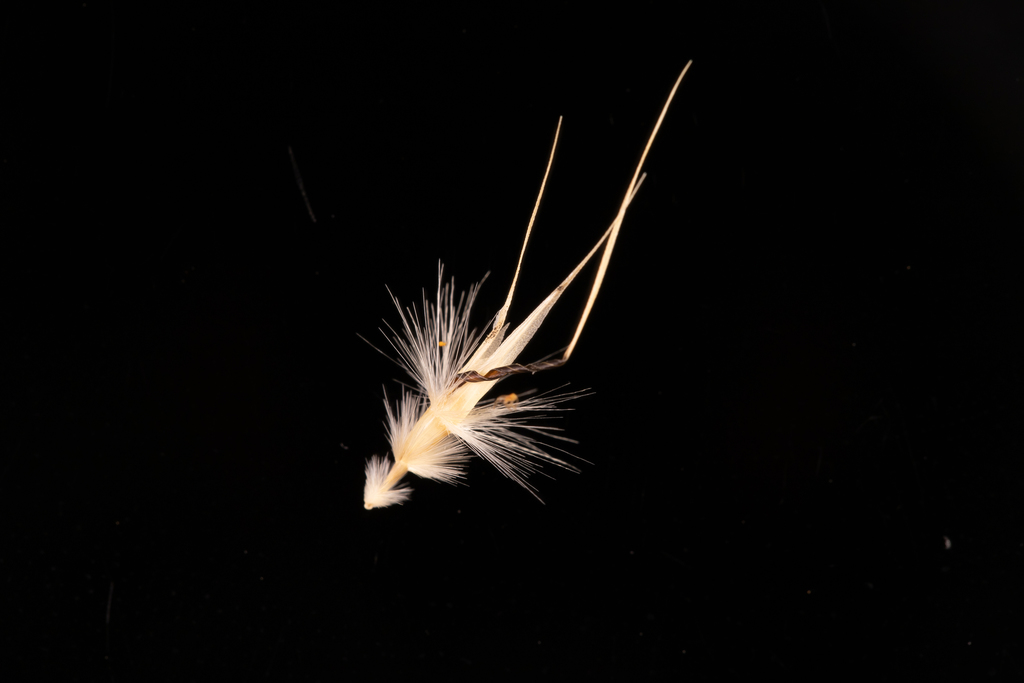
Common Wallaby-grass
Rytidosperma caespitosum
Rytidosperma caespitosum, known by various common names including common wallaby-grass, ringed wallaby-grass, and white-top, is a species of grass native to southern parts of Australia.
From the article Rytidosperma caespitosum on Wikipedia (CC BY-SA), quoted section by section
Description
It is a tufted perennial grass that reaches up to 90 centimetres high. Glumes are green with or without purple, and occur in a panicle of from 10 to 30 spikelets, each of which contains from four to nine individual flowers.
Range & habitat
It occurs throughout the wetter, cooler parts of southern Australia, through to hot, arid land such as Shark Bay. Its many forms span diverse habitats, variously tolerating a range of salinity and soils, including sands, loams, limestone, granite and laterite. It is considered one of the main native pasture grasses in southern Australia
Wikipedia: “Distribution and habitat”
What it does
Flowering occurs in spring or summer, usually in response to rain. The rust fungus Uromyces danthoniae, a species found that grows parasitically on the leaves of several Rytidosperma species in New Zealand and Australia, infects Rytidosperma caespitosum. It forms dense clusters of orange-brown aecidia on both surfaces of the leaf. It is also a host of Sphaerodothella danthoniae, a sac fungus that produces black, shiny leaf spots that occasionally coalesce into straight to irregular lines in the leaf surface of several species of Rytidosperma.
Wikipedia: “Ecology”
Where it lives
Recorded sightings
—
geo-referenced records in GBIF, from museums, herbaria and field observers.
Drag the globe to turn it. Dots are where records exist, not a range map; darker means more records.
In the stacks
Searching the stacks…
Every page naming Rytidosperma caespitosum in the Biodiversity Heritage Library →
This page is assembled live from iNaturalist, GBIF, Wikipedia, the Source Library and the Internet Archive. It is not yet part of the hand-edited codex. iNaturalist taxon 78918.