- Plants
- ›Vascular Plants
- ›flowering plants
- ›Dicots
- ›pinks, cactuses, and allies
- ›pink family
- ›Sagineae
- ›Sagina
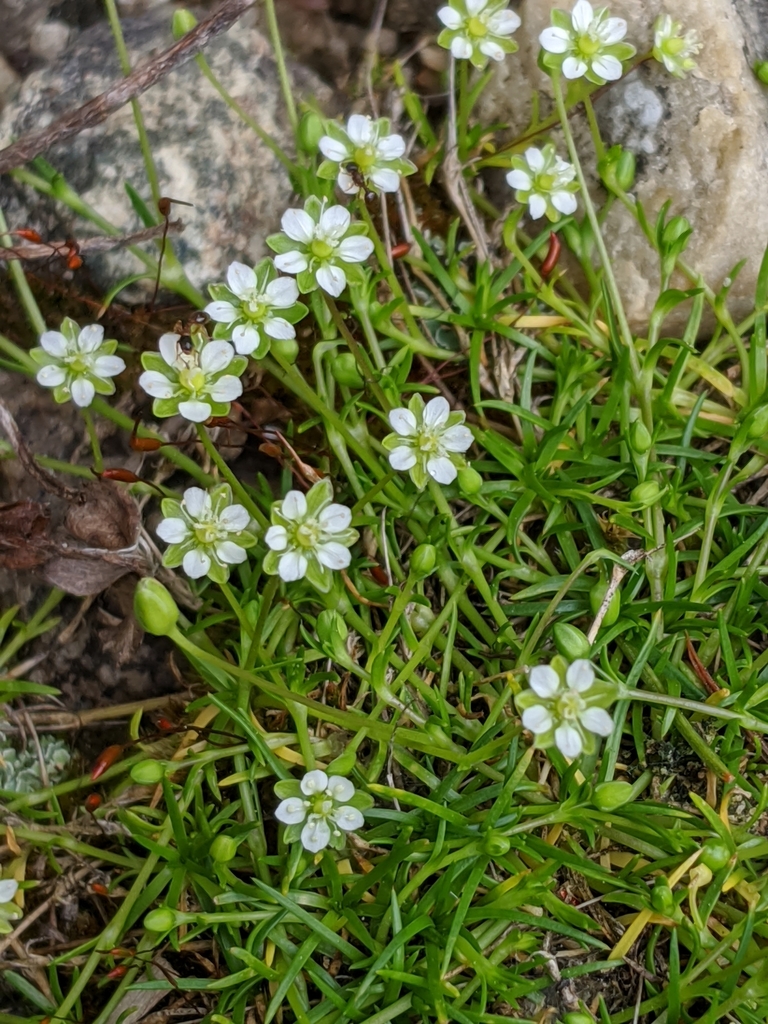
Alpine Pearlwort
Sagina saginoides
Sagina saginoides is a species of flowering plant in the family Caryophyllaceae known by the common names arctic pearlwort or alpine pearlwort. It has a circumboreal distribution; it can be found throughout the northern latitudes of the Northern Hemisphere. It grows in subalpine and alpine climates and other mountainous habitat at lower elevations. This is a small perennial herb producing a slender to threadlike stem just a few centimetres long, growing decumbent or erect. It is sometimes clumpy in form. The leaves are linear in shape and about 1 to 2 centimetres in length. The inflorescence is a solitary flower with five sepals and five small white petals.
From the article Sagina saginoides on Wikipedia (CC BY-SA), quoted section by section
Description
The alpine pearlwort is a small, tufted perennial plant growing from 3 to 10 centimetres (1.2 to 3.9 in) tall. Its stems are semi-erect and the stalked leaves are in opposite fused pairs with slender linear blades, entire margins and blunt tips. The erect flowering stem bears a globular bud followed by a single regular flower about 2 mm (0.1 in) in diameter. It has five turned back sepals, five white, ovate, blunt petals which are the same length as the sepals, ten stamens and five styles. The fruit is a five-chambered capsule and longer than the calyx. The snow pearlwort (Sagina nivalis) looks very similar but often has four rather than five petals.
Range & habitat
The alpine pearlwort has a circumboreal distribution; it can be found throughout the northern latitudes of the Northern Hemisphere and mountainous regions further south. It is found in short turf in thin soils on fell tundra, under snowdrifts, in melt-water wetlands, on ledges on rock faces, rocky banks, meagre pastures, roadside banks and bare ground. During the winter its dwarf stature and covering of snow protect it from the worst of the winds and low temperatures.
Wikipedia: “Distribution and habitat”
Where it lives
Recorded sightings
—
geo-referenced records in GBIF, from museums, herbaria and field observers.
Drag the globe to turn it. Dots are where records exist, not a range map; darker means more records.
In the stacks
Searching the stacks…
Every page naming Sagina saginoides in the Biodiversity Heritage Library →
This page is assembled live from iNaturalist, GBIF, Wikipedia, the Source Library and the Internet Archive. It is not yet part of the hand-edited codex. iNaturalist taxon 78923.