- Plants
- ›Vascular Plants
- ›flowering plants
- ›Dicots
- ›Sunflowers, Bellflowers, Fanflowers, and Allies
- ›Sunflowers, Daisies, Asters, and Allies
- ›Asteroideae
- ›groundsels and allies
- ›Senecioninae
- ›Senecio
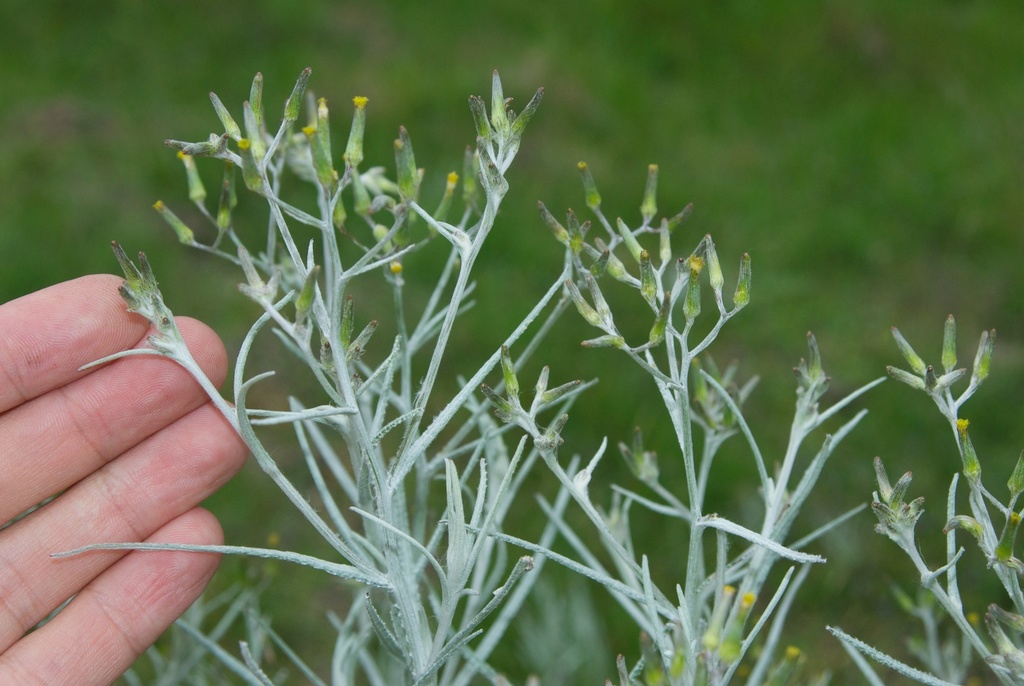
cotton burnweed
Senecio quadridentatus
Senecio quadridentatus is native to Australia and New Zealand. In New Zealand it is known by its Māori name pahokoraka or pekapeka. Senecio quadridentatus is an annual or perennial herbaceous flowering plant in the family Asteraceae. It is also known as Erechtites quadridentata Labill by the synonyms.
From the article Senecio quadridentatus on Wikipedia (CC BY-SA), quoted section by section
Description
This erect plant, Senecio quadridentatus, is an annual or short-lived perennial herb up to around 1m tall. Generally speaking, it is a silver-looking plant from a distance which is attractive. Its stems are branched from or near the hard woody base, covered with thick white fine hair-like filaments, becoming thin with age. Lower and middle stem leaves are basically evenly arranged and similar in size, about 4–12 cm long and 1.5-6 mm wide. These leaves are linear to narrow lance-shaped with pointed apex and subsessile, the upper surface grey-green with white tomentum or glabrous and the lower surface with moderate to dense white tomentum. Leaves margin is mostly entire or sometimes distantly toothed and revolute almost to midrib. Upper leaves are entire but smaller, maybe a little bit amplexicaul. Basal leaves may be relatively flattened and wider. The inflorescence is a loose umbellate panicle at the end of the branches. At the base of the flowerhead, there are 3-5 supplementary bracts which are 1-1.5 mm in length, and 12-13 involucral bracts that are 6–9 mm. Involucral bracts are narrow linear-lanceolate toward the incisive end and dry membranous without hair or with minute hairs around margins. The flower base (involucral bracts) is slender and narrow cylindrical. Its flowerhead, composed of around 30 disc florets with no ray florets, is yellow and about 2 mm in diameter. …
Range & habitat
Cotton fireweed (Senecio quadridentatus) is native to New Zealand and it exists in the mainland of New Zealand (South Island & North Island), as well as offshore islands, including Three Kings, Stewart Island and Chatham Island. It also presents in Australia, Tasmania, Timor and Indonesia. Cotton fireweed mainly distributes in rough and rocky places, such as riverbeds, rock outcrops, cliffs and waste places, and can be seen in shrubland and grassland sporadically. It prefers to grow in open places from lowland to mountain at an altitude of 1000 m above sea level. It cannot grow in places with a thick canopy which differs from other fireweeds because it needs adequate light. It can always present in the areas where disturbance events happened recently. Cotton fireweed may emerge quickly in new pastures and then disappear after several years. On fertilised land with superphosphate, lime or gypsum, it often increases. It reported that Senecio quadridentatus found in an urban area in Christchurch in New Zealand may be caused by the distribution of seeds by the wind from Port Hill not far away.
Wikipedia: “Distribution”
What it does
Senecio quadridentatus is a short-lived plant, annual or perennial. It is mainly a short-lived perennial and it can reshoot after disturbances events happened or it can grow as an annual where conditions are tougher. The flower period is from October to March. The fruiting period is from December to May. the flowering and fruiting period of Senecio quadridentatus varies greatly in different regions. Its seeds disperse by wind because its single-seeded fruit contains pappus, the function of which facilitates the dispersal of seeds. Its seeds can lie dormant on the ground for a couple of years, germinating quickly after summer heat, fire or other disturbances.
Wikipedia: “Life cycle”
In human culture
Senecio, the scientific Latin genus name derived from Latin senex, means old man. It may arise from the hoary pappus of the plants in this genus. Cotton comes from the white cottony appearance of the plants and fireweed results from the abundance of the species on the places where forests burned or other disturbance events happened.
Wikipedia: “Etymology”
Where it lives
Recorded sightings
—
geo-referenced records in GBIF, from museums, herbaria and field observers.
Drag the globe to turn it. Dots are where records exist, not a range map; darker means more records.
In the stacks
Searching the stacks…
Every page naming Senecio quadridentatus in the Biodiversity Heritage Library →
This page is assembled live from iNaturalist, GBIF, Wikipedia, the Source Library and the Internet Archive. It is not yet part of the hand-edited codex. iNaturalist taxon 79052.