- Plants
- ›Vascular Plants
- ›flowering plants
- ›Dicots
- ›Legumes, Milkworts, and Allies
- ›Legumes
- ›Acacias, Mimosas, Mesquites, and Allies
- ›Senegalia
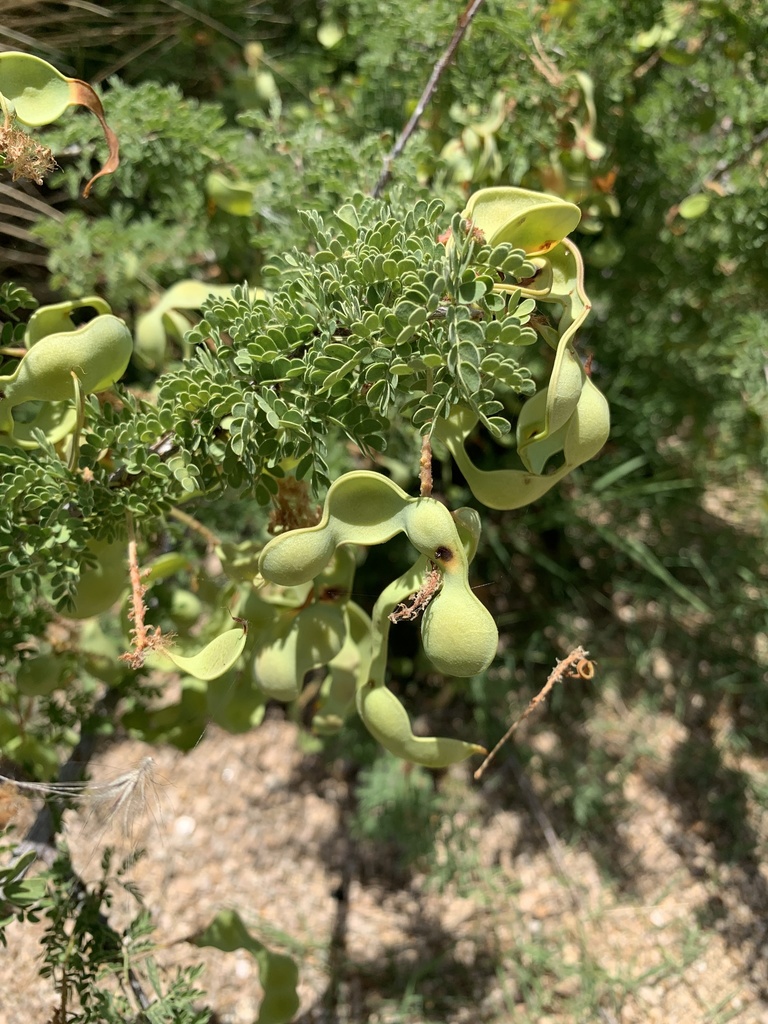
Catclaw Acacia
Senegalia greggii
Senegalia greggii, formerly known as Acacia greggii, is a species of tree in the genus Senegalia native to the southwestern United States and northern Mexico. Common names include acacia bush, catclaw acacia, catclaw mesquite, Gregg's catclaw, paradise flower, wait-a-minute bush, and wait-a-bit tree; these names mostly come from the fact that the tree has numerous hooked prickles with the shape and size of a cat's claw which tend to hook onto passers-by; the hooked person must stop ("wait a minute") to remove the prickles carefully to avoid injury or shredded clothing. (The common name "cat's claw" is also used to refer to several other plant species, including Uncaria tomentosa, a woody vine found in the tropical jungles of South and Central America.) The specific epithet greggii refers to Josiah Gregg, a 19th-century author, explorer, and amateur naturalist of the American Southwest and northern Mexico.
From the article Senegalia greggii on Wikipedia (CC BY-SA), quoted section by section
Description
It is a large shrub or small tree growing to 10–15 m (33–49 ft) tall with a trunk up to 20–30 cm (7.9–11.8 in) diameter. The grey-green leaves are deciduous, and bipinnate, divided into 1-3 pairs of pinnae, each pinna 2–3 cm (0.79–1.18 in) long with 10-18 leaflets that are 3–6 mm (0.12–0.24 in). Pinnae are most frequently in two pairs, with the proximal pair perpendicular to the petiolule and the distal pair forming a V at the tip. The blooms are produced in dense cylindrical spikes of numerous flowers, each individual flower with five cream colored 3 mm (0.12 in) petals and numerous creamy yellow 6 mm (0.24 in) stamens. The fruit is a flat, twisted legume (pod) 6–15 cm (2.4–5.9 in) long, containing generally 3 to 5 hard, flattened, medium brown seeds. The seed pod is constricted between seeds (a loment), and seed dispersal occurs both through dehiscence and breaks at these constrictions.
Range & habitat
Catclaw mesquite is native to the southwestern United States and northern Mexico. In the southwestern US it is found in California sporadically as far north as Humboldt County, but mainly in southern parts of the state. It is likewise a species of southern Nevada and is only found in Washington County in the southwestern corner of Utah. It is common in much of Arizona and southern New Mexico, but only grows in the Trans-Pecos and southernmost parts of Texas. In Northwestern Mexico it is native to three states, Baja California, Baja California Sur, and Sonora. In the northeast it is found in seven of eleven states including Chihuahua, Durango, Coahuila, Zacatecas, Nuevo León, and Tamaulipas in the north and Hidalgo to the south.
Wikipedia: “Range and habitat”
What it does
Senegalia greggii is most common in arroyos where its roots have access to deep water. Its seeds require physical scarification in order to germinate. This effectively prevents germination unless a flash flood disturbs the area and deposits enough water to increase the likelihood that seedlings will be able to establish deep enough roots to survive the dry season. Catclaw is fully drought deciduous and will usually lack leaves for most of the year. S. greggii has extrafloral nectaries, a trait shared with other senegalias. A tentative connection has been made between these glands and insects that would suggest a mutualistic relationship (as found in other Senegalia species). Ants are known to use the glands as a source of food and water, and may provide some defense for the plant against herbivorous insects. Like other arroyo trees in family Fabaceae, S. greggii is frequently afflicted with Desert Mistletoe, Phoradendron californicum. Unlike other legumes, S. greggii is not known to form root nodule associations with nitrogen-fixing bacteria. It is argued that this species may be an example of an evolutionary anachronism, in which the range and renewal of the species is limited due to the extinction of the mammalian megafauna responsible for seed dispersal. …
Wikipedia: “Ecology”
Where it lives
Recorded sightings
—
geo-referenced records in GBIF, from museums, herbaria and field observers.
Drag the globe to turn it. Dots are where records exist, not a range map; darker means more records.
In the stacks
Searching the stacks…
Every page naming Senegalia greggii in the Biodiversity Heritage Library →
This page is assembled live from iNaturalist, GBIF, Wikipedia, the Source Library and the Internet Archive. It is not yet part of the hand-edited codex. iNaturalist taxon 79056.