- Plants
- ›Vascular Plants
- ›flowering plants
- ›Dicots
- ›Legumes, Milkworts, and Allies
- ›Legumes
- ›Faboideae
- ›Sesbanieae
- ›Sesbania
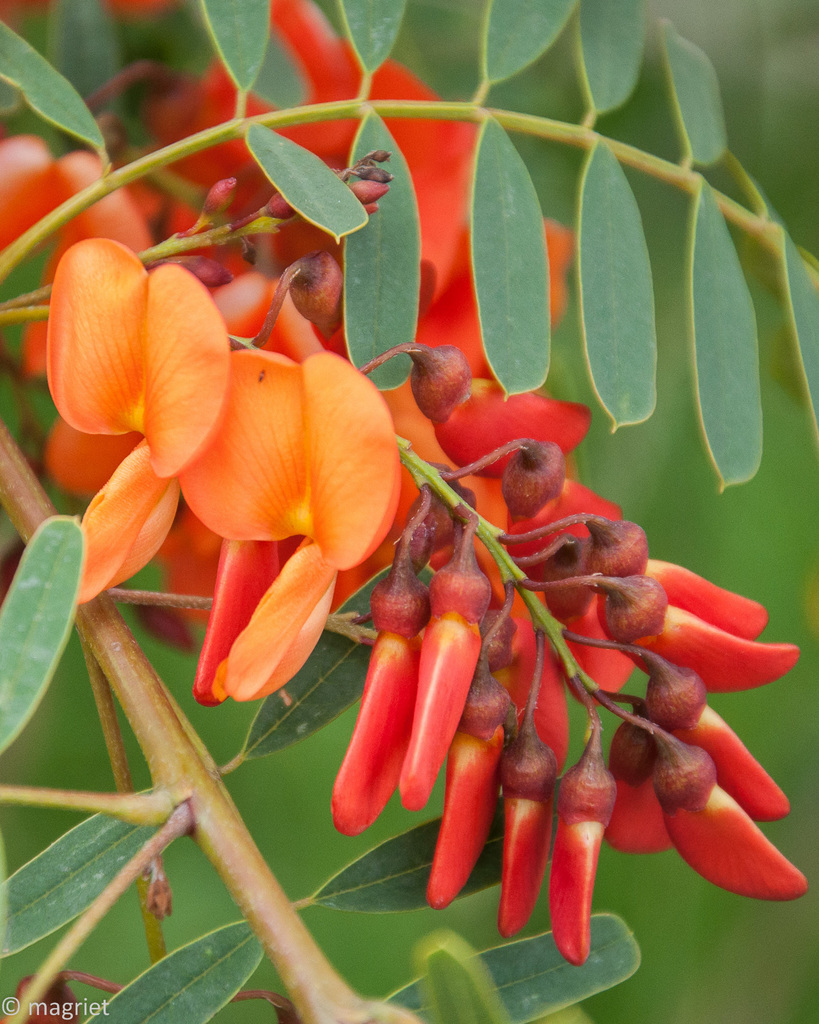
Scarlet Sesbane
Sesbania punicea
Sesbania punicea (Spanish gold, rattlebox, or scarlet sesban) is an ornamental shrub with reddish-orange flowers native to South America. It has deciduous leaves and grows to a height of 15 feet (4.5 m). This plant has a high demand for water, and thrives in swamps or wet areas. It requires a mildly acidic soil, with a pH between 6.1 and 6.5.
From the article Sesbania punicea on Wikipedia (CC BY-SA), quoted section by section
Description
The deciduous leaves are alternate and compound. Between five and 20 pairs of elliptical leaflets occur on a single stalk. The leaf margins are commonly entire, with little or no serration. Each leaflet is oblong and ends in a pointy tip. The leaves contain stipules that are usually inconspicuous. The flowers and fruits droop at the tips of the stalks. The branches of this shrub are rather thin, and green, but turn a darker red brown when they mature. The bark varies from gray brown to red brown with obvious horizontal lenticels.
Wikipedia: “Morphology”
Range & habitat
The species is native to Brazil, Argentina, Paraguay and Uruguay. It has spread to other parts of South America and many coastal southern United States as well as to parts of Africa. Due to its high demand for water, this species is often found on marshy shorelines. It also forms dense thickets and thrives in disturbed areas.
Wikipedia: “Distribution”
What it does
Flowers appear in late spring and persist until the autumn. In the United States, this species blooms between June and September, in South Africa between November and January. When the carpellous structures dry out, the seeds drop close to the base of the plant. The seed coats are impermeable, which means they can be dispersed by water. This impermeability is caused by callose. Hence, they are often found near rivers and brooks. This species is also commonly found near roadsides, maybe the seeds were imported with the soil used for construction. This species is shade-tolerant. Seedlings can produce flowers and seeds after three month, although flowering most commonly occurs at two years of age. The plant can survive frost, but not for prolonged periods of time .
Wikipedia: “Habitat and ecology”
Toxicity
Sesbania puniceas contains toxic saponic glycosides. The poison can be dangerous to local birds and mammals. Humans who ingest this plant or its seeds may become very sick and may suffer vomiting, diarrhea, respiratory failure, and death.
Where it lives
Recorded sightings
—
geo-referenced records in GBIF, from museums, herbaria and field observers.
Drag the globe to turn it. Dots are where records exist, not a range map; darker means more records.
In the stacks
Searching the stacks…
Every page naming Sesbania punicea in the Biodiversity Heritage Library →
This page is assembled live from iNaturalist, GBIF, Wikipedia, the Source Library and the Internet Archive. It is not yet part of the hand-edited codex. iNaturalist taxon 79065.