- Fungi Including Lichens
- ›Basidiomycete Fungi
- ›Higher Basidiomycetes
- ›Mushrooms, Bracket Fungi, Puffballs, and Allies
- ›Agaricomycetidae
- ›boletes and allies
- ›boletes
- ›Suillelloideae
- ›Rubroboletus
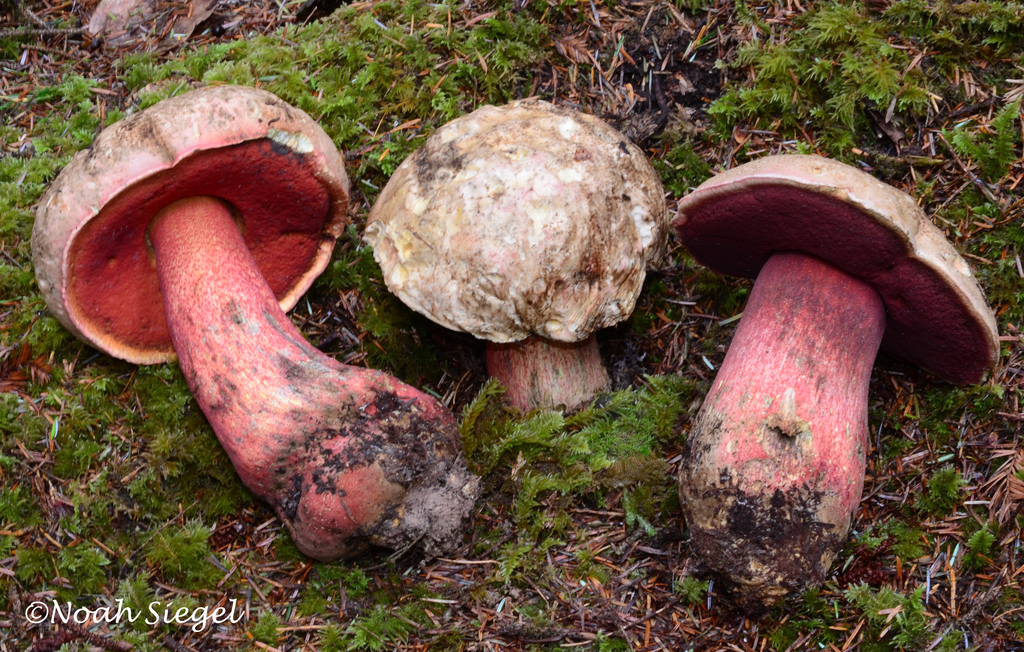
Red-pored Bolete
Rubroboletus pulcherrimus
Rubroboletus pulcherrimus—known as Boletus pulcherrimus until 2015—is a species of mushroom in the family Boletaceae. It is a large bolete from Western North America with distinguishing features that include a netted surface on the stem, a red to brown cap and stem color, and red pores that stain blue upon injury. Until 2005 this was the only bolete that has been implicated in the death of someone consuming it; a couple developed gastrointestinal symptoms in 1994
From the article Rubroboletus pulcherrimus on Wikipedia (CC BY-SA), quoted section by section
Description
Colored various shades of olive- to reddish-brown, the cap may sometimes reach 25 centimeters (10 in) in diameter and is convex in shape before flattening at maturity. The cap surface may be smooth or velvety when young, but may be scaled in older specimens; the margin of the cap is curved inwards in young specimens but rolls out and flattens as it matures. The cap may reach a thickness of 3 to 4 cm (1.2 to 1.6 in) when mature. The adnate (attached squarely to the stem) poroid surface is bright red to dark red or red-brown and bruise dark blue or black; there are 2 to 3 pores per mm in young specimens, and in maturity they expand to about 1 or 2 per mm. In cross section, the tubes and flesh are yellow. The tubes are between 0.5 to 1.5 cm (0.2 to 0.6 in) long, while the angular pores are up to 1 mm in diameter; pores can range in color from dark red in young specimens to reddish brown in age. The pores will stain a blue color when cut or bruised. The solid, firm stem is 7–20 cm (3–8 in) long and thick—up to 10 cm (4 in) in diameter, at the base before tapering to 2–5 cm (1–2 in) at the top. It is yellow or yellow-brown in color and bears a network of red reticulations on the upper 2/3 of its length. The spore print is olive-brown. The taste of the flesh is reportedly mild, and the odor indistinct, or "slightly fragrant".
Microscopic characters. …
Range & habitat
Rubroboletus pulcherrimus is found in western North America, from New Mexico and California to Washington, and may feasibly occur in British Columbia, Canada. One source notes it grows at low altitudes in the Cascade Range and Olympic Mountains; another claims it grows at high elevations, over 5,000 ft (1,500 m). Fruiting in autumn, it grows singly or in groups (although another source claims "never in groups") in humus in mixed woodlands. In the original publication describing the species, Thiers and Halling note that it is associated with forests containing tanbark oaks (Lithocarpus densiflora), Douglas-fir (Pseudotsuga menziesii), and grand fir (Abies grandis). Smith and Weber mention increased fruitings after warm heavy fall rains following a humid summer.
Wikipedia: “Distribution and habitat”
Toxicity
In general, blue-staining red-pored boletes should be avoided for consumption. Thiers warned that this species might be toxic after being alerted to severe gastrointestinal symptoms in one who had merely tasted it. In 1994, a couple developed gastrointestinal symptoms after eating this fungus and the husband died as a result. A subsequent autopsy revealed that the man had suffered an infarction of the midgut. Rubroboletus pulcherrimus was the only bolete that had been implicated in the death of someone consuming it. It is known to contain low levels of muscarine, a peripheral nervous system toxin. A 2005 report from Australia recorded a fatality from muscarinic syndrome after consuming a mushroom from the genus Rubinoboletus (but possibly a species of Chalciporus).
Where it lives
Recorded sightings
—
geo-referenced records in GBIF, from museums, herbaria and field observers.
Drag the globe to turn it. Dots are where records exist, not a range map; darker means more records.
In the stacks
Searching the stacks…
Every page naming Rubroboletus pulcherrimus in the Biodiversity Heritage Library →
This page is assembled live from iNaturalist, GBIF, Wikipedia, the Source Library and the Internet Archive. It is not yet part of the hand-edited codex. iNaturalist taxon 790951.