- Plants
- ›Vascular Plants
- ›flowering plants
- ›Dicots
- ›Legumes, Milkworts, and Allies
- ›Legumes
- ›Faboideae
- ›milkvetches, locoweeds, and allies
- ›Sphaerophysa
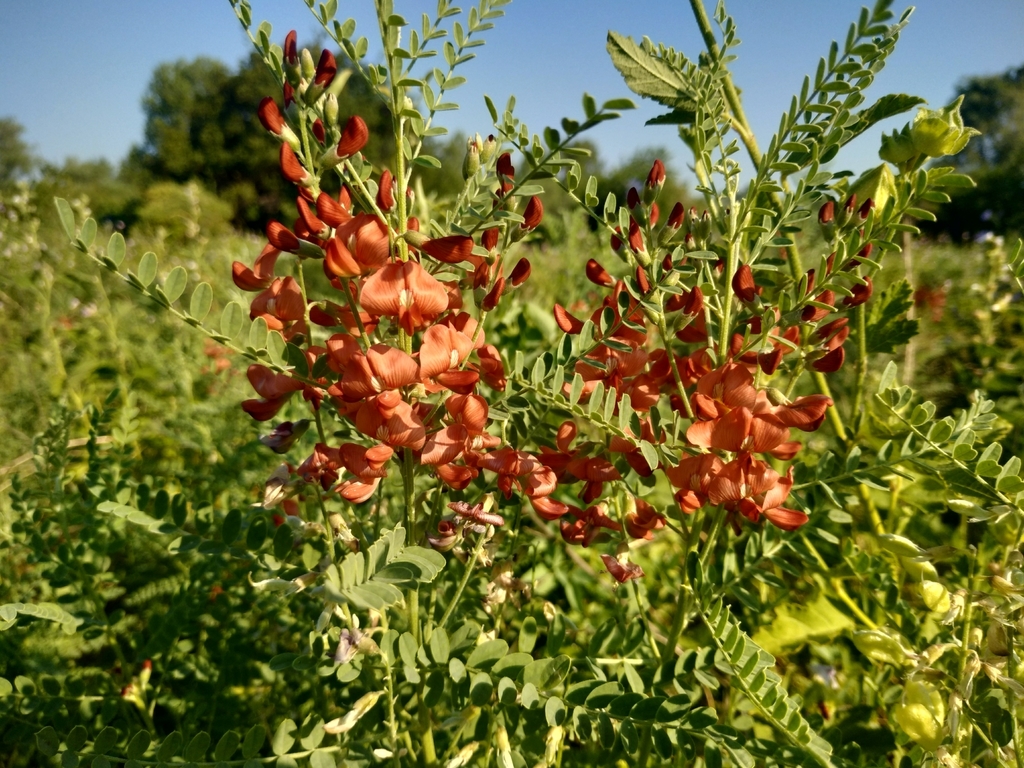
Austrian Peaweed
Sphaerophysa salsula
Sphaerophysa salsula is a species of flowering plant in the legume family known by the common names alkali swainsonpea, Austrian peaweed, and red bladder-vetch. It is native to Asia but it is known in many other parts of the world as an introduced species and often a noxious weed. It grows in cultivated land and disturbed habitat, easily tolerating alkaline substrates. It is commonly seen in areas where alfalfa is grown, because the seeds of the two species look similar and the weed seed is easily imported with the crop seed.
This is a long-lived perennial herb growing up to 1.5 m tall. It reproduces via seed as well as by sprouting vigorously from its creeping root system. The stems are coated in short white hairs. The leaves are made up of many oval leaflets each up to 2 cm long. The inflorescence is a raceme of several pea-like flowers each just over 1 cm wide. They may be brick-red to deep pink to brownish to red-orange. The fruit is a legume pod up to 3.5 cm long. It is inflated and bladderlike, hairless, translucent, shiny, and papery when dry. It is mottled greenish or reddish. It contains several seeds each about two millimeters long.
Where it lives
Recorded sightings
—
geo-referenced records in GBIF, from museums, herbaria and field observers.
Drag the globe to turn it. Dots are where records exist, not a range map; darker means more records.
In the stacks
Searching the stacks…
Every page naming Sphaerophysa salsula in the Biodiversity Heritage Library →
This page is assembled live from iNaturalist, GBIF, Wikipedia, the Source Library and the Internet Archive. It is not yet part of the hand-edited codex. iNaturalist taxon 79181.