- Plants
- ›Vascular Plants
- ›flowering plants
- ›Dicots
- ›Sunflowers, Bellflowers, Fanflowers, and Allies
- ›Sunflowers, Daisies, Asters, and Allies
- ›Barnadesioideae
- ›Barnadesieae
- ›Schlechtendalia
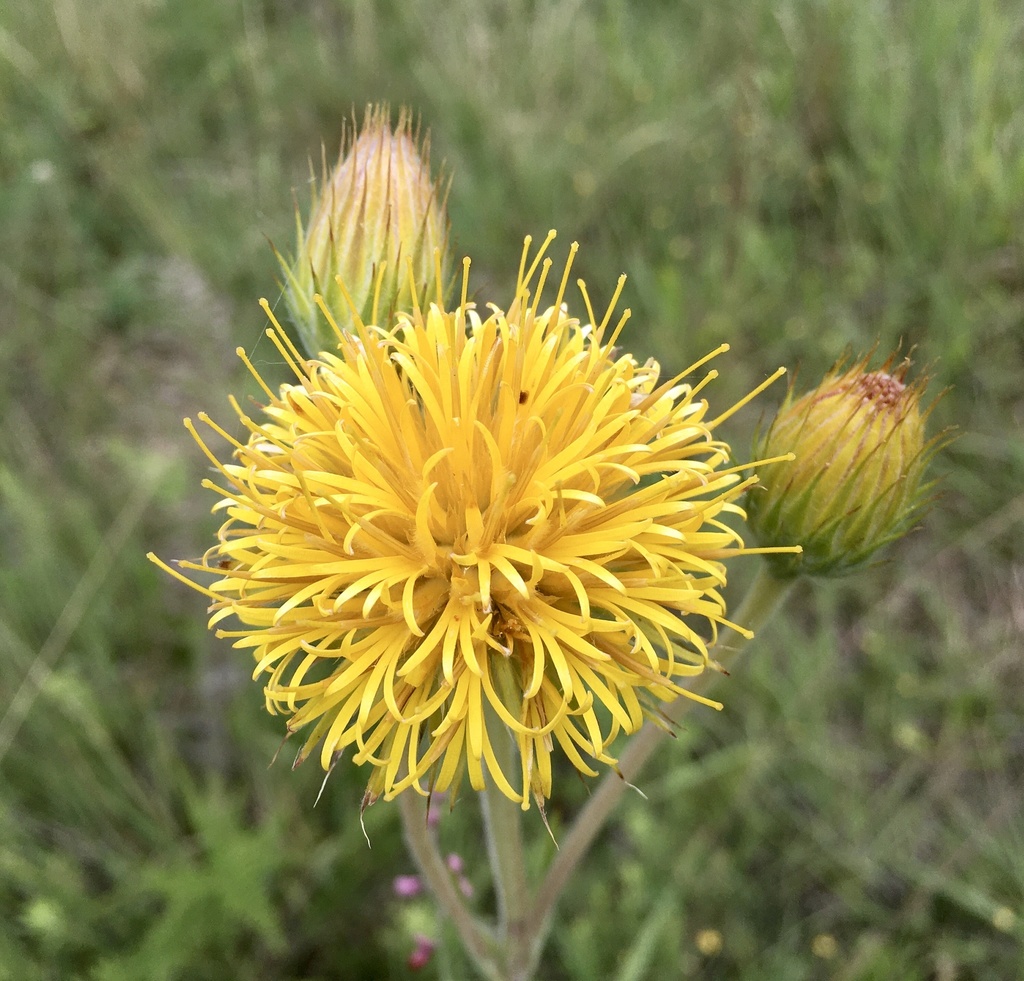
Schlechtendalia luzulifolia
Schlechtendalia is a genus of South American plants in the tribe Barnadesieae within the family Asteraceae. It is known in Portuguese as bolão de ouro, meaning "gold bullion". It is a perennial herbaceous plant, with rigid, linear leaves with a pointy tip. The corollas of the florets are yellow, and of the subbilobiate type, with four lobes merged into a strap, but split into teeth over half as deep, and one lobe (towards the centre of the flowerhead) free. This species flowers from September to December and the fruits are ripe in January or February. The only known species is Schlechtendalia luzulifolia, native to southern Brazil (Paraná, Rio Grande do Sul), Uruguay (Cerro Largo, Maldonado, Montevideo, Rocha), northern Argentina (Buenos Aires, Entre Ríos). This species has sixteen chromosomes (2n=16).
From the article Schlechtendalia luzulifolia on Wikipedia (CC BY-SA), quoted section by section
In human culture
The genus name honors German botanist Diederich Franz Leonhard von Schlechtendal. The species epithet luzulaefolia, refers to this plant having leaves similar to a woodrush.
Wikipedia: “Etymology”
Where it lives
Recorded sightings
—
geo-referenced records in GBIF, from museums, herbaria and field observers.
Drag the globe to turn it. Dots are where records exist, not a range map; darker means more records.
In the stacks
Searching the stacks…
Every page naming Schlechtendalia luzulifolia in the Biodiversity Heritage Library →
This page is assembled live from iNaturalist, GBIF, Wikipedia, the Source Library and the Internet Archive. It is not yet part of the hand-edited codex. iNaturalist taxon 792817.