- Animals
- ›Chordates
- ›Vertebrates
- ›Birds
- ›Woodpeckers and Allies
- ›Woodpeckers
- ›Typical woodpeckers
- ›Pied woodpeckers and allies
- ›Chloropicus
On eBird ↗
Bearded Woodpecker
Live sightings near you, the range map, bar charts of when it is seen, and Macaulay Library photos and recordings.
Bearded Woodpecker
Chloropicus namaquus
The bearded woodpecker (Chloropicus namaquus) is a species of bird in the family Picidae. It has a distinctive black and white head and brownish barred body. It is native to tropical central Africa. It has an extremely wide range and is a fairly common species, and the International Union for Conservation of Nature has rated its conservation status as being of "least concern". Some taxonomic authorities place this species in Dendropicos.
From the article Bearded woodpecker on Wikipedia (CC BY-SA), quoted section by section
Description
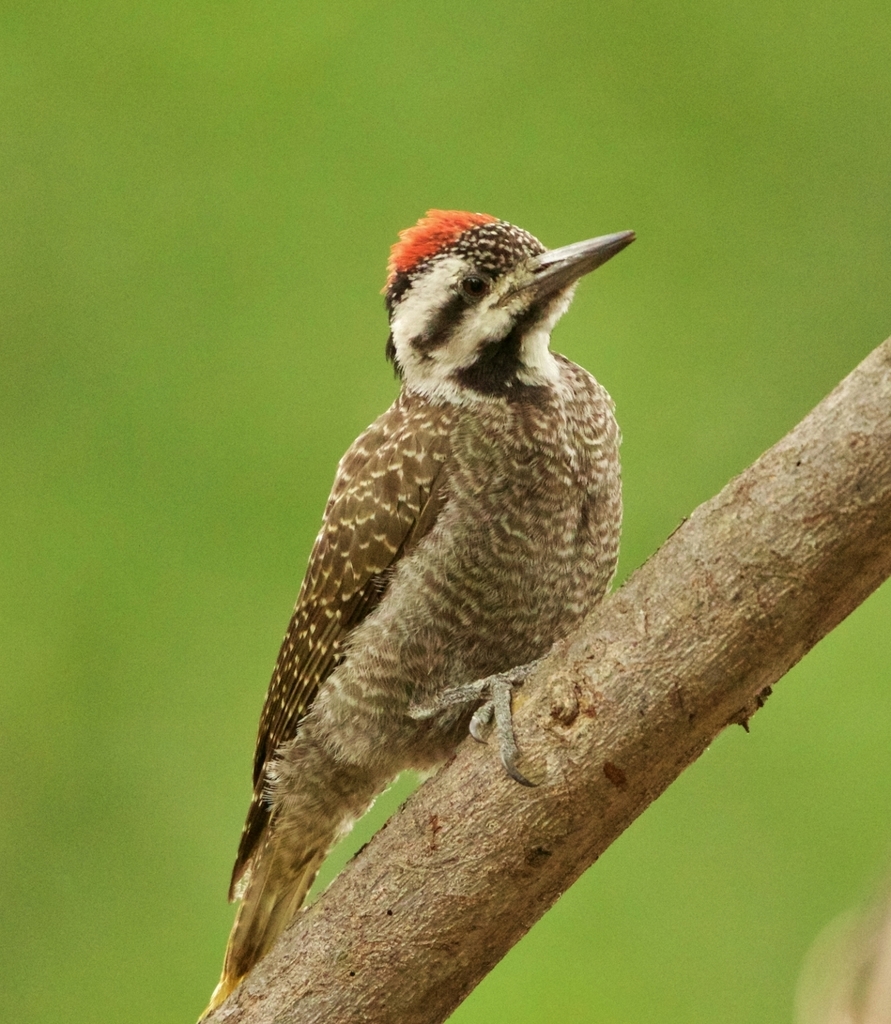
The bearded woodpecker is one of the largest woodpeckers in Africa growing to a length of about 25 cm (10 in). The head is distinctive with a black moustache, a broad black eye-stripe and black crown contrasting with a white supercilium, face, chin and throat. The male has a red hind crown which the female lacks. The mantle is black and the rest of the upper parts are yellowish-brown with narrow white barring. The tail is brown, barred white, the feathers having yellowish shafts. The underparts are grey with narrow white barring. The beak is large and greyish-black, the legs grey and the eyes red. Juveniles are similar to adults but the upper parts have a greenish tinge and more diffuse barring, and both sexes have some red colouring on the crown and nape.
Range & habitat
It is found in Angola, Botswana, Central African Republic, Chad, Democratic Republic of the Congo, Eswatini, Ethiopia, Kenya, Malawi, Mozambique, Namibia, Rwanda, Somalia, South Africa, Sudan, Tanzania, Uganda, Zambia, and Zimbabwe. It has a wide range of habitat types including woodland with sizeable trees, Brachystegia woodland, Euphorbia and Acacia woodland, the fringes of gallery forests and brushland. It is present from the lowlands up to altitudes of about 3,000 m (10,000 ft).
Wikipedia: “Distribution and habitat”
What it does
The bearded woodpecker often forages in pairs which communicate with each other vocally, flicking their wings as they call. Each bird will spend a long time on a single tree, hammering, probing and pecking with its beak and gleaning any stray insects it encounters, before flying off to another, often distant, tree. The diet consists of insects and their larvae, spiders, caterpillars and ants. It has been known to catch geckos and small lizards. This bird often drums loudly on branches, finishing each drum-roll with four taps. The nest hole is drilled in dead wood, up to 20 m (70 ft) above the ground. A clutch averaging three eggs is laid and incubation, by both parents, lasts thirteen days. The chicks are cared for by both birds and remain in the nest for about four weeks.
Wikipedia: “Ecology”
Listen
Looking for field recordings…
Where it lives
Recorded sightings
—
geo-referenced records in GBIF, from museums, herbaria and field observers.
Drag the globe to turn it. Dots are where records exist, not a range map; darker means more records.
In the stacks
Searching the stacks…
Every page naming Chloropicus namaquus in the Biodiversity Heritage Library →
This page is assembled live from iNaturalist, GBIF, Wikipedia, the Source Library and the Internet Archive. It is not yet part of the hand-edited codex. iNaturalist taxon 792926.