- Animals
- ›Chordates
- ›Vertebrates
- ›Birds
- ›Woodpeckers and Allies
- ›Woodpeckers
- ›Typical woodpeckers
- ›Pied woodpeckers and allies
- ›Dendrocoptes
On eBird ↗
Arabian Woodpecker
Live sightings near you, the range map, bar charts of when it is seen, and Macaulay Library photos and recordings.
Arabian Woodpecker
Dendrocoptes dorae
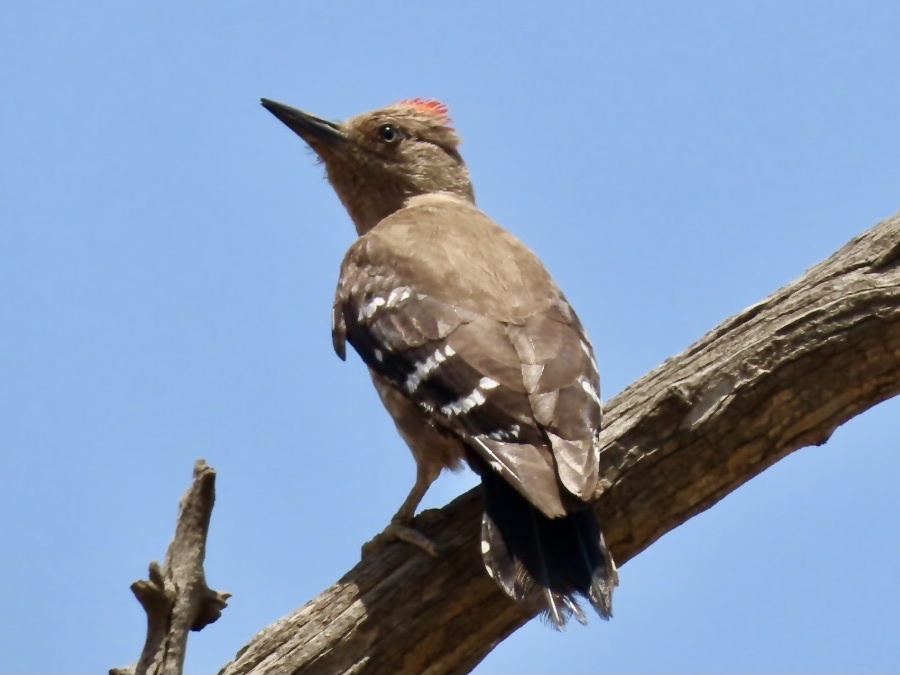
The Arabian woodpecker (Dendrocoptes dorae) or Sarat woodpecker, is a bird species of the family Picidae, native to the Sarawat Mountains of Saudi Arabia and Yemen. It is the only woodpecker that breeds on the Arabian Peninsula.
This species was first described in 1935 by the American naturalist George Latimer Bates and the Scottish zoologist Norman Boyd Kinnear, the scientific name being proposed by their occasional co-worker, the British Arabist St John Philby, in honour of his wife Dora.
From the article Arabian woodpecker on Wikipedia (CC BY-SA), quoted section by section
Description
The Arabian woodpecker grows to a length of about 18 cm (7 in). The male has a brownish or pale grey head with a bright red patch on the crown and nape. The back, wings, and tail are olive-grey to brown streaked with white, and the wings are barred with white. The underparts are grey streaked with white and the belly has the central area suffused with red. The female is similar but lacks the red crown patch. The call has been rendered as "pweek pit-pit-pit-pit-pit-pit-pit-ptptpt" and the bird occasionally drums on branches.
Range & habitat
The species is endemic to the mountains and foothills of the southwestern part of the Arabian Peninsula, being restricted to southwestern Saudi Arabia and western Yemen. It is found in a range of woodland habitats including, at lower altitudes, patches of Ficus, date palm and Pandanus. It is present in evergreen riparian forested corridors, on shading trees in coffee plantations, in orchards, on terraced cropland with isolated trees, and in woods and spinneys of Acacia, juniper, olive and Dracaena. Its altitudinal range is from sea level to 2,800 m (9,200 ft) but it probably only breeds between about 400 and 2,400 m (1,300 and 7,900 ft).
Wikipedia: “Distribution and habitat”
What it does
Like other woodpeckers, the Arabian woodpecker feeds on insect grubs which it extracts from holes in tree trunks and branches with its long tongue. It also feeds on spiders, aphids, fig-wasps and flying insects. The nest is in a hole in the trunk or branch of a tree, usually below 6 m (20 ft), excavated in dead wood. The main breeding season is from March to May, but a second brood is sometimes reared in November in Yemen.
Wikipedia: “Behaviour”
Listen
Looking for field recordings…
Where it lives
Recorded sightings
—
geo-referenced records in GBIF, from museums, herbaria and field observers.
Drag the globe to turn it. Dots are where records exist, not a range map; darker means more records.
In the stacks
Searching the stacks…
Every page naming Dendrocoptes dorae in the Biodiversity Heritage Library →
This page is assembled live from iNaturalist, GBIF, Wikipedia, the Source Library and the Internet Archive. It is not yet part of the hand-edited codex. iNaturalist taxon 792982.