- Animals
- ›Chordates
- ›Vertebrates
- ›Birds
- ›Woodpeckers and Allies
- ›Woodpeckers
- ›Typical woodpeckers
- ›Pied woodpeckers and allies
- ›Dryobates
On eBird ↗
Ladder-backed Woodpecker
Live sightings near you, the range map, bar charts of when it is seen, and Macaulay Library photos and recordings.
Ladder-backed Woodpecker
Dryobates scalaris
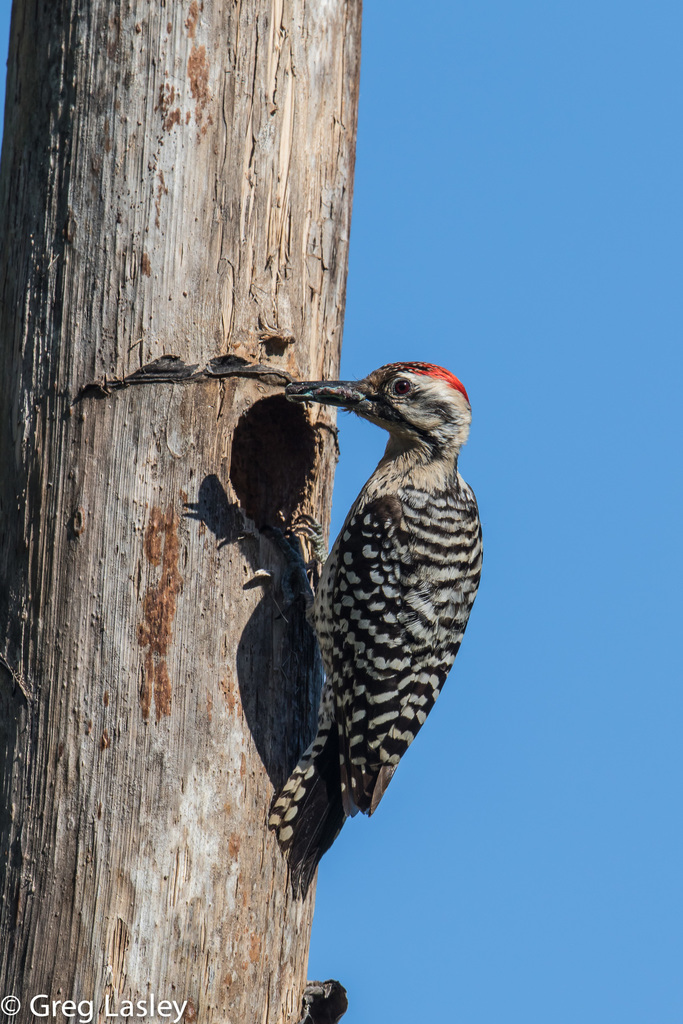
The ladder-backed woodpecker (Dryobates scalaris) is a North American woodpecker. Some taxonomic authorities, including the American Ornithological Society, continue to place this species in the genus Picoides.
From the article Ladder-backed woodpecker on Wikipedia (CC BY-SA), quoted section by section
Description
The ladder-backed woodpecker is a small woodpecker about 16.5 to 19 cm (6½ to 7½ inches) in length. It is primarily colored black and white, with a barred pattern on its back and wings resembling the rungs of a ladder. Its rump is speckled with black, as are its cream-colored underparts on the breast and flanks. Southern populations have duskier buff breasts and distinctly smaller bills. Adult males have a red crown patch that is smaller in immatures and lacking in adult females. The ladder-backed woodpecker is very similar in appearance to Nuttall's woodpecker, but has much less black on its head and upper back, and the range of the two species only intersects a minimal amount in southern California and northern Baja California. Hybrids are known.
Ladder-backed woodpeckers nest in cavities excavated from tree trunks, or in more arid environments a large cactus will do. The female lays between 2 and 7 eggs, which are plain white. The eggs are incubated by both sexes, but the nesting period and other details are unknown. Like most other woodpeckers the ladder-backed woodpecker bores into tree-trunks with its chisel-like bill to hunt for insects and their larva, but it also feeds on fruit produced by cacti.
Range & habitat
The ladder-backed woodpecker is fairly common in dry brushy areas and thickets and has a rather large range. The species can be found year-round over the southwestern United States (north to extreme southern Nevada and extreme southeastern Colorado), most of Mexico, and locally in Central America as far south as Nicaragua.
Wikipedia: “Range and habitat”
Listen
Looking for field recordings…
Where it lives
Recorded sightings
—
geo-referenced records in GBIF, from museums, herbaria and field observers.
Drag the globe to turn it. Dots are where records exist, not a range map; darker means more records.
In the stacks
Searching the stacks…
Every page naming Dryobates scalaris in the Biodiversity Heritage Library →
This page is assembled live from iNaturalist, GBIF, Wikipedia, the Source Library and the Internet Archive. It is not yet part of the hand-edited codex. iNaturalist taxon 792986.