- Plants
- ›Vascular Plants
- ›flowering plants
- ›Dicots
- ›myrtles, evening primroses, and allies
- ›myrtle family
- ›Myrtoideae
- ›Syzygieae
- ›Syzygium
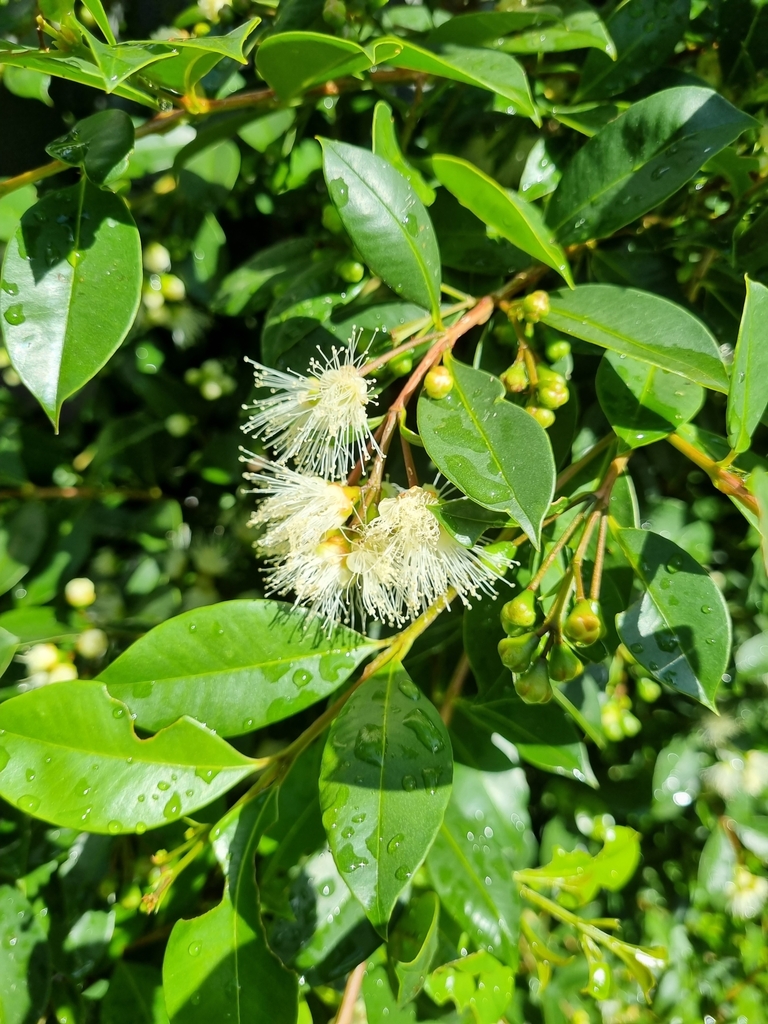
scrub cherry
Syzygium australe
Syzygium australe, with many common names that include brush cherry, scrub cherry, creek lilly-pilly, creek satinash, and watergum, is a rainforest tree native to eastern Australia. It can attain a height of up to 35 m with a trunk diameter of 60 cm. In cultivation, this species is usually a small to medium-sized tree with a maximum height of only 18m.
From the article Syzygium australe on Wikipedia (CC BY-SA), quoted section by section
Description
The leaves are opposite, simple, lanceolate from 4–8 cm long. Flowers are white and in clusters. The pink, elongated, edible fruits range from a size of 1.5 to 2.3 centimeters long, and ripen mainly in summer and autumn. The fruit surrounds a small, circular seed. The flavour of the fruit is described as having a refreshing taste, and have a small hint of sourness to them. This species is commonly confused with magenta cherry and the blue lilly pilly. However, the brush cherry has a paler trunk.
Range & habitat
The species occurs in coastal regions in Queensland and New South Wales, northwards from Batemans Bay.
Wikipedia: “Distribution”
At the table
Brush cherry is commonly cultivated in gardens in Eastern Australia, mostly as shorter, shrub-like cultivars such as "Aussie Boomer", "Aussie Compact", "Birdsville", "Bush Christmas", "Minipilly" and "Tiny Trev". These are especially popular as hedges. The pleasantly sour fruit are also eaten fresh or cooked. The fruit can be used to make jams and jellies. This species has been adopted by Coffs Harbour City Council as the City's floral emblem. Brush cherry is used as a subject for bonsai.
Wikipedia: “Cultivation and Uses”
Where it lives
Recorded sightings
—
geo-referenced records in GBIF, from museums, herbaria and field observers.
Drag the globe to turn it. Dots are where records exist, not a range map; darker means more records.
In the stacks
Searching the stacks…
Every page naming Syzygium australe in the Biodiversity Heritage Library →
This page is assembled live from iNaturalist, GBIF, Wikipedia, the Source Library and the Internet Archive. It is not yet part of the hand-edited codex. iNaturalist taxon 79311.