- Plants
- ›Vascular Plants
- ›flowering plants
- ›Dicots
- ›sandalwoods, mistletoes, and allies
- ›sandalwood family
- ›Santalum
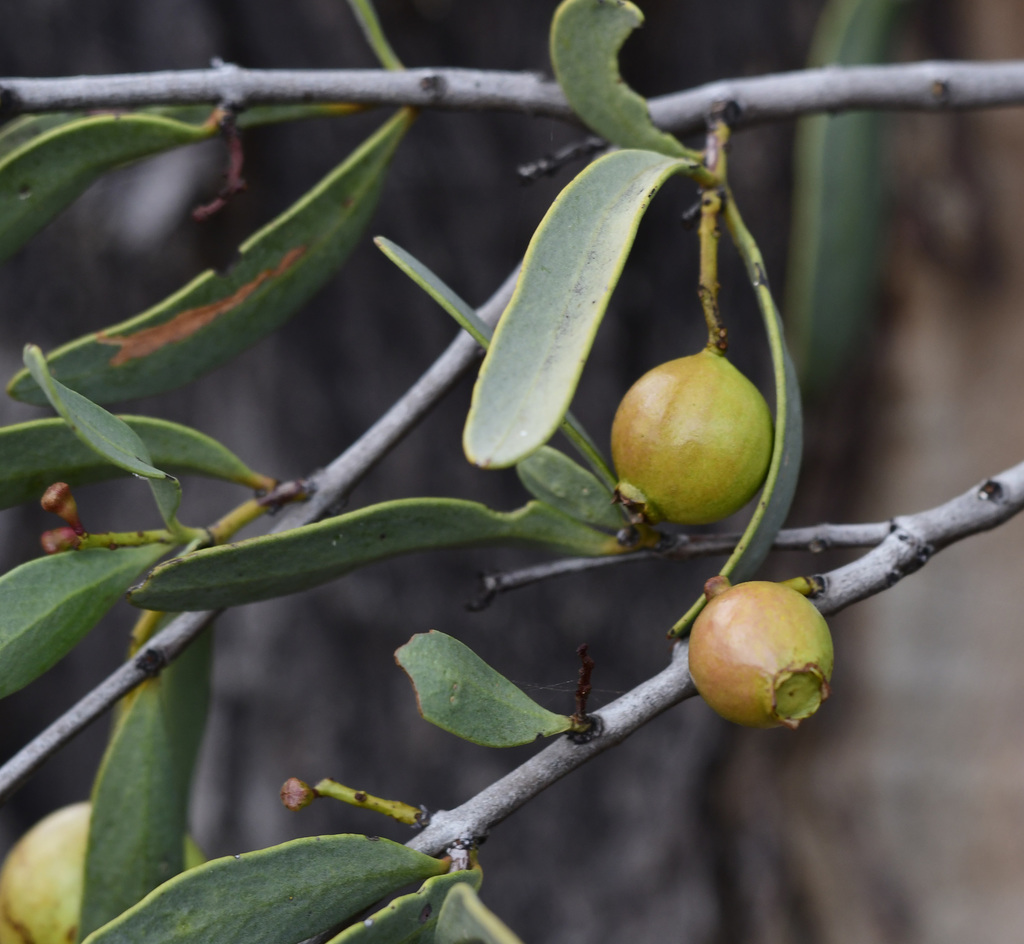
Australian sandalwood
Santalum spicatum
Santalum spicatum, the Australian sandalwood, also Waang and other names (Noongar) and Dutjahn (Martu), is a tree native to semi-arid areas at the edge of Southwest Australia, in the state of Western Australia. It is also found in South Australia, where it is protected and listed as a vulnerable species. It is traded as sandalwood, and its sandalwood oil has been used as an aromatic and a food source over history. S. spicatum is one of four Santalum species occurring in Australia.
From the article Santalum spicatum on Wikipedia (CC BY-SA), quoted section by section
Description
It is one of four species of the family Santalaceae to occur in Western Australia, and is native to semi-arid areas in the Southwest. It has a similar distribution to quandong (Santalum acuminatum) and is a hemi-parasite requiring macronutrients from the roots of hosts. It has a shrubby to small tree habit, but can grow to 6 metres (20 ft) and is tolerant of drought and salt. The foliage is grey-green in colour. The fruit of S. spicatum is spherical, about 3 centimetres (1.2 in) in diameter, and orange in colour. An edible kernel with a hard shell forms the bulk of the fruit; the shell is smoother than S. acuminatum's deeply pitted surface. Germination occurs during warm and moist conditions.
Range & habitat
Once found across the southwest of Australia (WA & SA), at the Swan Coastal Plain and inland regions of low rainfall, the impact of over-harvesting and land-clearing for wheat and sheep since the 1880s has greatly reduced the range and population of the species. The marsupial species Bettongia penicillata, known as the woylie, is known to consume and cache the seeds of this species, and is thought to have played a significant role in its dispersal before their decline in the twentieth century.
Wikipedia: “Distribution”
How it is grown
Germination is difficult, and may depend on the El Niño cycle. Success has been reported by placing the kernels in moist vermiculite in sealed plastic bags at room temperature. Once germinated, seeds should be planted next to a (preferably Australian native) seedling, and watered adequately. The main host species is Acacia acuminata, which is used in plantations, which sustains a 15- to 30-year, long-term host species in loamy sands over clay duplex soils. Rock sheoak Allocasuarina huegeliana, wodjil Acacia resinimarginea, and mulga Acacia aneura are also used.
Wikipedia: “Cultivation”
In human culture
S. spicatum has been used sustainably as a source of bush food and medicine for thousands of years by Aboriginal Australians, who also use it in smoking ceremonies. Soon after the arrival of Europeans in Western Australia, colonists began harvesting sandalwood trees to export overseas for incense production. This decimated sandalwood populations in the south west agricultural zone, and pushed harvesting out into the arid and semi-arid interior. Millions of trees have been exported since the 1840s, pushing the species towards extinction in the wild.
Wikipedia: “History”
Where it lives
Recorded sightings
—
geo-referenced records in GBIF, from museums, herbaria and field observers.
Drag the globe to turn it. Dots are where records exist, not a range map; darker means more records.
In the stacks
Searching the stacks…
Every page naming Santalum spicatum in the Biodiversity Heritage Library →
This page is assembled live from iNaturalist, GBIF, Wikipedia, the Source Library and the Internet Archive. It is not yet part of the hand-edited codex. iNaturalist taxon 793376.